Difference Between Boiler and Tankless Water Heater
Explore the difference between boiler and tankless water heater, covering operation, efficiency, installation, maintenance, and cost considerations to help homeowners decide.


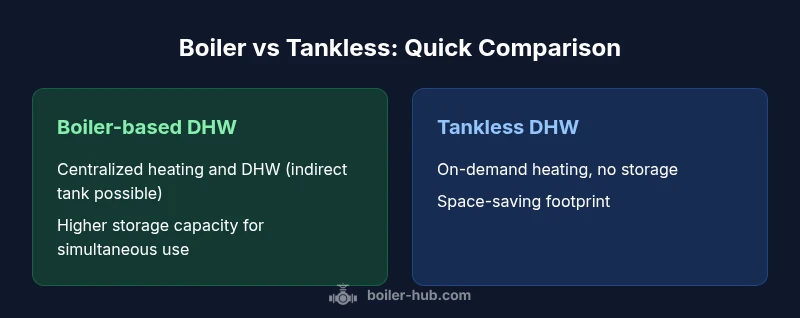
The difference between boiler and tankless water heater centers on how they heat water and meet hot-water needs. A boiler system heats water for space heating and may supply domestic hot water via an indirect storage tank or a combi configuration, while a tankless water heater heats water on demand at the tap without storing hot water. In short, boilers are centralized and can serve multiple zones; tankless units focus on immediate DHW with a smaller footprint.
What is a boiler? How it works
A boiler is a central heating device that uses fuel (gas, oil, electricity) to heat water, which then circulates through radiators or underfloor heating to warm a home. In many homes, the same boiler also serves domestic hot water (DHW) via an indirect storage tank or a combi boiler that heats water on demand. The boiler’s primary role is space heating, but its DHW function makes it a versatile centerpiece of the home’s hydronic system. When homeowners ask about the difference between boiler and tankless water heater, it’s essential to recognize that boilers can provide DHW as a byproduct of space heating or as a dedicated DHW source in a separate loop. This distinction influences efficiency, maintenance, and installation decisions. As Boiler Hub analyses show, the integration approach (indirect tank vs. combi) changes both performance and long-term costs.
What is a tankless water heater? How it works
A tankless water heater, or on-demand unit, heats water only when a hot tap is opened. It uses a heat exchanger, powered by gas or electricity, to raise water temperature as it flows through the unit. Because there is no storage tank, the hot water is delivered instantly at the point of use, provided the flow rate does not exceed the unit’s capacity. Tankless systems are popular for their compact size and potential energy savings, but their performance depends on your household’s peak hot-water demand and the unit’s rated flow (measured in gallons per minute, or GPM). Boiler Hub’s evaluation notes that multiple units or a larger-capacity model may be needed for busy households.
Storage vs on-demand: the core difference
The pivotal distinction is storage and delivery method. A boiler-related DHW setup often relies on a storage tank or a secondary heater, so hot water is available even if a faucet is opened in quick succession. By contrast, a tankless heater supplies water on demand, reducing standby heat loss but potentially limiting simultaneous hot-water use. If you’re comparing the difference between boiler and tankless water heater, think of storage as a buffer that smooths demand spikes, while on-demand systems maximize energy efficiency by eliminating storage losses. This contrast affects sizing, venting requirements, and control logic across the home. Boiler Hub’s practical guidance emphasizes matching system type to daily patterns of hot-water use.
Efficiency and energy use: boilers vs tankless
Efficiency comparisons hinge on how the system is used. High-efficiency condensing boilers can achieve excellent seasonal efficiency, especially when paired with an indirect DHW tank. Tankless heaters often boast high energy-efficiency ratings for on-demand operation but may incur standby losses depending on installation and climate. For homes with infrequent DHW needs, a tankless unit can reduce energy wasted in storage. In larger homes with continuous heating requirements, a boiler with an indirect coil might deliver DHW with fewer temperature fluctuations. Boiler Hub’s analysis indicates that the real-world efficiency depends on sizing, control strategies, and whether the boiler is optimized for DHW alongside space heating.
Hot water delivery and flow rates
Tankless models deliver DHW in real time, but their flow rate is limited by the unit’s capacity. In busy households, low water temperatures or reduced flow can occur if multiple fixtures are used simultaneously. Boilers with an indirect tank provide a more predictable DHW supply for many simultaneous uses, at the cost of extra storage and space. When evaluating the difference between boiler and tankless water heater, consider your peak demand: a single-family home with frequent showers and laundry pulses might fare better with a properly sized boiler-indirect setup, while a smaller home or apartment could benefit from a high-capacity tankless unit. Boiler Hub’s field observations stress the importance of aligning system capacity with daily usage patterns.
Installation considerations and compatibility
Installing a boiler often involves venting, chimney considerations, and radiative components for space heating. DHW via indirect tanks requires additional piping and a storage tank, which influences footprint and retrofit complexity. Tankless heaters demand appropriate venting (gas models), dedicated electrical circuits for electric units, and careful placement to maximize flow and temperature stability. Retrofitting an existing home requires assessing line sizes, heat loads, and clearance. In many cases, the choice depends on existing infrastructure: a home with a preinstalled boiler system may integrate DHW via indirect storage more easily, while a renovation might favor a compact tankless replacement where space is at a premium. Boiler Hub notes that consulting a licensed pro helps confirm feasibility before purchase.
Space, footprint, and installation footprint
A Boiler-and-indirect approach often occupies more space due to the boiler itself and the storage tank. However, modern compact boilers and high-efficiency indirect tanks can minimize space impact. A tankless water heater wins on footprint, typically occupying wall space or mounting near the point of use, freeing closet and basement space. The difference between boiler and tankless water heater is tangible in the room they require and how utilities are distributed within the home. For homeowners seeking to preserve storage, a well‑planned tankless installation can offer dramatic space savings, while those who want centralized control over multiple zones may prefer a boiler-centered design. Boiler Hub’s guidance emphasizes examining the home’s layout and future expansion plans when deciding on placement and size.
Cost and lifecycle considerations
Cost is a function of equipment price, installation complexity, and long-term operating costs. Boilers may have higher upfront costs due to radiators, piping, and possible indirect tanks, but their long lifespan and compatibility with large homes can justify the investment. Tankless heaters often have lower upfront costs for a compact unit, but multiple units or higher-capacity models to cover whole-house needs can increase total cost. Operating costs depend on fuel type, energy prices, and usage patterns. In general, boilers with indirect tanks deliver dependable DHW for busy households, while tankless systems can reduce standby energy losses but may demand careful sizing to meet high concurrent demand. Boiler Hub’s lifecycle estimates stress evaluating total cost of ownership over 10–15 years.
Common myths and misapplications
One common myth is that tankless water heaters are always more efficient than boilers. Reality shows that efficiency depends on usage, climate, and proper sizing. Another misconception is that all boilers automatically provide endless DHW. In practice, many setups rely on storage or hybrid configurations to smooth demand. Misapplication often occurs when a homeowner selects a boiler without considering peak hot-water loads or when a tankless unit is undersized for simultaneous fixtures. Boiler Hub’s field notes highlight the value of a professional sizing and heat-load calculation to avoid overmatching or underperforming installations.
How to choose: a practical decision framework
Choosing between boiler and tankless begins with defining hot-water needs, climate, and space constraints. Step one is to estimate peak DHW demand and space-heating requirements, then assess existing infrastructure. Step two is to review fuel type, energy costs, and local codes, followed by a professional load calculation. Step three is to weigh storage versus on-demand preferences, considering future plans such as adding a bathroom, family growth, or radiant heating. Step four is to compare installed cost ranges, maintenance expectations, and warranty terms. Throughout, consider the reliability, service availability, and training of local technicians for each system. Boiler Hub’s decision framework emphasizes practical, real-world scenarios over marketing claims.
Scenario-based recommendations
- Scenario A: Large family in a heating-dominated climate with frequent hot-water use. A boiler with an indirect DHW tank is often the strongest choice, offering stable supply and efficient space heating integration.
- Scenario B: Small to mid-sized home with limited space and moderate hot-water demand. A high-capacity tankless unit or a pair of units can deliver on-demand DHW with space savings, provided the system is sized for concurrent use.
- Scenario C: Renovation where existing piping and venting favor minimal disruption. A modern combi boiler may provide DHW on demand while reusing existing lines for space heating, reducing retrofit complexity. Boiler Hub’s recommendations emphasize tailoring the solution to your vitality of use and long-term goals.
Practical maintenance checklist
- Schedule annual routine maintenance with a licensed technician to inspect heat exchangers, burners, and electrical components.
- Test safety devices, valves, and pressure relief regularly and document inspections for code compliance.
- Bleed radiators and verify thermostatic controls to ensure balanced heating and consistent hot water.
- Check for leaks and corrosion around connections and indirect storage coils if used.
- For tankless units, flush the system periodically to prevent mineral buildup and maintain flow.
- Keep venting clear and ensure adequate combustion air for gas-fired units. Following these steps helps sustain performance and extends the system’s life. Boiler Hub’s field guidelines emphasize proactive maintenance as a core component of total ownership cost.
Comparison
| Feature | Boiler-based DHW system | Tankless water heater |
|---|---|---|
| Heat source and purpose | Central boiler for space heating with DHW via indirect tank or combi | On-demand heating at the tap, no storage |
| Water storage | Storage buffer via indirect tank or no storage if combi | No storage; water heated as drawn |
| Flow and capacity | High, depends on boiler size and radiator load | Limited by unit capacity; multiple units for high concurrent use |
| Energy efficiency considerations | High efficiency with proper indirect setup; standby losses vary | Very efficient in on-demand mode but may have standby issues if oversized |
| Space requirements | Boiler room, storage tank, plus distribution piping | Compact wall-mount option; minimal footprint |
| Installation complexity | More complex if upgrading existing heating system | Often simpler for new installs but requires correct sizing |
| Maintenance | Annual boiler service; indirect tank requires coil check | Regular flushing and descaling for mineral-heavy water |
| Best use case | Large homes with radiant heating or multi-zone needs | Smaller homes or spaces where storage-free DHW is valued |
Advantages
- Potentially lower standby heat loss with well-sized tankless units
- Space savings with a compact tankless installation
- Centralized control and reliable DHW supply with boilers and indirect tanks
- High efficiency options available for both systems
- Durable, long lifespans with proper maintenance
The Bad
- Higher upfront cost for boiler systems with radiators and indirect tanks
- Tankless units may require multiple services to meet peak demand
- Complexity in retrofit projects can raise installation costs
- Under-sizing a tankless unit or boiler can lead to poor performance
Boiler-based DHW with indirect storage often delivers the most reliable, scalable solution for larger homes; tankless units excel in space-saving and on-demand DHW for smaller homes or retrofits.
If you need consistent hot water for multiple fixtures and space heating, a boiler with indirect storage is typically the best fit. If space and on-demand DHW in a smaller home are priorities, a properly sized tankless system can be superior. Ultimately, match system type to usage patterns, climate, and existing infrastructure.
Questions & Answers
What defines the key difference between boiler and tankless water heater?
The main difference is how hot water is produced: boilers often heat water for space heating and may use an indirect tank for DHW, while tankless heaters provide hot water on demand without storing it. The choice affects efficiency, capacity, and installation requirements.
The key difference is storage and delivery—boilers are centralized, tankless are on-demand.
Can a boiler also provide on-demand hot water without a storage tank?
Yes, some boilers are combi models that heat water on demand for DHW, bypassing the need for a separate storage tank. This setup is common in smaller homes but requires careful sizing for concurrent uses.
Yes, combi boilers can provide on-demand hot water without a storage tank.
Do tankless water heaters save energy compared to boilers?
Tankless heaters can be more energy-efficient for intermittent use since there’s no standby heat loss. However, in homes with high concurrent hot-water demand or poor sizing, boilers with indirect storage can be more efficient overall.
Tankless units save energy when hot water use is sporadic, but proper sizing matters.
What maintenance do I expect with these systems?
Boilers require annual servicing of the burner and heat exchanger, while tankless units should be flushed periodically to prevent mineral buildup. Indirect tanks also need coil checks and occasional sensor maintenance.
Regular professional checks keep both systems running smoothly.
Which lasts longer, a boiler or a tankless water heater?
Lifespans vary by model and maintenance, but both can last 15–20+ years with proper care. Tankless units often have longer expected lifespans but may have higher ongoing maintenance needs.
Both can last many years with good maintenance; lifespans depend on usage and care.
Is a combi boiler a better option for my home?
A combi boiler provides DHW on demand and space heating if needed, reducing storage. It’s ideal for smaller homes but may struggle with very high concurrent DHW loads in larger households.
Combi boilers suit smaller homes needing both heating and DHW with limited space.
Key Points
- Assess peak hot-water demand before choosing.
- Boilers suit large homes and radiant heating; tankless suits compact spaces.
- Consider total cost of ownership, not just upfront price.
- Sizing accuracy is critical for both options.
- Professional load calculations improve reliability and efficiency.