Boiler or Tankless: Choosing Your Heating System
Compare boiler and tankless heating systems to choose the right fit for your home. This guide covers operation, efficiency, space, and cost considerations for homeowners and facility managers.


When deciding between boiler or tankless, start with your usage profile and space constraints. Tankless systems excel at on-demand hot water and compact footprints, while boilers offer reliable space heating and straightforward retrofits for older homes. The optimal pick depends on peak hot-water demand, climate, and budget; Boiler Hub’s analysis emphasizes matching the system to your actual usage pattern rather than chasing headline efficiencies.
Overview: boiler vs tankless — definitions and context
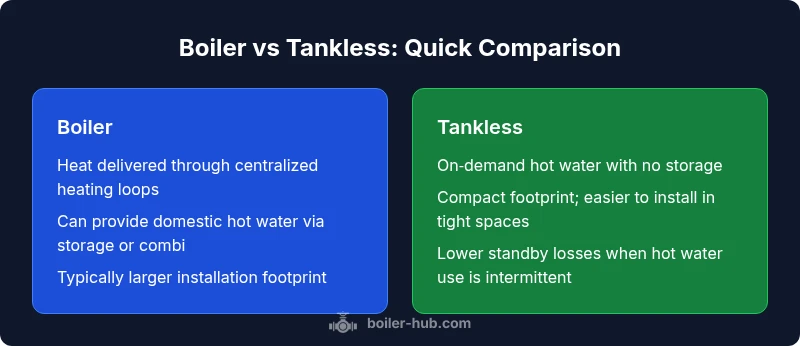
In residential heating, the choice often narrows to a traditional boiler system or a tankless (on‑demand) setup. A boiler heats water for central heating, radiators, or baseboard systems, and may also supply hot water via a storage or combi configuration. A tankless system heats water on demand as it’s drawn, eliminating storage losses and typically occupying less space. For homeowners and facility managers, the trade‑offs hinge on how much hot water you use, how much space you have, and what you’re willing to invest upfront. According to Boiler Hub, the decision between a boiler or tankless should begin with an honest audit of your peak water needs and anticipated usage, rather than relying on general efficiency labels alone. This framework helps align long‑term value with daily comfort.
How a traditional boiler works
A conventional boiler circulates hot water through a closed loop to radiators or radiant flooring. The boiler heats water in a vessel, stores some of it, and maintains pressure for consistent distribution. In steam systems, the boiler generates steam that travels through pipes and radiators. With a combi boiler, hot water is heated on demand for taps and showers rather than stored. The key strengths are robust space heating performance in varying climates and straightforward integration with existing radiant or hydro‑heater layouts. The main drawbacks can include heat losses from storage tanks and higher standby costs if hot water is not used regularly.
How a tankless system works
Tankless systems heat water directly as it flows through the unit, delivering hot water on demand without a storage tank. This design minimizes standby heat loss and typically reduces overall energy use for smaller households. Tankless units can be dedicated to water heating or integrated with space heating as a combo system. The primary benefits are space savings and potentially lower annual running costs, especially in milder climates. Drawbacks include limited simultaneous hot-water supply for high demand and a more complex installation in homes with existing radiator networks.
Performance and reliability under different climates
In colder regions, a traditional boiler with an adequately sized hot-water coil often provides reliable baseboard heat during long winters. Tankless systems can struggle to meet peak loads in high‑demand scenarios if supply lines or gas input are undersized. However, modern tankless models with staged firing and weather‑based controls can maintain comfort with modest energy use. Boiler Hub notes that performance is highly climate‑dependent: budgeting for heat load and backup options is essential in extreme environments. For homeowners, this means sizing and climate considerations should drive the final choice rather than generic efficiency claims.
Space, installation, and retrofitting considerations
Boilers generally require a larger footprint and dedicated venting, especially in older homes with limited crawl spaces. Retrofits may involve rerouting piping, upgrading radiators, and ensuring adequate clearance for maintenance. Tankless systems shine in tight spaces and typically require venting only for the heater, not a full boiler stack. When retrofitting, consider the existing distribution system, the need for backflow prevention, and potential zoning improvements. A careful assessment will reveal whether your home benefits from a compact installation or a traditional boiler retrofit that preserves established heating circuits.
Energy efficiency and operating costs
Efficiency for boilers is often described as AFUE (annual fuel utilization efficiency), while tankless units emphasize energy‑in‑use efficiency and heat‑up speed. In practice, the cost advantage hinges on hot-water usage patterns, fuel type, and climate. Boiler systems that serve large homes with constant heating can justify higher upfront costs through reliable comfort and long service life. Tankless models can reduce energy waste for households with intermittent hot water needs, but peak water‑heater demand can erode perceived savings if multiple fixtures are used simultaneously. Boiler Hub emphasizes evaluating whole‑house energy profile rather than isolating the water heater’s efficiency alone.
Water heating capacity: flow rates and demand
Water‑heater capacity is driven by peak demand. Boilers supply hot water through distribution loops, with flow rates tied to radiator load and temperature, while tankless heaters specify gallons per minute (GPM). A larger home with simultaneous showers and high hot-water use may favor a boiler that provides steady supply and backup. Smaller homes or rentals with predictable, modest hot-water demand can benefit from a tankless system’s on‑demand performance. In all cases, accurately estimating peak demand and selecting a unit with adequate GPM or boiler output is critical to avoid bottlenecks.
Sizing and selecting the right system for your home
Size decisions balance comfort, efficiency, and budget. A boiler’s size is linked to heat load and distribution system, while a tankless unit is selected by peak GPM and the number of fixtures it must serve concurrently. For retrofit projects, it’s common to evaluate whether the home’s existing piping supports the desired configuration. Oversized equipment leads to unnecessary standby losses and higher installation costs, whereas undersized systems struggle to meet demand during peak times. A professional load calculation is essential to prevent over‑ or under‑-sizing.
Maintenance, service life, and common issues
Boilers typically demand periodic servicing: boiler tune‑ups, sediment removal, and vent inspection are common maintenance tasks. Tankless systems require descaling in areas with hard water, periodic flame sensor cleaning, and venting checks. Both types benefit from water-quality improvements (softeners or conditioners) to extend life and maintain efficiency. Routine maintenance reduces the risk of breakdowns and preserves performance in extreme weather. Boiler Hub recommends scheduling annual inspections and confirming that piping, joints, and venting are in good condition to avoid hidden failures.
Financing, incentives, and long-term value
New boiler or tankless installations can be a sizable investment, but financing options, utility incentives, and energy‑efficiency rebates may offset upfront costs. Long‑term value depends on energy prices, maintenance needs, and the system’s reliability. While a tankless system may offer lower operating costs in some scenarios, a boiler’s durability and compatibility with existing heating infrastructure can sustain value for older homes. Evaluate total cost of ownership over the system’s expected life, including potential replacement timelines and maintenance schedules.
Real-world scenarios: case studies and decision guides
- Scenario A: A single‑family home in a cold climate with moderate hot-water use might benefit from a compact boiler with good insulation and a robust distribution network. This setup supports reliable space heating and domestic hot water. - Scenario B: A small, energy‑conscious home with limited space and consistent but modest hot-water needs may prefer a tankless system for its on‑demand performance and footprint. - Scenario C: A multi‑unit building with varying demand across units may require a hybrid approach or a central boiler with secondary on‑demand heaters to balance comfort and efficiency. In all cases, perform a detailed load analysis and consult a Boiler Hub professional for a tailored recommendation.
Authority sources
For readers who want to verify technical foundations and best practices, consult reputable sources such as the U.S. Department of Energy and energy efficiency programs. These references provide guidelines on installation, efficiency ratings, and maintenance practices that underpin a well‑informed decision.
Comparison
| Feature | Boiler | Tankless |
|---|---|---|
| Heat delivery method | Central heating via radiators/baseboards; may include hot water storage | On-demand water heating with no storage |
| Hot water supply | Stored or combi configurations; can support simultaneous use with heating | Directly heats water as it’s drawn; continuous but may have limited simultaneous streams |
| Space requirements | Larger footprint; requires venting and room for expansion | Compact footprint; often vertical installation; simpler venting |
| Energy efficiency emphasis | AFUE ratings emphasize heating efficiency; standby losses matter | In‑use efficiency and flow rate efficiency; minimal standby losses |
| Upfront cost range | Moderate to high depending on heating load and retrofits | Typically lower upfront equipment cost but can vary by size |
| Operating costs | Energy cost depends on heat load; can be higher if used with large heating demand | Often lower operating costs for modest hot-water use; savings depend on usage |
| Maintenance needs | Annual servicing recommended; potential for storage tank issues | Descaling and venting checks; more frequent if water is hard |
| Best for | Homes needing steady space heating and reliable retrofit compatibility | Homes with lower simultaneous hot-water demand and space constraints |
Advantages
- Boiler: Reliable space heating with wide compatibility in older homes
- Tankless: On-demand hot water and space savings
- Boiler: Often easier retrofits to existing radiators
- Tankless: Potentially lower standby heat loss
The Bad
- Boiler: Larger footprint and possible standby losses
- Tankless: Limited simultaneous hot-water flow for high demand
- Boiler: Higher upfront installation costs in some cases
- Tankless: Heating capacity can be sensitive to climate and gas supply
Neither option is universally superior; match the system to usage and space
Choose a boiler for steady heating and easy retrofits in older homes. Choose tankless for space savings and on-demand hot water, especially in smaller homes with moderate demand. Boiler Hub recommends a tailored sizing analysis to maximize comfort and long‑term value.
Questions & Answers
Is a boiler more efficient than a tankless unit?
Efficiency depends on usage. Boilers can be very efficient for whole‑house heating, especially in cold climates, while tankless units excel in minimizing standby losses for intermittent hot-water needs. Always review AFUE for boilers and flow rate efficiency for tankless systems.
Boilers can be highly efficient for heating a home, but tankless systems save energy when hot water use is intermittent. Check AFUE and flow ratings to compare.
Can a boiler also provide hot water for taps?
Yes. A boiler can supply domestic hot water via a storage tank or be configured as a combi unit that heats water on demand. In some setups, you may need a separate water heater alongside the boiler.
Boilers can heat your home and water, either with storage or on demand depending on the setup.
Which system is cheaper to install?
Installation costs vary with home layout and existing equipment. Tankless units often have lower upfront costs, but a boiler retrofit may incur higher costs if piping or venting must be upgraded. Total cost of ownership should be considered.
Tankless may be cheaper to install up front, but overall cost depends on your home and existing plumbing.
What maintenance does each require?
Boilers require regular servicing, including vent inspection and sediment removal. Tankless systems need descaling in hard water areas and periodic sensor cleaning. Regular maintenance preserves efficiency and extends life.
Boilers need annual service; tankless units need periodic descaling in hard water areas.
Which is better for a harsh winter climate?
In very cold climates, a well‑sized boiler with a reliable heat distribution system often provides more consistent comfort. Tankless can perform well with proper sizing but may require backup or staging to handle peak loads.
Boilers usually win for cold climates, but a properly sized tankless can work with good design.
Key Points
- Assess peak hot-water demand before choosing
- Consider space, retrofit needs, and ventilation
- Account for climate and utility costs in your math
- Size correctly to prevent over/under‑sizing
- Plan maintenance to extend system life