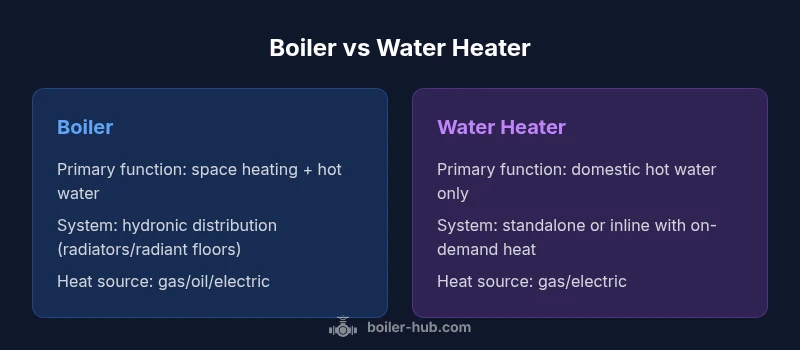
Difference Between a Boiler and a Water Heater: A Practical Guide
A rigorous, analytical comparison of boilers vs water heaters, outlining how each works, where they fit, and the decision factors homeowners and facility managers should consider.


A boiler provides both space heating and hot water, while a water heater typically supplies only domestic hot water. If you already have or plan a hydronic heating system (radiators or radiant floors), a boiler is usually the better long‑term option. For homes that only need hot water, a standalone water heater can be more cost‑effective.
Difference between a boiler and a water heater
Understanding the difference between a boiler and a water heater is fundamental for homeowners planning a heating solution. A boiler heats water to circulate through radiators or underfloor heating, delivering space warmth as a secondary benefit to domestic hot water. A water heater, by contrast, is designed primarily to heat and store hot water for taps, showers, and appliances. The distinction matters for installation, fuel choices, maintenance needs, and long-term operating costs. According to Boiler Hub, the best choice hinges on how you heat your home, how much hot water you use, and whether you plan to run a hydronic system alongside domestic hot water. This article establishes a clear framework to help you select the option that aligns with your home’s layout, fuel availability, and budget. The goal is to avoid mismatched equipment, excessive energy use, and avoidable maintenance surprises. As you read, consider how your current heating layout, future expansion plans, and local energy costs influence the decision.
How boilers work
A boiler is a central heating device that heats a working fluid (usually water) and circulates it through a system of radiators, baseboard heaters, or radiant underfloor loops. Boilers come in several configurations: combi (combination) boilers that heat water on demand, system boilers that feed a storage cylinder, and traditional or conventional boilers paired with an external hot water tank. The heat source can be gas, oil, or electricity, with gas-fired models being the most common in many regions. Condensing boilers recover additional heat from exhaust gases, delivering higher efficiency when paired with well-insulated distribution. In many homes, a boiler supports space heating year-round and can also supply domestic hot water if the system is configured with a storage tank or a combi setup. Regular maintenance, including annual servicing, helps sustain efficiency and extend lifespan.
How water heaters work
Water heaters are dedicated to domestic hot water production. They come in two major forms: storage tanks and tankless (on‑demand) units. Storage tank heaters store a ready supply of hot water, typically in a cylinder insulated to minimize heat loss. Tankless models heat water directly as it’s drawn, avoiding a storage tank but requiring a higher instantaneous energy input. Water heaters can be gas-powered or electric. Gas units may require venting to the outdoors, while electric models do not. The efficiency of water heaters is influenced by the design (tank vs tankless), the insulation of the tank, and the thermal efficiency of the heat source. Importantly, traditional water heaters do not actively heat space; they focus on providing hot water for taps and appliances. This distinction drives cost considerations, installation complexity, and maintenance needs.
Core differences at a glance
- Primary function: Boiler = space heating + hot water (if configured); Water heater = hot water for taps only
- System integration: Boiler typically integrates with radiators or underfloor heating; Water heater operates as a stand-alone hot water source
- Heat distribution: Boiler circulates a heated fluid through a home network; Water heater heats water directly for fixtures
- Fuel and venting: Both can use gas or electricity, but gas boilers often require venting and more complex vent/venting strategies; electric models simplify venting
- Efficiency path: Condensing boilers offer high efficiency when paired with proper insulation; water heaters vary (tank vs tankless) and depend on usage patterns
- Footprint and space: Boilers usually require room for the boiler unit and distribution piping; water heaters require space for the tank or compact tankless unit
- Maintenance: Boilers demand periodic servicing of the boiler and distribution system; water heaters require tank flushing and anode rod inspection (for tank models)
- Cost outlook: Upfront costs for a boiler plus distribution can be higher; standalone water heaters may be cheaper to purchase and install but could incur higher heating costs if hot water demand grows
Space heating integration vs domestic hot water demand
The deciding factor often hinges on whether you need space heating in addition to hot water. Homes with radiators, baseboard heaters, or radiant floor systems rely on a boiler to distribute heat throughout the living spaces. If you do not require space heating, a dedicated water heater may meet your needs more efficiently and with lower upfront cost. In some retrofit scenarios, homeowners opt for a combi boiler, which provides hot water on demand and also heats the home; this can be attractive for smaller homes or off-grid setups but may introduce pressure and flow considerations for simultaneous instantaneous hot water use. Boiler Hub analyses suggest aligning equipment with current and anticipated demand while considering climate, insulation, and energy costs in your area.
Efficiency, fuel types, and operating costs
Efficiency is a central factor in the long-term economics of either option. Boilers have made substantial gains through condensing technology, variable-speed pumps, and integrated controls that optimize cycling and zone heating. Water heaters’ efficiency is commonly described by the energy factor (EF) or uniform energy factor (UEF) in tank models, with tankless variants often boasting high efficiency by reducing standby losses. Fuel type materially influences operating costs: natural gas generally offers lower fuel costs than electricity in many regions, but electricity can be cleaner depending on the grid mix. Pay attention to standby losses (tank storage) and first-hour rating for hot water availability. In a complete cost picture, you should weigh initial installation, equipment lifespan, maintenance needs, and expected energy consumption over 10–20 years. Boiler Hub’s analysis notes that the total cost of ownership varies by home design and local energy prices, not just equipment price.
Installation, space, and maintenance considerations
Installations for boilers are typically more complex, requiring space for the boiler, distribution piping, expansion tanks, and in some cases, venting or flue systems. The presence of radiators or radiant floor loops influences the choice of boiler type and sizing. Water heaters come in several configurations, with tank models requiring space for a tank and, for gas units, a vent. Tankless water heaters demand careful venting design and adequate gas supply or electrical capacity. Regular maintenance for both systems includes checking valves, leaks, pressure (for boilers), and flushing or anode rod inspection (for tank heaters). When considering a retrofit, you must consider existing piping, the ability to adapt to current or planned fuel sources, and the availability of service technicians with expertise in hydronic heating systems. The right choice balances reliability, comfort, and long-term serviceability.
Replacement and retrofit considerations
If you already have a hydronic heating system, upgrading to a high-efficiency condensing boiler can yield meaningful energy savings over time, especially in colder climates. Replacing a stand-alone water heater with a newer, more efficient model may be appropriate if hot water demand is high but space heating is not a priority. In multi-zone homes, a boiler with zone controls can deliver predictable comfort and energy savings, whereas a water heater upgrade alone may not improve space heating efficiency. For larger homes or those undergoing renovations, consider a hybrid approach that integrates solar thermal or heat pump systems to reduce fossil fuel dependence. The decision should consider not only the current needs but also potential future changes in occupancy, insulation, and energy costs.
Purchasing guide: questions to ask and steps
- Determine your primary need: space heating, hot water, or both. 2) Assess current infrastructure: radiators, piping, electrical capacity, venting requirements. 3) Compare fuel availability and costs in your region. 4) Calculate total cost of ownership, including installation, maintenance, and expected lifespan. 5) Review compatibility with smart controls, zoning, and future expansion. 6) Solicit quotes from qualified installers and check references. 7) Verify warranty terms and service availability. 8) Plan for permits and code requirements. A methodical evaluation using these steps helps ensure the chosen system meets comfort, reliability, and budget goals. Boiler Hub recommends aligning the selection with your climate, usage patterns, and long-term energy strategy.
Myth busting and real-world scenarios
Myth: A boiler is always more efficient than a water heater. Reality: Efficiency depends on how the system is used and maintained; modern boilers can be highly efficient, but tankless water heaters can rival boiler efficiency in hot water delivery. Myth: You must vent every gas-fired unit. Reality: Some high-efficiency gas boilers have balanced flue and may use narrower vent configurations, but most setups require venting to expel combustion gases. Myth: A water heater can never support space heating. Reality: Some water heaters, notably combi units, can deliver space heating alongside hot water, but this depends on system design. Real-world scenarios show that urban homes with limited space may benefit from a compact boiler with integrated controls, while rural homes with low hot-water demand may perform well with a tank-style water heater. This section synthesizes practical experiences from homeowners and facilities managers to ground the decision in real usage patterns.
Comparison
| Feature | Boiler | Water Heater |
|---|---|---|
| Primary function | Heats space heating plus domestic hot water (if configured) | Heats domestic hot water for taps and appliances only |
| System type | Hydronic distribution (radiators, radiant floors) | Standalone or inline with on-demand heat |
| Heat distribution medium | Hot water circulated through a home network | Hot water delivered directly to fixtures |
| Fuel options | Gas, oil, electricity (varies by model) | Gas, electricity (varies by model) |
| Venting/installation | Often requires venting for gas; may need space planning for radiators | Gas models require venting; electric models do not |
| Efficiency path | Condensing options with advanced controls | Tank vs tankless efficiency varies by model; on-demand often efficient |
| Typical footprint | Larger footprint due to boiler and piping network | Smaller footprint, especially compact tankless units |
| Maintenance | Annual boiler service; distribution checks | Tank flushing and anode rod inspection for tanks; limited service if tankless |
| Hot water capacity | Can serve high-demand hot water with properly sized system | Limited to domestic hot water supply; simultaneous space heating not guaranteed |
Advantages
- Consolidates heating and hot water if you already need space heating
- Potentially better overall energy efficiency with condensing boiler systems
- Good long-term resilience when paired with zone controls and modern thermostats
- Flexible fuel options (gas, oil, electricity) depending on installation
- Can support multiple heating zones for comfort and control
The Bad
- Higher upfront cost and more complex installation
- Maintenance and service require skilled technicians familiar with hydronic systems
- Longer payback period if space heating demand is low or absent
- Ventilation requirements for gas boilers add installation considerations
- If you only need hot water, a boiler adds unnecessary complexity and space
Boilers win for homes with space heating; water heaters win for hot-water-focused needs
If you require space heating, a boiler is generally the better long-term investment due to integrated hydronic systems and potential energy savings. If your primary need is domestic hot water with minimal space heating, a dedicated water heater is typically more cost-effective and simpler to install.
Questions & Answers
What is the main difference between a boiler and a water heater?
The boiler provides space heating and, if configured, hot water; a water heater focuses on producing domestic hot water. The choice hinges on whether you need heating support beyond hot water.
The boiler heats your home in addition to hot water, while a water heater only heats water for taps and appliances.
Can I replace my boiler with a water heater if I only need hot water?
Yes, you can switch to a water heater if you don’t need space heating. You’ll lose in‑home heating capacity, and you may need to install separate heating, insulation, or alternative climate controls.
You can, but you’ll lose space heating capability and may need a separate heating solution.
Are boilers more efficient than water heaters?
Efficiency depends on the specific models and usage. Modern condensing boilers can be very efficient, while high‑efficiency tankless water heaters can also be efficient for hot-water tasks.
It depends on the model and how you use them; both can be efficient in the right setup.
Do boilers require venting?
Most gas boilers require venting to safely remove combustion gases, though high‑efficiency designs may use balanced flue systems. Electric boilers do not vent. Water heaters also require venting if gas-fired.
Gas boilers usually vent, electric ones don’t, but always check local codes.
What factors should guide my decision for replacement or retrofit?
Consider your climate, hot-water demand, current piping, space for equipment, energy prices, and potential future needs such as additional zones or renewable integrations.
Think about climate, how much hot water you use, and whether you need space heating now or later.
Key Points
- Assess whether space heating is essential before choosing
- Compare total cost of ownership, not just upfront price
- Consider existing radiators or underfloor systems when selecting a boiler
- Evaluate fuel availability and potential for future efficiency upgrades
- Plan for venting, space, and maintenance requirements