Boiler vs Hot Water Heater: A Practical Side-by-Side Guide
A practical, evidence-based comparison of boilers vs hot water heaters, covering efficiency, installation, costs, and suitability for homes and facilities. Learn which option fits your climate, needs, and budget with expert guidance from Boiler Hub.


Boiler vs hot water heater — the right choice depends on how you heat, store, and use domestic hot water. For most homes, a direct comparison of system type, efficiency, installation needs, and ongoing costs helps homeowners decide between a boiler-based heating setup and a traditional water heater. Boiler Hub outlines the key factors that influence performance and value.
Understanding the Basics: What Each System Does
According to Boiler Hub, the term boiler vs hot water heater describes two broad approaches to heating water for a home's heating system and domestic use. A boiler typically heats water to circulate as steam or hot water through radiators or radiant floors, and can also supply domestic hot water if paired with the right coil or indirect tank. A traditional hot water heater, by contrast, focuses solely on domestic hot water and uses a dedicated tank or tankless unit. The Boiler Hub team found that most homes benefit from a clear understanding of how these systems integrate with space heating and hot water demands. In practice, the choice influences installation layout, fuel type, and ongoing maintenance. By clarifying these roles early, homeowners and facility managers can align equipment with local climate, energy costs, and occupancy patterns. This article uses a structured comparison to help you decide whether a boiler-based heating system or a conventional water heater better serves your needs, both now and over the system’s lifespan.
Core Differences: Boiler vs Hot Water Heater in Practice
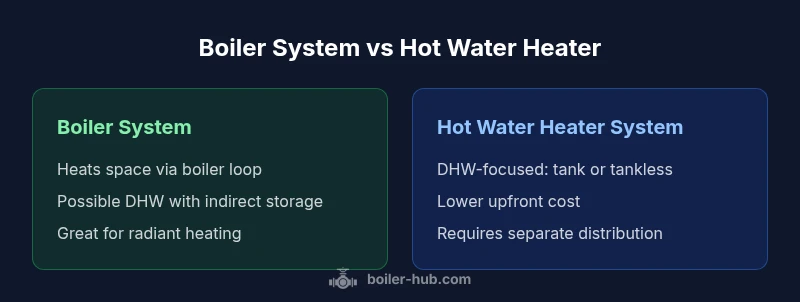
The boiler and a hot water heater are designed to serve different primary purposes, yet modern homes increasingly use them in complementary ways. A boiler heats water (or creates steam) for space heating and, when equipped with an indirect storage tank or compatible coil, can provide domestic hot water as well. A standalone hot water heater focuses on delivering domestic hot water with high reliability, using a tank or tankless design. In terms of installation, boilers typically require a controlled, vented mechanical room with proper combustion air, while water heaters demand less space and simpler venting. Understanding these core differences helps homeowners anticipate the type of distribution system (radiant, baseboard, or forced-air) and plan for future upgrades or maintenance. Boiler Hub emphasizes assessing how your climate and occupancy patterns affect whether you lean toward a boiler-centric setup or a dedicated water heater.
Efficiency, Ratings, and What They Mean
Efficiency metrics differ between boilers and water heaters, and a straight AFUE or Energy Factor comparison can be misleading if the distribution losses aren’t included. Modern condensing boilers often deliver high system efficiency by reclaiming heat from exhaust, which lowers fuel consumption for space heating and, with indirect storage, hot water. Tankless or high-efficiency water heaters add to overall efficiency for domestic hot water, but distribution and standby losses still influence real-world performance. Boiler Hub recommends evaluating the whole-system efficiency, factoring in your distribution network (radiant floors, baseboard, or forced-air) and climate. When comparing boiler vs hot water heater options, consider both appliance efficiency and the efficiency of the heating circuit that serves your home.
How They Fit with Different Heating Systems
The integration of a boiler vs hot water heater can drastically affect home comfort and energy bills. Boilers naturally pair with radiant floor systems and steam radiators, offering consistent temperature control and often better energy distribution. In homes without radiant heating, a boiler’s advantage may hinge on the indirect domestic hot water tank, which stores DHW efficiently for peak demand. Conversely, traditional water heaters excel in straightforward, smaller homes or retrofit projects where space is limited and there’s no need for a centralized heating loop. The decision should account for existing piping, the desired balance of space heating vs. hot water, and how much you value centralized control. Boiler Hub notes that the best choice aligns with your climate, occupancy, and long-term energy costs.
Installation Considerations and Space Requirements
Installation constraints are a practical determinant in the boiler vs hot water heater decision. A boiler system often requires a dedicated mechanical room or basement space, robust venting, and room for expansion of piping and radiators. Indirect storage tanks may occupy additional space but offer reliable DHW with high comfort. A tank-style water heater needs DHW storage space and a vent channel, and tankless units demand a compact installation footprint but may require higher upfront complexity for simultaneous space heating or higher demand. Assess your available square footage, ventilation capacity, and access for future service. Boiler Hub emphasizes planning for service access and safe exhaust routing to avoid indoor air quality issues.
Costs: Upfront and Lifetime Operating Costs
Upfront costs for a boiler system are typically higher than a conventional water heater, especially when an indirect storage tank or radiant heating is included. However, long-term operating costs can be lower with modern condensing boilers and well-integrated DHW storage. A standard water heater usually incurs lower initial expense but may incur higher energy bills if the heating load is significant or if it relies on an energy-inefficient distribution strategy. When comparing boiler vs hot water heater costs, it’s essential to estimate fuel costs, repair intervals, and the potential need for additional equipment like expansion tanks, tempering valves, and circulation pumps. Boiler Hub analysis shows that long-term value often favors a well-meshed boiler with indirect storage in colder climates.
Maintenance and Reliability: What to Expect
Maintenance requirements differ between the two paths. A boiler system generally requires annual service, pressure checks, inspection of the venting system, and periodic pump maintenance. Indirect storage tanks also need occasional inspection for heat exchanger performance. A hot water heater demands regular checks on the anode rod (for tank units), venting, and periodic flushing to remove sediment. Tankless water heaters require mineral scale management and periodic safety checks. Boiler Hub emphasizes scheduling professional service before peak seasons and keeping CO detectors and proper venting in place to ensure reliability and safety.
Climate and Household Scenarios: When One Beats the Other
In colder climates or homes with significant heating loads, a boiler with an indirect storage tank often provides superior overall efficiency and comfort, delivering consistent DHW alongside space heating. In milder climates or smaller homes, a traditional water heater may suffice, with lower upfront costs and simpler maintenance. The decision also depends on occupancy patterns; high hot-water demand during peak hours can favor a dedicated water heater in some layouts, while large homes with complex distribution benefit from a centralized boiler system. Boiler Hub highlights tailoring the solution to climate, load profiles, and long-term energy pricing.
The Role of Indirect Storage Tanks and Tankless Options
Indirect storage tanks connect to a boiler to provide DHW without a separate water heater, leveraging the boiler’s heat output for efficient, centralized hot water. Tankless water heaters offer continuous hot water with no storage, which can be attractive for households with erratic hot-water usage but may struggle with simultaneous demand. Indirect storage can balance efficiency with reliability, while tankless systems require careful sizing and, in some cases, a larger fuel line or venting upgrade. When weighing boiler vs hot water heater choices, consider whether you want centralized DHW, point-of-use flexibility, or a hybrid approach to optimize resilience and comfort.
Practical Decision Framework: How to Decide Quickly
Use a two-step framework: (1) map your hot-water peak demand and heating load, (2) estimate total cost of ownership over 10–15 years. If space heating is a priority and you have a compatible distribution system, a boiler with indirect storage is often the best long-term value. If you prioritize minimal disruption, lower upfront cost, and simpler maintenance, a dedicated water heater may be preferable. Boiler Hub recommends engaging a qualified contractor to run load calculations and verify venting and clearances before committing to a boiler vs hot water heater path.
Troubleshooting and Common Pitfalls
Common pitfalls include underestimating peak hot-water demand, leading to short-lived comfort during heavy use, and choosing an oversized unit that wastes energy. Another pitfall is ignoring the distribution system’s efficiency—an excellent boiler can perform poorly if piping or radiators are leaky or poorly insulated. Tankless water heaters can fail to meet high simultaneous demand if not correctly sized. Boiler Hub advises auditing insulation, pipe runs, and venting in tandem with selecting the heating path to avoid counterproductive results.
Final Steps: Planning a Replacement or New Build
For a replacement, perform a system audit, evaluate life expectancy, and map the potential downtime for installation. For new builds, design the heating and DHW to align with climate, energy costs, and occupancy, choosing a boiler-based system when radiant heating is desired and a dedicated water heater when DHW needs are modest. The Boiler Hub team recommends a phased approach to equipment upgrades, prioritizing energy efficiency and resilience, and ensuring that the distribution network is ready to support whichever path you choose. A well-planned decision now yields reliable comfort for years to come.
Comparison
| Feature | Boiler System | Hot Water Heater System |
|---|---|---|
| Primary function | Heats home via boiler loop or steam distribution; can supply DHW with indirect storage | Provides domestic hot water (tank or tankless); no central heating involvement |
| Energy source | Gas/oil-fired boiler connected to the home heating circuit | Gas/oil/electric DHW heater with separate distribution |
| Storage type | Central boiler with indirect storage or integrated DHW coil | Dedicated DHW tank or tankless unit |
| Space requirements | Boiler room or furnace closet plus piping network | DHW closet or utility space; may be small or integrated in attic/garage |
| Efficiency metric | AFUE for boiler plus distribution losses; overall system efficiency matters | Energy Factor/UEF for tank or tankless efficiency |
| Maintenance needs | Regular boiler servicing, venting checks, pump maintenance | Annual tank or tankless service; anode replacement and venting checks depending on model |
| Typical upfront cost range | Medium to high upfront (depends on boiler size and indirect storage) | Low to medium for standard tank water heaters; higher for tankless |
| Best for | Homes with extended heating load or radiant systems; space heating focus | Smaller homes or buildings needing simple DHW with minimal space |
| Lifespan | 20-30 years for the boiler system with distribution components | 8-15 years for conventional tank water heaters; 15-20 for tankless |
Advantages
- Can provide both space heating and domestic hot water from a single system
- High-efficiency modern boilers can reduce fuel use
- Indirect storage tanks offer reliable hot water without separate heater
- Centralized system can simplify service and maintenance
The Bad
- Higher upfront costs for installation and equipment
- Greater system complexity can lead to longer downtime during repairs
- Requires adequate space and proper venting in many homes
Boiler systems offer integrated heating and hot water with strong long-term efficiency; dedicated water heaters are simpler and cheaper upfront.
Choose a boiler if you want centralized heating and robust DHW with potential energy savings. Opt for a standalone water heater if you need a simpler, lower up-front solution and space is limited.
Questions & Answers
What is the fundamental difference between a boiler and a hot water heater?
A boiler heats water to supply space heating and often DHW, potentially via indirect storage. A hot water heater focuses on DHW production, using a tank or tankless design, with no built-in space heating function.
Boilers heat your home and water through a central system; water heaters heat water for taps only. The main difference is the heating load served.
Can I use a boiler to supply hot water without space heating?
Yes, with an indirect storage tank or a coil, a boiler can provide domestic hot water while not occupying the full DHW capacity of a separate heater. However, this adds a layer of integration to the system design.
Yes, you can use a boiler to supply hot water with indirect storage, but you’ll still be integrating with a heating circuit.
Are boilers more efficient than conventional water heaters?
Efficiency depends on model and system design. Modern boilers, especially condensing models, can be highly efficient, and when paired with efficient DHW storage, overall system efficiency may surpass that of older water heaters.
Modern boilers can be very efficient, especially with indirect storage; efficiency depends on overall system design.
Which is better for radiant heating?
A boiler-based system is typically better for radiant heating because it can distribute heat through a dedicated loop. Tank-type water heaters do not provide space heating directly.
Boilers are generally better for radiant heating since they supply heat through a distribution system.
What is indirect storage, and why is it popular with boilers?
Indirect storage uses the boiler’s heat to warm a dedicated DHW tank via a heat exchanger, offering reliable DHW without a separate furnace. It pairs well with efficient boilers and can reduce standby losses.
Indirect storage uses the boiler to heat a DHW tank, providing steady hot water with reduced standby loss.
What maintenance schedule do these systems require?
Boilers require annual servicing, vent checks, and pump maintenance. Water heaters need periodic flushing, anode inspections, and venting checks. Tankless options require scale management and periodic safety checks.
Annual boiler service and regular DHW maintenance for water heaters keep systems reliable.
Key Points
- Evaluate total cost of ownership, not just upfront price
- Match the system to climate, heating load, and occupancy
- Consider indirect storage with a boiler for reliable DHW
- Tankless DHW can save space but may require careful sizing
- Plan venting, insulation, and distribution for best performance