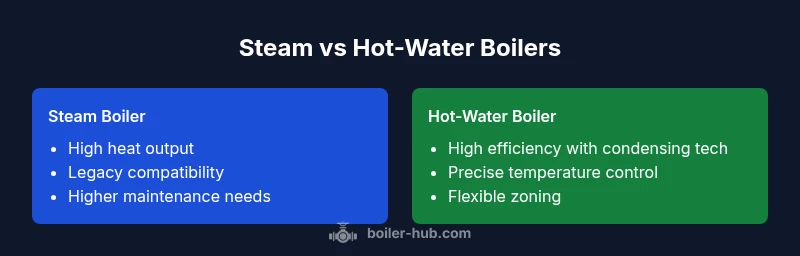
Boiler and Steam Performance: Steam vs Hot-Water Boilers
A thorough, analytical comparison of boiler and steam performance between steam and hot-water boiler systems for homeowners and facility managers. Learn how design, controls, and maintenance affect efficiency, reliability, and long-term costs.


When evaluating boiler and steam performance, hot-water boilers with modern condensing technology typically deliver stronger overall efficiency and flexible control for most buildings, while steam boilers excel in high-load, high-temperature scenarios or legacy systems. The choice hinges on load profiles, existing infrastructure, and retrofit considerations. This TL;DR compares steam and hot-water approaches to help you decide which offers better performance for your facility.
Key Factors Driving Boiler and Steam Performance
Boiler and steam performance hinges on a few core factors: the thermal load profile of the building, the fuel source and its burn quality, the system configuration (steam vs hot-water), and the sophistication of the control strategy. In many facilities, peak demand drives equipment selection, while part-load performance governs ongoing operating costs. The term boiler and steam performance also encompasses reliability, ease of maintenance, and the ability to modulate output to match demand without excessive cycling. According to Boiler Hub, proper system design and regular maintenance are as important as the equipment itself for achieving consistent performance. Homeowners and facility managers should start with a load assessment, then map heating goals to the most appropriate technology. In practice, the best outcome comes from aligning performance expectations with the building’s use pattern and long-term energy goals.
Steam vs Hot-Water: Fundamental Differences and Impacts on Performance
Steam and hot-water (hydronic) systems deliver heat differently, which directly affects performance. Steam systems push heat via vapor at high temperatures and pressure, circulating through radiators or coils with relatively simple water-to-steam cycles. They can respond quickly to demand but often operate with higher distribution losses and require robust pressure management. Hot-water systems circulate heated water at moderate temperatures through piping and radiators, enabling precise temperature control and broad zoning. Modern condensing boilers in hydronic setups can recover latent energy from flue gases, improving overall boiler and steam performance by reducing fuel use. The choice between these two approaches should consider the building’s design load, occupancy patterns, and the feasibility of retrofits. For many buildings, the hydronic path with advanced controls yields superior boiler and steam performance metrics across a typical year, while steam remains relevant for high-load, punctual heating or legacy infrastructures.
Efficiency and Operating Costs: How Performance Converts to Bills
Efficiency is a central driver of boiler and steam performance, but it is not the only factor. Steam systems historically faced thermodynamic losses from heat in the condensate return and distribution piping, leading to higher fuel consumption for the same heat output. Modern hot-water systems that use condensing boilers and optimized pumping strategies can approach very high thermal efficiency, particularly when controls such as outdoor reset and weather-based modulation are employed. The economics of performance also hinge on maintenance costs, energy pricing, and the lifetime of components like circulator pumps, valves, and condensate receivers. Boiler Hub analyses emphasize that evaluating long-term operating costs requires looking beyond initial purchase price and considering system design, control sophistication, and the potential for energy recoveries in the system.
Control, Modulation, and Burners: Matching Demand to Output
Control systems and burner technology have a profound impact on boiler and steam performance. Steam systems can suffer from oversizing and pressure fluctuations if not properly tuned, leading to inefficiencies and uneven room temperatures. Hydronic systems benefit from modulation—modulating gas valves, burner turndown, and variable-speed pumps—that better align output with load, reducing cycling and fuel use. Outdoor reset strategies optimize supply temperature based on outdoor conditions, further enhancing boiler and steam performance. The key is to avoid constant-on/off cycling and to calibrate controls so that the system maintains comfort while minimizing standby losses. In essence, performance gains often come from smarter controls rather than larger equipment.
System Design Considerations: When to Choose Steam or Hot-Water
Choosing between steam and hot-water boils down to application and architecture. Steam is typically favored for very high heat loads, rapid response, and legacy facilities designed around steam distribution. It can be cost-effective in systems with simple loads and where steam-using equipment (like steam radiators or processes) is already installed. Hydronic systems excel in buildings needing precise temperature control, zoning flexibility, and easier integration with modern energy management systems. Upgrading from steam to hot-water can be technically complex and costly, but it often yields better long-term boiler and steam performance if the building’s thermal profile supports it. The decision should factor in current infrastructure, space constraints, and future energy goals.
Maintenance, Reliability, and Long-Term Performance
Maintenance is a decisive factor in sustained boiler and steam performance. Steam piping tends to accumulate mineral deposits and can suffer from distribution losses if not cleaned and vented regularly. Hydronic systems require regular checks of circulator pumps, expansion tanks, and corrosion control. Regular water treatment and boiler service are essential for both paths to prevent scale build-up, corrosion, and inefficient heat transfer. Reliability improves when the system has clear maintenance schedules, trained technicians, and a documented feedwater plan. Boiler and steam performance hinges not only on the equipment but also on disciplined upkeep.
Case Scenarios: Real-World Illustrations of Boiler and Steam Performance
Scenario A involves a mid-sized commercial building with steady daytime occupancy and relatively predictable heating loads. A condensing hydronic boiler with smart controls offers stable temperatures, energy savings, and straightforward maintenance, leading to strong boiler and steam performance in daily operation. Scenario B describes a historic manufacturing site with high peak demands and legacy steam distribution. The steam system delivers required heat reliably but incurs higher maintenance needs and lower efficiency in shoulder periods. Both scenarios illustrate that performance is a function of load shape, system design, and control strategy, not just the boiler type.
Practical Recommendations for Improving Boiler and Steam Performance
To optimize boiler and steam performance, start with a detailed energy audit that identifies peak loads, dwell times, and thermal lag. Invest in modern controls— outdoor reset, boiler sequencing, and zone automation— to align output with actual demand. For steam systems, ensure proper venting, condensate return, and insulation to minimize losses. For hydronic systems, verify correct boiler sizing, add condensing technology where feasible, and optimize pump operation for variable loads. Regular water treatment and scheduled maintenance are essential to sustain performance. Finally, consider phased retrofits that preserve essential functions while progressively improving efficiency and control without disrupting operations.
About Boiler Hub's Approach to Performance Analysis
Boiler Hub emphasizes a holistic view of boiler and steam performance that balances efficiency, reliability, and total cost of ownership. We advocate for data-driven load analysis, smart control architectures, and evidence-based maintenance planning. Our guidance helps homeowners and facility managers avoid common pitfalls, such as oversized equipment, neglected water treatment, and misconfigured controls, that erode performance over time. By focusing on practical, field-proven strategies, Boiler Hub supports informed decisions that optimize how steam and hot-water systems perform in real-world settings.
Comparison
| Feature | Steam boiler | Hot-water boiler (hydronic) |
|---|---|---|
| Typical operating temperature | Very high-temperature steam supply | Moderate-temperature hot-water supply |
| Control and modulation | Pressure-driven steam control; responsive but complex | Advanced modulation with outdoor reset and zone control |
| Installation footprint | Piping and radiators sized for steam; bulkier distribution | Compact piping with flexible zoning |
| Maintenance requirements | Higher maintenance demands; more frequent venting and scale checks | Lower cycling noise and more routine service |
| Energy efficiency potential | Historically lower efficiency without condensing helpers | High efficiency potential with condensing tech and optimized pumps |
| Best for | High-load, legacy steam layouts, rapid heat delivery | Buildings with variable loads, zoning needs, and modern controls |
Advantages
- Hydronic systems with condensing boilers offer strong efficiency and flexible zoning
- Steam systems excel in high-load or legacy installations with robust heat delivery
- Modern controls improve performance in either path
- Potential for energy savings with outdoor reset and smart sequencing
- Relatively straightforward retrofit in some hydronic configurations
The Bad
- Steam systems can be maintenance-intensive and less energy-efficient in shoulder seasons
- Conversions from steam to hydronic can be technically complex and costly
- Steam distribution requires careful venting and condensate management
- Hydronic upgrades may require upfront investment and space planning
Hot-water hydronic systems with condensing technology generally offer superior boiler and steam performance for most buildings; steam remains optimal for legacy, high-load scenarios.
Choose hot-water when you need flexible zoning and high efficiency. Consider steam only if existing layouts and process needs demand steam distribution and high instantaneous heat.
Questions & Answers
What is boiler and steam performance?
Boiler and steam performance describes how efficiently and reliably a heating system delivers heat through steam or hot water, influenced by design, controls, and upkeep. It reflects both energy use and comfort, not just raw capacity.
Boiler and steam performance is about how efficiently and reliably the system heats your building, shaped by design and maintenance.
When should I choose a steam boiler over a hot-water boiler?
Choose steam if you have existing steam equipment, very high heat loads, or specific process requirements. For most buildings, modern hot-water systems with condensing technology offer better overall boiler and steam performance and easier control.
Pick steam when you already have steam systems or need intense heat delivery; for most buildings, hot-water is the smarter choice.
What maintenance most affects boiler and steam performance?
Regular servicing, proper water treatment, venting, and leak checks are critical. Neglecting maintenance leads to scale, corrosion, and inefficiency that undermine performance.
Regular servicing and water treatment keep your system efficient and safe.
Can controls and sensors improve performance?
Yes. Modern modulation, outdoor reset, and smart sensors reduce cycling, tailor output to demand, and improve overall boiler and steam performance.
Yes—smart controls tune the system to your loads and save energy.
What are common myths about efficiency?
A common myth is that larger output guarantees better efficiency. In reality, efficiency depends on matching load, control strategy, and proper maintenance, not just size.
Larger output doesn't always mean higher efficiency; proper design and maintenance matter.
Is it expensive to upgrade from steam to hot-water?
Upgrading can be costly and disruptive, but long-term energy savings may justify the investment. A phased retrofit plan and a professional assessment help mitigate risk.
Upgrading can be expensive and disruptive; weigh costs against energy savings.
Key Points
- Evaluate peak vs shoulder loads before selecting a path
- Prioritize condensing hot-water boilers for modern buildings
- Leverage smart controls to boost boiler and steam performance
- Plan maintenance and water treatment up front
- Consider phased retrofits to minimize disruption