Boiler or Boiler Room: A Practical Comparison for Homes and Facilities
A data-informed comparison of boiler vs boiler room concepts for homeowners and facility managers, covering safety, ventilation, costs, and maintenance to guide smarter decisions.


Boiler is the heating unit; boiler room is the dedicated space that houses it, along with controls and piping. A clear understanding of this distinction helps homeowners and facility managers assess safety, ventilation, and maintenance needs. Boiler Hub analysis highlights the importance of proper room layout, clear access, and code compliance when evaluating or upgrading heating systems.
Understanding the terms: boiler vs boiler room
In practical terms, a boiler is the heating unit that converts fuel into heat for water or steam. The boiler room is the dedicated space that houses the boiler, surrounding equipment, and often the controls, fuel lines, and ventilation. Understanding this distinction is essential for safety, efficiency, and compliance. Homeowners and facility managers frequently conflate the two, but misinterpretation can lead to improper sizing, ventilation gaps, or code violations. The boiler room design influences access for service, the risk of carbon monoxide buildup, and the ease of routine maintenance. In this article, we compare these concepts, discuss when they interact, and offer decision guidance for new installations or upgrades. According to Boiler Hub, the relationship between a boiler and its room shapes every major decision, from space planning to safety protocols.
Space planning and layout considerations for safety and access
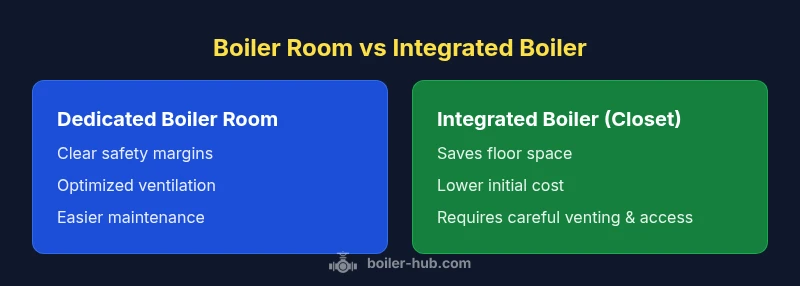
The physical footprint of a boiler system shapes every decision from initial sizing to ongoing maintenance. A dedicated boiler room offers generous clearance around the unit, room for service tools, and unobstructed access to exhaust vents, gas lines, and condensate drains. In contrast, an integrated setup tucked into a utility closet or basement alcove saves floor space but compresses working room and can complicate servicing. When evaluating a space, start with minimum clearance guidelines from manufacturers and local codes, then add practical allowances for future filter changes, filter cabinets, or expansion of piping. Proximity to living areas matters for noise and heat transfer, so consider vibration isolation mounts and wall damping. Adequate lighting, drainage, and a clear path to the exterior exhaust are not optional embellishments—they’re safety essentials that reduce the risk of accidental damage during maintenance or emergency shut-offs.
Ventilation, combustion air, and CO safety
Boilers require a source of combustion air and proper venting to operate safely. In a dedicated room, you can usually provide explicit ventilation pathways, dedicated exhaust ducts, and CO monitoring that meets your local codes. When a boiler is installed in a closet or tight space, sealed-combustion or direct-vent configurations become more common to limit indoor air exchange. Regardless of location, ensure clearances to flammable materials, unobstructed access for maintenance, and functioning CO detectors in nearby living spaces. Regular testing of alarms and vent integrity should be part of a monthly check routine to prevent dangerous buildup.
Efficiency implications of room design and insulation
Room design directly affects heat gains, losses, and overall system efficiency. A well-insulated boiler room minimizes unintended heat in adjacent spaces, reduces duct and pipe heat loss, and helps maintain stable operating temperatures. Properly sized vents and ducts improve exhaust flow, while a clutter-free environment reduces emergency shut-off time and maintenance delays. Efficiency is not only about the boiler’s efficiency rating; it depends on how well the surrounding space supports steady temperatures and predictable heat distribution. Thoughtful layout also allows for easier staging of multiple boilers or additional equipment like circulation pumps or water heaters, which can contribute to better overall performance.
Codes, standards, and regulatory landscape
Compliance matters for both new installations and retrofits. Local building codes, fire codes, and gas-safety standards typically dictate minimum ventilation, clearance, mounting, and exhaust requirements. A dedicated boiler room often simplifies adherence because you can isolate combustion from living spaces and implement controlled venting. In integrated configurations, compliance hinges on the chosen equipment type and approved installation methods. Always verify permits, inspection schedules, and required documentation with your local authority before breaking ground. While guidelines vary, the core principle remains: ensure safe combustion, reliable venting, and clear service access.
Retrofit and upgrade scenarios: when to retrofit the room or reconfigure space
Older homes or facilities with a cramped or poorly ventilated setup benefit most from dedicated space upgrades. If you’re adding a high-efficiency boiler or switching to a sealed-combustion model, a dedicated room can simplify ducting, vent runs, and CO safety measures. Retrofitting a closet into a compliant boiler space may involve structural adjustments, new venting, and enhanced ventilation, all of which impact cost and schedule. For some smaller buildings or apartments, a compact, high-efficiency boiler with external venting to a shared stack may be the practical option. The decision should weigh upfront construction costs against ongoing maintenance, safety risk, and potential energy savings.
Cost, lifecycle considerations and maintenance planning
Cost drivers include room build-out, venting work, piping upgrades, and requirements for permits or safety devices. A dedicated boiler room usually carries higher upfront costs but can reduce maintenance time, downtime, and potential code-related penalties over the boiler’s life. In contrast, integrated setups may lower initial expenses but demand careful planning for service access, vibration control, and CO safety monitoring. Lifecycle planning should account for expected boiler life, repair costs, and the value of reliable, safe operation for occupants. Regular professional maintenance remains essential in either configuration to sustain efficiency and safety.
Configuration options and when each makes sense
A dedicated boiler room is typically preferred in larger homes, multi-tenant buildings, or facilities with multiple heating zones. It offers predictable airflow, easier sensor placement, and straightforward compliance. Integrated options, such as a closet or utility nook, suit smaller homes or remodels where space is at a premium, provided ventilation and clearances are met. In both configurations, coordinating with a licensed installer to review space, controls, and ventilation can prevent common pitfalls. The best choice often balances space constraints, safety priorities, and long-term operating costs.
Monitoring, controls, and safety devices
Regardless of location, monitor boiler health with regular checks of pressure relief valves, expansion tanks, and thermostat controls. CO detectors should be placed in nearby living areas and tested monthly. Modern boilers offer remote monitoring, fault codes, and simplified diagnostic alerts that help identify problems before they escalate. A well-designed system includes clear labeling, accessible shut-off valves, and a documented maintenance schedule so future technicians can quickly diagnose issues.
Decision framework: a practical approach to planning your project
Start with an assessment of available space, then define non-negotiables such as ventilation, CO safety, and service access. Compare the long-term value of a dedicated boiler room against the upfront savings of an integrated installation. Gather quotes that separate construction costs from equipment and permit fees. Include a risk assessment for potential code non-compliance or safety concerns. Finally, confirm the plan with your local building department and a licensed heating professional, ensuring the chosen configuration aligns with performance goals and budget.
Common myths and practical truths
Myth: A boiler in a closet is always as safe as a dedicated room. Truth: Safety depends on proper venting, clearances, and monitoring, regardless of location. Myth: A bigger space always means better efficiency. Truth: Efficiency depends on equipment quality and system design, not just room size. Myth: Venting is optional if the boiler is sealed. Truth: Even sealed systems require correctly designed venting for exhaust and condensate.
Practical step-by-step guide to choosing and implementing a plan
- Define your goals: safety, efficiency, accessibility, and budget. 2) Assess available space and existing ventilation. 3) Consult local codes and obtain necessary permits. 4) Engage a licensed installer to propose one or more configurations. 5) Compare total lifetime costs, including maintenance and energy use. 6) Plan for future expansion or upgrades and document the chosen approach.
Comparison
| Feature | Boiler in dedicated room | Boiler integrated into space (e.g., closet) |
|---|---|---|
| Safety and ventilation | Improved control with dedicated air supply and venting | Potential risk if space lacks adequate ventilation and clearance |
| Accessibility and maintenance | Easier service access and safer work environment | Can be cramped, increasing maintenance time |
| Noise and vibration control | Typically isolated, reducing noise transfer | Noise may propagate to living areas in tight spaces |
| Space footprint | Requires dedicated room with floor area and exits | Saves floor space in living areas but needs careful planning |
| Regulatory compliance | Simplified compliance due to controlled environment | Compliance depends on space design and venting in situ |
| Energy efficiency opportunities | Better ducting, heat recovery options in room | Limited optimization in integrated setups |
| Initial and ongoing costs | Higher upfront due to room build-out and permits | Lower initial cost but potential retrofit expenses later |
Advantages
- Clear safety margins and ventilation control
- Easier maintenance access for technicians
- Better room acoustics with reduced noise in living areas
- Improved regulatory compliance with isolated combustion
The Bad
- Higher upfront construction costs and potential remodeling
- Requires dedicated space which may impact layout
- Potential increased complexity for multi-zone systems
Dedicated boiler rooms generally offer safer, more code-compliant operation and easier maintenance, but require more space and upfront investment.
For buildings with available space, a dedicated room is usually the better long-term choice. If space is tight, a well-planned integrated solution can work, but it demands meticulous venting, access, and safety arrangements.
Questions & Answers
What is the difference between a boiler and a boiler room?
A boiler is the heating unit that generates heat for water or steam, while the boiler room is the dedicated space housing the boiler and related equipment. The two concepts are related but serve different purposes in design, safety, and maintenance.
A boiler is the heater itself; the boiler room is the space that holds it and the related pipes and controls.
Do I need a dedicated boiler room by code?
Requirements vary by locale, but most areas require proper ventilation, combustion-air supply, and safe clearances around the boiler. Always check with local authorities and a licensed installer.
Code rules depend on where you live, but ventilation and safe clearances are usually required.
What are typical costs to retrofit a space into a boiler room?
Costs vary based on space, venting needs, and permitting. Expect to budget for equipment, labor, and any necessary structural or ventilation upgrades.
Retrofitting costs depend on space, venting, and permits; plan for equipment and labor.
Can a boiler be safely installed in a closet or living area?
Yes, with proper venting, clearances, and CO safety measures. Many modern sealed-combustion boilers are designed for closet installs when properly configured.
It can be safe in a closet with the right venting and safety measures.
What maintenance considerations come with a boiler room vs integrated setup?
Dedicated rooms typically offer easier access, drainage, and service workflows. Integrated setups may complicate visits and require more careful layout planning.
Maintenance is usually easier in a dedicated room.
Which option saves more energy in the long run?
Energy savings depend on overall system design, equipment efficiency, and operation. A dedicated room enables better ducting and venting optimization, which can improve energy performance.
Energy savings come from design and equipment, not location alone.
Key Points
- Assess space early to determine feasibility for dedicated room vs integrated setup
- Prioritize ventilation, combustion air, and CO safety in any configuration
- Plan for maintenance access and clear service pathways
- Balance upfront costs with lifecycle savings and safety benefits
- Consult local codes and a licensed installer before committing