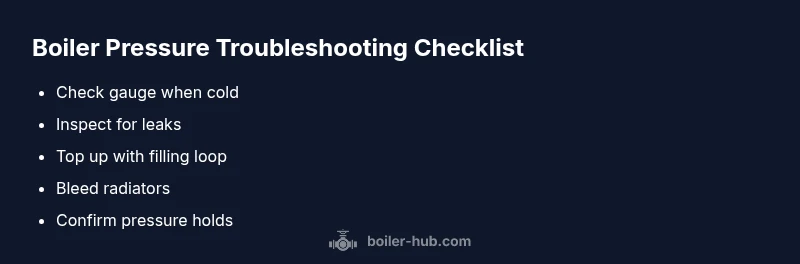
Why Does My Boiler Have No Pressure? A Practical Troubleshooting Guide
Diagnose and fix low boiler pressure quickly with practical checks, safe re-pressurizing steps, and prevention tips. Learn when to call a pro and what to expect.


If you’re asking why does my boiler have no pressure, the likely culprits are a small leak or a failed expansion vessel. Start with the simplest checks: inspect visible pipes for dampness, verify the pressure gauge (target about 1–1.5 bar when cold), and bleed radiators only if you notice trapped air. If pressure won’t hold, follow the full step-by-step guide below and seek a pro if unsure.
Why pressure drops in boilers happen
According to Boiler Hub, low boiler pressure is a common problem that can stem from leaks, faulty expansion vessels, or trapped air. When pressure falls, your boiler may not heat water effectively, and you could notice cold spots in radiators or uneven heating throughout the house. Boilers rely on a closed loop of water that’s pressurized to move heat efficiently. If the loop develops a drip, or if the expansion vessel loses its ability to absorb expansion, the system can no longer maintain the target pressure. Quick, proactive checks help you avoid bigger problems, like air locks or system corrosion, and often point to a simple fix you can perform safely.
In many homes, the most frequent culprits are small leaks that you can spot around joints or radiator bleed points, or a failed expansion vessel that no longer cushions pressure changes. The key signal is a gauge that sits low on the scale or dipping whenever the boiler fires up. Regular monitoring, especially after topping up water, is a smart habit. The goal is to keep the pressure within the boiler’s recommended range (often around 1–1.5 bar when cold). If you’re unsure, assume the risk of letting pressure fall further and seek guidance or a professional assessment.
Common causes of low boiler pressure
- Leaks in the system: A tiny crack in pipes, a corroded joint, or a faulty radiator valve can steadily drain pressure without obvious puddles. Look for damp patches on walls, under the boiler, or around fittings.
- Faulty expansion vessel: The expansion vessel acts like a shock absorber for pressure spikes. If its diaphragm fails, the system can’t accommodate heating expansion and pressure drops quickly.
- Bleed valve left open: After repressurizing, a bleed valve left slightly open will let water escape and the gauge won’t settle.
- Faulty pressure relief valve or filling loop issue: A stuck or incorrectly seated valve can vent pressure or prevent proper top-up.
- Air in the system: After a top-up or radiator bleed, air pockets can make readings fluctuate and reduce effective pressure until vented.
Note: Not every low-pressure scenario is caused by a single fault; often two issues coincide, especially in older systems. A professional inspection can confirm whether the expansion vessel or a hidden leak is the root cause.
Safe initial checks you can perform today
- Read the gauge when the boiler is cold to establish baseline pressure. Most systems aim for about 1 bar when cold.
- Look for visible leaks and damp patches around the boiler, radiators, and loops. Pay attention to fittings and joints.
- Check radiator bleed valves: are you sure you closed them tightly after bleeding? If you notice uneven heating, air pockets may remain and need venting.
- Inspect the filling loop setup: ensure the external valves are closed when not in use and that you only connect the loop when topping up.
- Turn off heating before adjusting: repressurize only when the system is cool; operating while hot can lead to dangerous pressure surges.
If you notice a puddle, a hissing sound, or a strong gas smell, stop and call a professional immediately. Pressure problems can be symptoms of more serious issues.
How to re-pressurize your boiler: Step-by-step
Re-pressurizing should be done carefully. Start with the boiler cold and powered off. Then follow these practical steps to bring the pressure up safely:
- Step 1: Close the filling loop if it is open and ensure the boiler is cold. This prevents sudden pressure surges.
- Step 2: Locate the filling loop valves and prepare the hose and fittings. Make sure you know which valve is the primary feed and which is the return.
- Step 3: Slowly open the filling loop valves and watch the pressure gauge. Open gradually to avoid over-pressurizing; stop around 1–1.5 bar when cold.
- Step 4: Close the valves and remove the filling hose once the target pressure is achieved. Check that there are no leaks at the joints.
- Step 5: Reset and run the boiler for a short period to see if pressure holds as the system warms. If it drops again, there may be a leak or a faulty vessel.
- Step 6: If air remained after repressurizing, bleed radiators starting with the highest floor, then recheck pressure.
- Step 7: Monitor pressure over the next 24 hours and note any fluctuations. If it returns to low, do not continue guessing—call a professional.
If this doesn’t work, try re-checking all connections and consider a professional inspection to assess expansion vessel integrity and leak presence.
Safety, risks, and when to call a professional
Always treat boiler work with safety in mind. Pressurizing a hot boiler can be dangerous due to pressure surges, and leaks may indicate larger issues such as corrosion or faulty fittings. If you smell gas, hear hissing, or notice damp patches near gas lines, evacuate and call your gas emergency line immediately. Do not attempt major repairs yourself if you are unsure. A licensed heating engineer can verify the integrity of the expansion vessel, check for hidden leaks, and ensure the system is correctly pressurized and safe.
Prevention and maintenance to avoid future pressure loss
Prevention is better than repair. Schedule an annual boiler service and have the expansion vessel checked every 3–5 years (or as recommended by your boiler manufacturer). Keep a simple log of pressures read from the gauge during cold and after heating, and note any changes. If you recently topped up water, consider scheduling a quick service to verify that there are no leaks and that the system remains in good condition. Regularly bleeding radiators and addressing any leaks promptly will help maintain steady pressure over time.
Steps
Estimated time: 45-60 minutes
- 1
Confirm boiler is cold and safe
Power off the boiler and allow it to cool completely before starting any repressurizing work. This reduces the risk of scalding from hot water or steam. Wear protective gloves and keep children away from the work area.
Tip: Never attempt to repressurize a hot boiler. - 2
Locate the filling loop and valves
Find the filling loop on your boiler and identify the two valves that supply water to the loop. Ensure you know which valve is feed and which is return, and confirm that the loop is compatible with your boiler model.
Tip: If you’re unsure of the loop, refer to your boiler manual or contact a professional. - 3
Open valves slowly
Open the two filling loop valves gradually and watch the pressure gauge closely. A slow, deliberate turn prevents sudden pressure spikes and potential damage to seals or joints.
Tip: Do not force the valves; a smooth motion is safer and more controllable. - 4
Top up to 1–1.5 bar (cold)
Continue until the gauge reads within the 1–1.5 bar range when the boiler is cold. If you’re unsure, stop a little short and recheck after heating. Overfilling can cause high pressure and safety valves to release.
Tip: Small increments beat rushing to the target. - 5
Close the filling loop and inspect
Close the filling loop valves and remove the hose. Check for any signs of leakage at joints or valves. If leaks are present, do not proceed with further pressure adjustments.
Tip: Wipe connections clean to spot any damp patches quickly. - 6
Bleed radiators and recheck
If air is suspected, bleed radiators starting with the highest floor. After bleeding, re-check the system pressure and ensure it remains in the normal range.
Tip: Bleed only what’s necessary to avoid reintroducing air. - 7
Test heating and water; monitor pressure
Turn the heating on briefly and observe how the pressure behaves as the system warms. If the pressure stays steady, you’re done. If it drifts downward, stop and call a professional for a more thorough assessment.
Tip: Keep a log of pressure readings for future reference.
Diagnosis: Boiler pressure gauge reads low (below 1 bar) or drops after heating
Possible Causes
- highSystem leaks (pipes, joints, or radiators)
- mediumFaulty expansion vessel or diaphragm
- lowAir trapped in the system after topping up or bleeding
Fixes
- easyInspect for leaks, tighten fittings, and repair or replace faulty valves
- easyTop up pressure via the filling loop to 1–1.5 bar when cold, then re-test after heating
- mediumTest expansion vessel; replace if faulty (professional)
Questions & Answers
Why is my boiler showing low pressure?
Low pressure is usually caused by leaks or expansion vessel failure. It can also result from air entering the system after bleeding.
Low boiler pressure is usually caused by leaks or expansion vessel failure, or air in the system after bleeding.
How do I repressurize my boiler?
Repressurize using the filling loop, opening valves slowly until the gauge reads about 1 to 1.5 bar when cold. Close valves and check for leaks.
Use the filling loop, open slowly until 1 to 1.5 bar when cold, then close and inspect for leaks.
What is an expansion vessel and why does it fail?
An expansion vessel soaks up pressure changes as water expands. If the diaphragm fails, pressure can drop and the system can’t compensate.
An expansion vessel buffers pressure changes; if it fails, pressure drops and the system can't compensate.
Is low boiler pressure dangerous?
Low pressure isn’t usually dangerous by itself, but it signals leaks or faults that warrant attention.
Low pressure isn’t usually dangerous, but it can indicate leaks or faults that need attention.
When should I call a professional?
If pressure drops again after repressurizing or you notice persistent leaks, corrosion, or a faulty expansion vessel, call a pro.
Call a professional if pressure keeps dropping after topping up or you see leaks.
Can radiators cause pressure problems?
Radiator leaks can cause pressure loss; bleeding alone won’t fix a leak and won’t stop pressure dropping.
Radiator leaks can cause pressure loss; bleeding won’t fix a leak.
Watch Video
Key Points
- Identify leaks first and stop further loss.
- Keep cold-pressure around 1–1.5 bar.
- Close the filling loop after topping up and check for leaks.
- Call a professional if pressure returns to low after top-up.