Why Does a Boiler Turn On Randomly? A Practical Troubleshooting Guide
Discover why your boiler turns on by itself and how to diagnose safely. This Boiler Hub guide covers common causes, quick checks, and step-by-step fixes for homeowners and facility managers.


Boiler turning on randomly is usually caused by a stuck thermostat, a malfunctioning aquastat, or a misconfigured timer. Start with the simplest checks: verify thermostat settings and schedules, inspect wiring for loose connections, and reset any smart controls. If the issue persists, shut down the boiler and contact a licensed technician to diagnose electrical or gas safety concerns.
Why the boiler turns on randomly
According to Boiler Hub, a boiler that activates on its own is usually a symptom of an issue in the control system, not a mysterious self-start. The question, why does boiler turn on randomly, often points to a handful of culprits: a misbehaving thermostat, a stuck aquastat, a faulty timer, or an aging relay in the control circuit. In modern heating systems, even a small misreading can trigger a heat cycle. This block will unpack the most common triggers and what they typically indicate, with practical checks you can perform without specialized tools. While some fixes are straightforward, others require professional service, especially when gas safety is involved. The aim is to empower you to identify the most probable cause and take safe, incremental steps toward a solution.
Quick reality check on symptoms
- Random activation can manifest as a boiler firing off in the middle of the night, or cycling on during mild weather when ample heat isn’t needed.
- If you notice accompanying issues like unusual noises, banging, or water leaks, these signals often point to related mechanical or sensor problems rather than a simple timer misread.
- Always treat gas-fired boilers with caution; if you detect gas smell or low safety readings, evacuate and call emergency services.
The role of the thermostat: the most common starting point
Thermostats and smart room sensors are designed to keep your home at a set comfort level. If a thermostat is miswired, has a stuck contact, or is experiencing a sensor drift, it can falsely demand heat. Likewise, a smart thermostat can trigger boiler cycles based on weather data or app commands that may conflict with a traditional timer. In many cases, simply resetting the thermostat, replacing batteries, or updating firmware can resolve the issue. If the thermostat is near heat sources, drafts, or direct sunlight, readings can be skewed, causing stray activations.
Aquastats, boilers, and the logic of heat demand
An aquastat governs when the boiler should heat water in the system. A malfunction—sticky relay contacts, a miscalibrated high-limit, or a fault in the differential control—can cause the boiler to think there is heat demand even when there isn’t. These devices are sensitive to wiring and power supply variations; electrical noise or a loose connection can also create false signals. Diagnosing aquastat issues often requires checking the control’s setpoints and, if needed, replacing aging components.
The timer and external controls: schedules, remotes, and resets
Many boilers are connected to schedules or external controls like zone thermostats. A timer that is out of sync with the actual heat demand, a stray jumper, or an automatic restart function can cause the unit to fire unexpectedly. It’s common for multiple devices (thermostats, timers, and smart hubs) to interact, creating conflicting signals. Document and compare each device’s programmed times with your actual usage to identify mismatches.
Wiring, relays, and the control board: the silent contributors
Even with the thermostat and aquastat functioning correctly, aging wiring, loose connections, or a failing relay on the control board can make the boiler fire when it shouldn’t. Look for signs like warm wiring, discoloration, or buzzing noises. Because control boards handle multiple inputs, a fault here can create cascading misreads. When in doubt, avoid DIY electrical testing on gas-fired units; call a licensed professional for a safe inspection.
External influences: other devices that can trigger heat
Older homes or multi-zone systems sometimes have additional devices that can influence heat demand, such as zone valves, outdoor reset controls, or wireless sensors. A misbehaving zone valve might falsely call for heat, while outdoor sensors can misread ambient temperature and prompt unexpected cycling. Isolating external devices one by one can help identify the culprit, starting with the least invasive components.
Putting it together: a practical diagnostic mindset
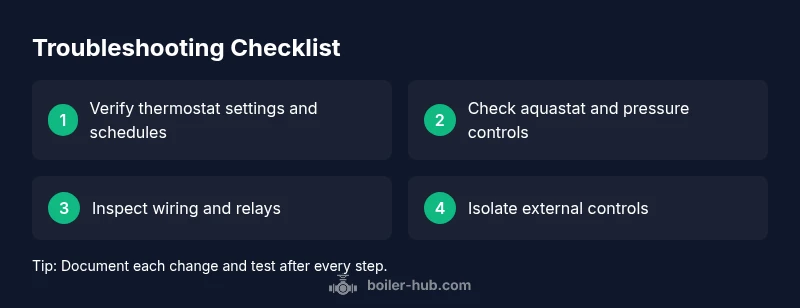
Approach the problem methodically: start with the simplest check (thermostat and schedules), then move to sensors and timers, and finally inspect the wiring and control boards. Always verify power states and safety devices before handling any components. If you’re unsure about any step, pause and consult a professional—especially when gas lines or combustion risks are involved.
What this means for homeowners and managers
A boiler that turns on randomly is rarely a single-point failure. It’s usually a system of interacting controls that misbehave under certain conditions. By understanding the common culprits and following a structured troubleshooting path, you can prevent unnecessary energy use, maintain comfortable temperatures, and reduce the risk of dangerous situations. Boiler Hub’s guidance emphasizes safety, gradual testing, and clear documentation to support informed decisions.
Steps
Estimated time: 60-90 minutes
- 1
Verify thermostat settings and timers
Check all thermostats and reset any that show signs of drift. Confirm schedules align with actual occupancy and heating needs. If you use a smart thermostat, run firmware updates and re-pair it with the boiler system. Tip: Note any pattern of activation that coincides with a specific time or temperature setting.
Tip: Document the exact settings before making changes. - 2
Test the aquastat and pressure controls
Locate the aquastat and check the differential, high-limit, and any boiler pressure readings. Ensure there are no loose wires and that the sensor is clean and free from corrosion. If readings are off, recalibrate or replace the sensor as needed.
Tip: Turn off power before touching any electrical components. - 3
Inspect electrical wiring and relays
Inspect accessible wiring for signs of wear, chafing, or loose connections. If the boiler uses a relay module, test for sticking contacts or signs of arcing. Replace damaged parts and re-secure wiring safely.
Tip: If you see scorch marks or melted insulation, stop and consult a pro. - 4
Isolate external devices
Temporarily disconnect external controllers (zone valves, outdoor sensors, timers) one at a time to observe if the random activation stops. Reconnect devices methodically after testing.
Tip: Label each disconnected device to track changes. - 5
Reset and test after changes
Power down the system, then restore power and cycle the boiler to see if the issue persists. Run through a few heating cycles under normal conditions to confirm stability.
Tip: Keep records of cycles and outcomes to share with a technician. - 6
Call a professional if uncertain
If the problem remains after these steps, especially with gas safety concerns, contact a licensed technician for a comprehensive diagnostic.
Tip: Professional service can prevent safety risks and ensure code compliance.
Diagnosis: Boiler turns on by itself or without demand
Possible Causes
- highFaulty thermostat or misconfigured timer
- highStuck aquastat/low-water cut-off switch
- mediumWiring short or aging control board relay
- lowExternal devices (remote stats, sensors) triggering heat
Fixes
- easyTest thermostat and timer settings; replace faulty thermostat or sensor
- mediumInspect aquastat and differential control; recalibrate or replace if needed
- hardCheck relay contacts and connections on the control board; consult a pro if wiring seems compromised
- easyDisconnect or disable non-essential external controls to identify culprits
Questions & Answers
Why does my boiler turn on randomly even when no hot water is needed?
Most often the issue is a faulty thermostat, misconfigured timer, or a stuck aquastat. External controls or aging relays can also trigger unintended activations.
Common culprits are thermostat or timer problems, followed by aquastat or wiring faults.
Could a smart thermostat cause this, and how do I fix it?
Yes. Smart thermostats can misread room conditions or send conflicting commands. Start by updating firmware, re-pairing with the boiler, and temporarily bypassing smart routines to test the baseline.
A misbehaving smart thermostat can trigger unwanted cycles; update and re-pair to test.
Is a faulty pressure switch the usual culprit?
A faulty pressure switch or aquastat can create false heat demand signals. Inspect for correct pressures and replace worn components if readings are inconsistent.
Yes, pressure switches can misread and cause random activations.
When should I be concerned about gas safety?
If you smell gas, hear hissing, or notice dead vegetation near vents, evacuate and call emergency services. Do not attempt DIY fixes when gas is involved.
Gas smells or signs mean immediate danger—seek professional help.
What maintenance steps prevent random activations?
Regular maintenance, clean sensors, check for loose wires, and verify compatibility of all control devices to avoid signal conflicts.
Preventive checks and proper device compatibility reduce surprises.
Do I need a full boiler replacement if this continues?
Not necessarily. Many cases are fixable with a thermostat, aquastat, or relay replacement. A professional assessment helps determine if components are past their service life.
Most times, a repair is enough, but an expert opinion is essential.
Watch Video
Key Points
- Identify root causes through a structured approach.
- Verify thermostat, timer, and aquastat first.
- Check wiring and external controls for interference.
- When in doubt, consult a licensed professional.
- Maintain yearly servicing to prevent recurrence.