Why Boiler Not Working: A Practical Troubleshooting Guide
Fast, practical steps to diagnose and fix a boiler that won't turn on or heat properly. Learn common causes, safety tips, and when to call Boiler Hub for expert guidance.


According to Boiler Hub, the most common reasons a boiler won’t work are power or control issues, a tripped circuit, a faulty thermostat, frozen condensate, trapped air, or ignition faults. Begin with a quick power check and reset, confirm thermostat settings, and ensure the gas supply and water valve are open. If unresolved, follow the diagnostic flow for safe, step‑by‑step fixes.
Why the boiler not working: quick context
Boiler failure is rarely a single, mysterious fault. When you search for 'why boiler not working,' you're likely seeing a mix of power, control, and safety issues. Boilers rely on a precise sequence of steps to heat water, and if any one part fails, heat delivery stops. According to Boiler Hub, the most common culprits are power or control issues, a tripped circuit, a faulty thermostat, frozen condensate, trapped air, or ignition faults. Understanding these causes helps you tailor your approach and avoid chasing symptoms you don't understand. In practice, the fastest path to a warm home is a disciplined, stepwise process that starts with the simplest checks and progresses to more detailed examinations only as needed. This article keeps that order, emphasizes safety, and gives you clear decision points so you can decide whether a repair is doable at home or when to call a professional. With a calm, methodical plan, you can reduce downtime, protect your equipment, and minimize the risk of gas leaks or electrical faults.
Common failure modes and how they show up
Boilers can fail in several predictable ways. You may notice no heat when you turn up the thermostat, a boiler fires briefly then goes quiet, or erratic heating cycles. In many homes, the root causes cluster into a few familiar categories. Power issues surface as a tripped breaker, blown fuse, or a plug that’s come loose. Control issues often relate to a faulty thermostat, a dead battery, or wiring problems that prevent the unit from recognizing a demand for heat. Ignition problems are common in older gas boilers, and can result from a weak flame, a clogged burner, or an interrupted gas supply. Air locks or trapped air in radiators and the heating circuit can prevent circulation, producing cold spots or banging noises. Condensate-related freezing can stop modern high-efficiency boilers in cold weather, triggering a safety lockout. Gas boilers may also display error codes or warning lights that point to venting, pressure, or combustion problems. Keeping a simple log of symptoms helps you see patterns and reduces duplicate testing. Boiler Hub analysis shows that most outages are caused by these categories rather than mysterious faults.
Safety considerations before troubleshooting
Safety first: boilers involve electricity, gas, and high temperatures. Before you touch anything, turn off the boiler at the wall or switch off the power to the unit, and if you smell gas, evacuate and call emergency services. Never bypass safety features or remove guards to test components. Use a CO detector and ensure your smoke detector is functioning. Ventilation matters: ensure the boiler room is not sealed, and avoid working alone if you are uncertain. Only perform tasks within your comfort level and follow manufacturer instructions for shutoff procedures. If you have any hesitation about gas, combustion safety, or electrical work, call a licensed professional immediately. This prevents dangerous conditions and ensures compliance with local safety regulations. Remember that incorrect tinkering can lead to leaks, fire risk, or carbon monoxide exposure.
Tools and safety gear you may need
Gather the basics: a flashlight, a digital multimeter or a basic voltage tester, a screwdriver set, and a radiator bleed key. Wear safety gloves and eye protection. Keep a towel or container handy to catch any water. Have your boiler manual handy or download the PDF from the manufacturer's site. Use non-flammable cleaners and avoid liquids near live electrical components. If you are unsure about any step, step back and seek professional help rather than forcing a fix.
Diagnostic approach: a proven flow for no-heat symptoms
Start with a high-level check of power and controls, then move to fluid and gas systems. Use a symptom-to-diagnosis flow: 1) Is the boiler receiving power? 2) Are thermostat and control settings correct? 3) Is there a gas supply and ignition functioning? 4) Is the pressure within the safe range? 5) Is the condensate trap clear and draining? 6) Are radiators free of air? Each step narrows the field until you identify the root cause or determine that professional help is needed. Record codes or observed fault indicators and consult the manual or Boiler Hub’s guidance for the specific code. This structured approach reduces trial-and-error testing and speeds resolution.
Quick fixes to try first (before calling a pro)
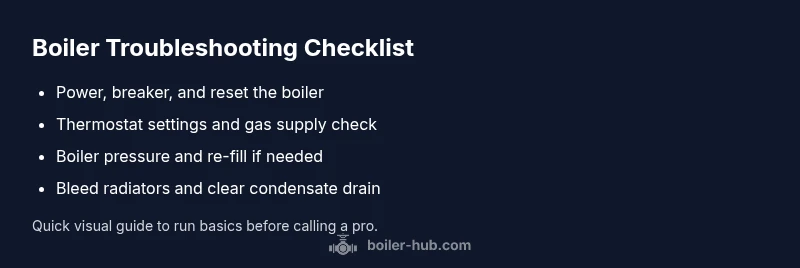
Try these basic steps in order: 1) Check the power and reset the boiler; 2) Verify thermostat settings and replace batteries if needed; 3) Inspect gas valve and ensure there is gas supply, but do not attempt to light if you smell gas; 4) Check boiler pressure and re-pressurize slowly if low; 5) Inspect the condensate drain in cold weather for freezing; 6) Bleed radiators to release trapped air. Each fix is designed to be safe and straightforward; if a step fails or the breaker trips again, stop and seek professional assistance.
When to call a professional
If the boiler still won't operate after the basic checks, or if you encounter gas smells, error codes you can't interpret, high-pressure indications, or abnormal boiler noises, contact a licensed heating engineer. Gas safety and venting problems demand professional evaluation. A pro can verify combustion efficiency, test for carbon monoxide, inspect the heat exchanger, and ensure electrical connections meet code. For complex issues, Boiler Hub recommends scheduling a service call rather than risking repeated failed heating. Regular annual servicing also reduces the risk of sudden outages.
Prevention: keeping your boiler reliable
Regular maintenance is cheaper than emergency repairs. Schedule annual boiler service, check the expansion vessel pressure, and have the coolant and filling loop inspected. Keep the area around the boiler clear and test CO detectors monthly. In winter, ensure condensate lines are clear and insulate pipes to minimize cold-weather stress. Maintain steady thermostat calibration and update any smart controls as needed. Boiler Hub analysis suggests that proactive maintenance reduces failure rates and extends boiler life.
Steps
Estimated time: 30-60 minutes
- 1
Power check and reset
Inspect the boiler plug, outlet, and wall switch. If the breaker tripped, reset it and try to start the boiler again. Wait 60 seconds after resetting to see if the unit responds.
Tip: If the breaker trips again, stop and call a licensed electrician or HVAC tech. - 2
Thermostat and controls
Validate that the thermostat is set to heat and at an appropriate temperature. Check for any error codes on the boiler display and replace batteries if it’s wireless. Ensure timers aren’t turning the system off unexpectedly.
Tip: Document the current settings and any codes before taking further action. - 3
Gas supply and ignition (if applicable)
For gas boilers, confirm the gas valve is open and there is no gas smell. If the burner won’t ignite, do not force a light; consult your gas supplier or a technician. If you hear hissing or detect a gas odor, leave the area immediately.
Tip: Never bypass safety interlocks; safety matters first. - 4
Check boiler pressure
Look at the pressure gauge; typical cold pressure is around 1 bar. If pressure is low, use the filling loop per the manual to bring it up gradually to the recommended range. Recheck after the system stabilizes.
Tip: Do not overfill; over-pressurizing can damage components. - 5
Inspect condensate trap and drain
In cold weather, the condensate trap can freeze and halt modern boilers. Locate the trap and clear any blockages; ensure the condensate line drains freely. If freezing is suspected, allow it to thaw naturally before testing again.
Tip: Avoid using heat sources to thaw the trap; patience prevents damage. - 6
Bleed air from radiators
If you have radiators, bleed to remove trapped air and restore circulation. Recheck system pressure after bleeding. Finish by running the hot water mode briefly to ensure stable operation.
Tip: Keep a cloth handy to catch any water droplets during bleeding.
Diagnosis: No heat or hot water after turning on boiler
Possible Causes
- highPower supply issue (outlet, plug, or breaker)
- highThermostat/control fault or mis-set
- mediumGas supply or ignition problem
- mediumAir lock or trapped air in system
- lowCondensate trap or drainage problem (condensing boilers)
Fixes
- easyCheck that the boiler is powered and the breaker is not tripped; reset if needed
- easyDouble-check thermostat settings and battery status; set to proper heat/hot water modes
- mediumVerify gas valve is open and there is gas supply; attempt a safe ignition reset if you are experienced
- easyBleed air from the system or radiators to restore circulation
- easyInspect condensate drain for blockages or freezing and clear as permitted
Questions & Answers
What is the first thing I should check when my boiler stops heating?
Begin with power, the breaker, and thermostat settings. If the boiler doesn’t respond after a reset, proceed with the diagnostic steps for no-heat symptoms.
First check power and thermostat, then follow the diagnostic steps if needed.
Why does my boiler click but not start?
A clicking sound often signals ignition or safety lockout issues, or a faulty control board. Check gas supply, flame status, and any error codes, and call a pro if uncertain.
Clicking usually means ignition or safety lockouts—check the controls and gas supply, then seek help if needed.
Can I fix a boiler myself?
Some basics are safe, like power and thermostat checks, but many repairs involve gas and electrical safety. If unsure, avoid risky tasks and hire a licensed technician.
Basic checks are okay, but anything involving gas or electricity should be handled by a licensed pro.
What causes low boiler pressure?
Low pressure often stems from leaks, recent bleeds, or filling errors. Refill slowly according to the manual and recheck the gauge after heating cycles.
Low pressure usually means a leak or a recent bleed; refill carefully and recheck.
When should I replace versus repair?
If the boiler is older than 10–15 years and repairs are frequent, replacement is often more cost-effective. Consider efficiency, fuel type, and future maintenance.
If it's old and costly to repair, replacement may be wiser in the long run.
Watch Video
Key Points
- Start with power and thermostat checks to rule out quick fixes
- Prioritize safety; gas and electricity require professional care
- Use a defined diagnostic flow to identify root causes
- Regular maintenance reduces future outages