Boiler Not Turning On: Quick Troubleshooting Guide
When your boiler is not turning on, start with power and thermostat checks, then follow a safe, structured troubleshooting flow. Boiler Hub guides homeowners and facility managers to diagnose common faults and restore heat quickly.


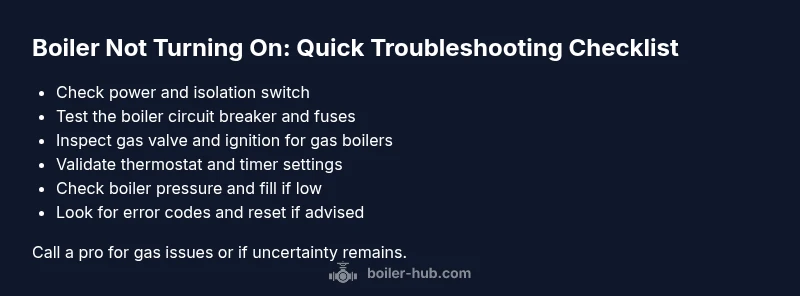
If your boiler is not turning on, begin with the basics: ensure power is on, verify the mains switch or breaker, and check the thermostat and timer settings. Next, inspect the gas supply and ignition, and confirm boiler pressure is in the normal range. If the fault remains, consult the diagnostic flow or contact a qualified boiler technician.
What to check first when the boiler is not turning on
When a boiler refuses to fire, the fault is almost always a simple, observable issue before diving into complex diagnostics. Start with the obvious power and control checks. Verify the boiler is plugged in (if applicable) and that the main power switch is ON. Check the wall socket, extension leads, and any smart plugs that may cut power. Then move to the boiler’s own on/off switch, the reset button, and the user-facing controls. If you notice an error code on the display, note it down as it guides troubleshooting. Finally, confirm the room thermostat and boiler timer are set correctly for the current heating demand. By following these basics you can often resolve the problem quickly without specialized tools.
Safety first: Before you troubleshoot
Safety is the priority when dealing with boilers. If you smell gas, hear hissing sounds, or notice a carbon monoxide alarm, evacuate the area and call your gas emergency number immediately. Do not attempt to light the boiler or tamper with gas lines. If you’re unsure about any step, stop and seek professional help. Ensure children and pets are kept away, and wear appropriate PPE if you need to handle manuals or open panels. A safety check list keeps you from overlooking critical risks that could lead to injury or more damage.
Power and control checks
Power-related issues are by far the most common reason a boiler won’t turn on. Start with the basics: confirm the boiler’s plug is seated (if it has one) and the outlet is live. Check the main switch on the boiler and any local isolation switch. Look at the circuit breaker or fuse box for a tripped breaker or blown fuse. If the boiler has a reset button, try a safe reset following the manufacturer’s instructions. If you’ve recently had electrical work or a power outage, recheck the circuit feeding the boiler to ensure it’s protected by a working breaker. If the power checks pass but the boiler still won’t start, the fault may lie with the control board or interlock switches.
Gas supply and ignition checks
If you have a gas boiler, interrupted gas supply or ignition failure can prevent firing. First, confirm the gas valve is fully open and the boiler has access to gas pressure. If you smell gas, leave the area and contact the gas supplier immediately. For boilers with a standing pilot, ensure the pilot is lit and stable; for newer boilers with electronic ignition, there should be an ignition spark during startup. If ignition occurs intermittently or not at all, it may indicate a dirty igniter, sensor fault, or control issue. In most cases, only a qualified technician should service gas components.
Thermostat and timer settings
A misconfigured thermostat or a timer set to a period when heat is not needed is a frequent culprit. Check the room thermostat (or smart thermostat) and confirm it is active and set to a higher target temperature than the current room. Verify the boiler’s internal timer or programmer, ensuring it is not in a vacation mode or disabled. If you have multiple zones, confirm all intended zones are enabled. A sudden heat drop or unresponsive boiler can be caused by a software glitch; a quick re-pairing or reboot of the thermostat can fix the issue in many cases.
Pressure and safety controls
Low boiler pressure or a safety lockout due to high pressure can stop the boiler from firing. Check the pressure gauge on the boiler; most systems operate in a nominal range (often around 1–2 bar when cold but refer to your manual). If pressure is low, you’ll need to repressurize the system according to the manual. Look for any visible leaks or drips in radiators, pipes, or the boiler itself. Bleeding radiators to remove trapped air can also help if the system is unbalanced. If pressure fluctuates or remains outside the recommended range after topping up, there may be a leak or a faulty expansion vessel.
Common wiring and fuse issues
Electrical faults can stem from loose wiring, corroded terminals, or damaged cables. Turn off power before inspecting wiring where you’re comfortable; loosely connected wires or burnt connectors can prevent the boiler from starting. Check the wiring harnesses at the boiler control panel for signs of wear or discoloration. Ensure that any fuses are intact and that LEDs on the control board respond when power is applied. If you see error codes, refer to the user manual or manufacturer’s site for what they indicate and whether a reset is appropriate.
When to call a pro
If basic checks don’t restore heat, or you encounter gas concerns, unusual noises, persistent error codes, or you’re uncomfortable working with electrical or gas components, it’s time to contact a licensed boiler technician. A professional can interpret error codes, test gas pressures safely, and verify combustion efficiency. Regular service from a qualified technician can identify issues before they cause outages and help maintain efficiency. The Boiler Hub Team emphasizes never attempting risky repairs that require gas connections or sealed components without proper training.
Preventive maintenance to avoid future outages
Preventive maintenance reduces the likelihood of the boiler failing to turn on. Schedule an annual service with a qualified technician, usually before peak heating season. Keep the surroundings clear of dust and debris and check venting paths for blockages. Replace worn seals and filters as recommended by the manufacturer, and keep the area around the boiler clean and accessible. Regularly test the boiler’s safety devices and alarms to ensure they respond promptly. A small ongoing maintenance routine keeps your system reliable and efficient across colder months.
Steps
Estimated time: 60-90 minutes
- 1
Verify power and main switch
Ensure the boiler is plugged in if it uses a plug; turn on the main switch. If there is a separate isolation switch near the boiler, switch it ON and ensure it remains engaged. A sudden power loss can leave the boiler in a safe shutdown state, so this step is foundational.
Tip: If the outlet is controlled by a wall switch, ensure that switch is ON before testing the boiler. - 2
Check circuit protection
Inspect the dedicated boiler circuit breaker or fuse. Reset a tripped breaker or replace a blown fuse with the same rating. Do not bypass safety devices; if the breaker trips repeatedly, there may be a fault downstream that needs a professional assessment.
Tip: Note any tripped indicators to discuss with a technician. - 3
Inspect gas supply and ignition
For gas boilers, confirm the gas valve is fully open. If there is a gas smell, leave the area and contact the gas provider. If ignition does not occur within a few seconds of attempting to start, there may be an ignition sensor issue or a control fault.
Tip: Never attempt to relight a pilot or service gas lines yourself if you are unsure of the procedure. - 4
Review thermostat and timer settings
Check that the room thermostat is set higher than room temperature and that the boiler’s timer or programmer is active. If you recently changed this setup, revert to your typical heating schedule or run a manual test heat cycle to verify response.
Tip: If you have a smart thermostat, try a quick reset or re-pair with the boiler. - 5
Check boiler pressure and water level
Read the pressure gauge; many systems operate around 1–2 bar when cold. If pressure is too low, you’ll need to top up using the filling loop according to the manual, watching for any leaks. High pressure also triggers safety shut-offs—release some pressure or bleed radiators if needed following the manual.
Tip: Always follow the manufacturer’s instructions for repressurization to avoid overflow. - 6
Inspect for error codes and reset
Look at the boiler display for error codes and consult the manual for their meaning. Some faults can be reset with a safe button sequence; others require professional service. Record the codes for reference when you call a technician.
Tip: Do not perform a full internal reset if you’re unsure what the code means. - 7
Call a professional if unresolved
If the boiler still won’t light after these checks, or you encounter gas concerns, water leaks, or persistent error codes, contact a licensed boiler technician. A pro can safely diagnose combustion faults, electrical faults, and gas-related issues with calibrated equipment.
Tip: Schedule preventive maintenance to avoid future outages.
Diagnosis: Boiler won't turn on
Possible Causes
- highPower supply or electrical fault
- mediumThermostat or control board failure
- mediumGas supply or ignition issue
- lowLow boiler water pressure or safety lockout
- lowBlocked condensate or safety switch
Fixes
- easyCheck mains power, reset breakers, and replace any blown fuses; re-energize the boiler circuit
- easyTest/adjust thermostat and timer settings; re-pair or reboot smart thermostats if applicable
- mediumVerify gas supply; ensure gas valve is open and ignition is functioning; call pro if gas odors are present
- mediumInspect and top up boiler pressure to the manufacturer’s recommended range; check for leaks
- mediumInspect safety switches and condensate trap; clear blockages or faults requires professional service
Questions & Answers
What should I check first if my boiler won't turn on?
Begin with power, the boiler switch, and the breaker. Then verify thermostat and timer settings. If the display shows an error code, note it for reference when seeking help.
Start with power and control checks, then thermostat settings. Note any error codes for later reference.
Why won't my boiler ignite even with power?
Ignition issues can stem from gas supply, dirty igniter, or faulty sensors. If you smell gas, do not attempt to light it; contact the gas provider immediately.
Ignition problems often relate to gas supply or a faulty ignition sensor. If you smell gas, leave the area and call the provider.
Is it safe to reset a boiler myself?
Some boilers support a safe reset, but not all faults should be reset without understanding the code. Always consult the manual and avoid resets if you’re unsure of the fault.
Reset only if the manual says it’s safe and you understand the fault code.
What does no heating mean when the boiler is silent?
No heating might indicate a power issue, thermostat misconfiguration, or a safety lockout. Check the power, thermostat, and pressure before calling a pro.
No heating usually points to a power, thermostat, or lockout issue.
When should I call a professional?
Call a licensed technician if basic checks don’t restore heat, you detect gas concerns, or error codes persist. Routine service helps prevent future outages.
If basic checks fail or you have gas concerns, contact a professional.
Can low pressure cause a boiler not to turn on?
Yes. Low pressure can trigger lockouts. Repressurize per the manual and check for leaks. If pressure remains unstable, a professional should inspect the system.
Low pressure can stop the boiler from turning on; repressurize and check for leaks, then call a pro if it stays off.
Key Points
- Start with power and control checks before anything else
- Gas and ignition issues require caution and may need a pro
- Monitor pressure and safety switches to prevent lockouts
- Use the diagnostic codes to guide repair steps
- Schedule regular maintenance to prevent future failures