Oil Boiler Not Turning On: Troubleshooting Guide
Urgent, practical guide to diagnose and fix an oil boiler not turning on. Learn safe checks, diagnostic flow, and when to call a pro. Boiler Hub offers actionable steps to restore heat quickly and prevent future outages.


The most likely cause is a power or ignition issue, not a fault of the oil itself. Start with the easy checks: confirm the boiler switch and breaker are on, verify the thermostat is calling for heat, and reset the ignition if allowed. If these steps don’t restore operation, move to a professional diagnostic. This quick fix approach minimizes downtime and safety risks.
Common causes for an oil boiler not turning on
If your oil boiler won’t light or start, the issue is almost always something simple and safe to check first. The most common culprits are power supply problems, thermostat miscommunication, or ignition faults. In many cases, a quick review of the basics can save a service call. According to Boiler Hub Analysis, homeowners who verify power and thermostat settings typically regain heat without escalating to a full service. Start by confirming the boiler switch is on, the circuit breaker feeding the boiler is intact, and there are no tripped fuses. If the power is good, move on to the thermostat and ignition. Inspect the thermostat to ensure it is calling for heat and that its temperature setting is appropriate for the current room temperature. If your thermostat is old or has a weak battery, replace or recalibrate it. Ignition failures can be caused by a faulty electrode, a dirty burner, or a blown ignition transformer. Do not force the burner to start; instead, follow the steps in this guide to isolate the fault safely.
Safe, quick checks you can perform today
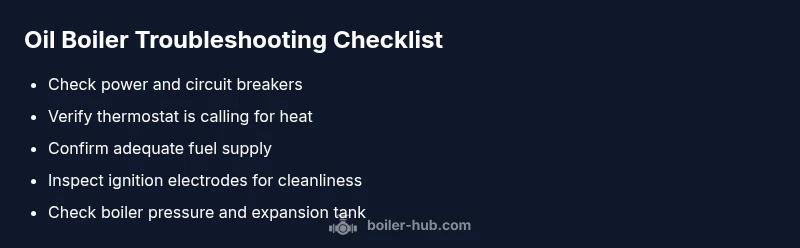
Before calling a technician, run through a short, safe checklist. First, switch off the boiler, then check the power supply at the boiler and at the wall outlet or circuit breaker. Ensure the boiler's power switch is in the 'on' position and that the display is active. Next, check the room thermostat and any programmable timer. Confirm it is set to heat mode and that the call-for-heat signal is being sent. If you have an oil gauge, verify there is adequate fuel; a low fuel level can silence the burner. Look for visible signs of leaks or water on the boiler or nearby pipes, and listen for a whirring or humming sound that might indicate a stuck relay or pump. Finally, if your boiler has an error code on the control panel, note it down and consult the manual or Boiler Hub's troubleshooting flow.
Diagnostic flow overview
Understanding the diagnostic path helps you avoid wasted effort. Symptoms like 'no ignition', 'no heat', or 'flickering burner' point to specific causes. Start with power and control signals, then verify fuel supply and ignition. If the boiler shows an error code, look up the code in your manual or Boiler Hub's database. The flow below maps symptoms to likely causes and practical fixes, from high-likelihood issues (power, thermostat) to less common failures (ignition components, pressure problems).
Safety considerations and when to call a pro
Oil boilers run on gas and oil and involve high temperatures, hot surfaces, and pressurized circuits. If you smell fuel, hear gas odor, or see smoke or alert lights, stop immediately and call emergency services. Do not attempt to disassemble sealed ignition chambers or tamper with oil lines. While many fixes are safe for do-it-yourselfers, diagnosing fuel system or combustion issues should be left to licensed technicians. Boiler Hub's safety guidelines emphasize turning off power before inspection and wearing protective gloves when handling hot components.
Prevention tips to avoid future outages
Regular maintenance reduces the odds of an oil boiler not turning on when you need heat. Schedule annual professional servicing, replace worn ignition parts, and test safety controls quarterly. Keep the oil tank topped up or schedule automatic deliveries to prevent fuel-starved starts. Clean or replace air filters and ensure vents are unobstructed. Install a smart thermostat with a dedicated service mode to avoid miscommunication, and maintain a simple log of service dates and any recurring fault codes. Consistent maintenance supports reliable heat and helps you catch issues early before they become outages.
When to seek professional help
If the quick checks and safe troubleshooting steps do not restore heat, contact a licensed boiler technician. A pro can verify fuel supply, measure boiler pressure, test ignition electrodes, and inspect the burner assembly with appropriate tools. Having your service history and any error codes handy will speed the diagnostic visit. Boiler Hub recommends scheduling service after major fuel interruptions, after a long heating season, or if you notice persistent abnormal noises, leaks, or performance dips.
Steps
Estimated time: 45-60 minutes
- 1
Check power and switches
Begin by ensuring the boiler power switch is on and the house circuit breaker feeding the boiler is not tripped. Look for any tripped indicators on the boiler’s control panel. This simple check often resolves an “oil boiler not turning on” scenario.
Tip: Always start with the lowest-risk step to avoid shocks or burns. - 2
Verify fuel supply
Confirm that there is adequate oil in the storage tank and that the fuel valve is open. If the boiler has an external pump, listen for the pump’s hum or clicking sound. A starved fuel supply is a common cause of no-start conditions.
Tip: If the tank is low, arrange a delivery before testing further. - 3
Test thermostat and heat call
Check that the thermostat is set higher than room temperature and that the system is in heating mode. If you have a programmable timer, ensure it isn’t shutting off heat during normal operation times.
Tip: Replace old batteries in thermostats and clean any dust from sensor areas. - 4
Inspect ignition system
Carefully inspect ignition electrodes and burner for soot or debris. A dirty electrode can prevent ignition. If you’re comfortable, remove any visible deposits with a dry cloth; never use liquids on heated parts.
Tip: Never touch ignition components with bare hands while power is connected. - 5
Check boiler pressure and expansion tank
Review the pressure gauge on the boiler. If pressure is too low or high, it can prevent ignition. Inspect the expansion tank for proper air charge if applicable.
Tip: Low pressure is common after fuel interruptions; consult the manual for the correct range. - 6
Attempt restart and monitor
After performing the above checks, re-energize the system and attempt a controlled restart. Observe any error codes on the display and note them for reference.
Tip: If the boiler still won’t start, stop and call a professional rather than forcing repeated attempts.
Diagnosis: Oil boiler not turning on
Possible Causes
- highNo power to the boiler due to a switched-off circuit or blown fuse
- mediumFaulty thermostat or incorrect settings preventing heat call
- mediumIgnition failure or faulty control panel
- lowInsufficient fuel supply or fuel pump issue
- lowLow boiler pressure or expansion tank problem
Fixes
- easyCheck that the boiler switch is ON and the corresponding circuit breaker is not tripped.
- easyTest and recalibrate or replace the thermostat if needed, ensuring it is calling for heat.
- mediumReset ignition or inspect ignition electrodes for cleanliness; replace if faulty.
- easyEnsure there is adequate oil supply; top up if necessary and verify fuel line is unobstructed.
- mediumCheck boiler pressure and expansion tank, top up or service as needed to restore proper pressure.
- hardIf the issue persists, call a licensed technician for a comprehensive diagnostic.
Questions & Answers
Why won’t my oil boiler turn on after a power outage?
A power outage can reset the boiler control or trip fuses. Start by restoring power, resetting the boiler, and checking for any fault codes.
A power outage can reset the boiler; restore power and check for fault codes.
Should I reset my oil boiler myself?
Yes, if the manual provides a safe reset procedure and you can access the reset switch. Do not reset if you smell gas or see damage.
You can reset if the manual says it’s safe to do so and there’s no gas smell.
What does it mean if the boiler pressure gauge is low?
Low pressure can prevent ignition or heat transfer. Refill to the recommended range as per the manual or call a pro.
Low pressure can stop the boiler from starting; refill to the right level per the manual.
Can ignition failures be DIY fixes?
Some ignition issues are solvable with cleaning or electrode replacement if you have the right tools and training. If unsure, contact a pro.
Ignition issues can sometimes be fixed yourself if you’re comfortable and careful, otherwise call a professional.
How often should an oil boiler be serviced?
Annual professional servicing is typically recommended, especially after seasons of heavy use or fuel interruptions.
Most boilers should be serviced yearly to stay reliable.
When should I call a professional?
Call a professional if checks don’t restore heat, if you smell fuel, or notice leaks, unusual noises, or error codes.
If basic checks fail or you smell fuel, call a licensed technician.
Watch Video
Key Points
- Power and thermostat checks first; ignition issues are next.
- Keep fuel topped up to prevent startup failures.
- Call a professional for fuel system or ignition problems.
- Regular maintenance reduces unexpected outages.