Why Won't Boiler Come On? A Practical Troubleshooting Guide
Urgent, step-by-step troubleshooting for boilers not turning on. Learn safe checks, diagnostic flow, and when to call a professional—brought to you by Boiler Hub.


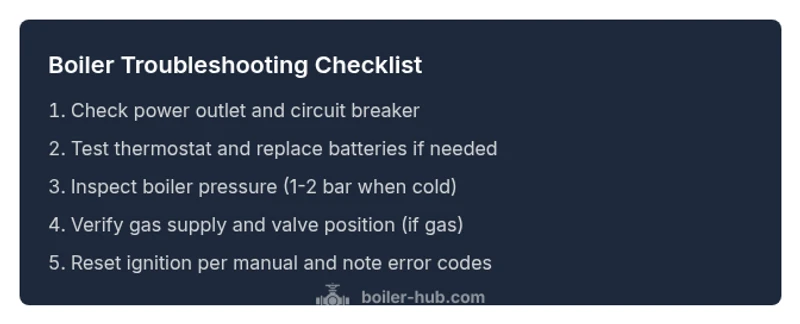
Most boiler not turning on issues are caused by power or thermostat faults. Verify the boiler has power, the wall switch is on, and the circuit breaker hasn’t tripped. Check the thermostat and programmer batteries, then reset the boiler if the manual allows. If the problem persists, follow the diagnostic flow for deeper checks.
Immediate Safety and Why This Happens
According to Boiler Hub, when a home boiler fails to light, the situation is urgent but often straightforward to diagnose with a calm, methodical approach. The Boiler Hub team found that most no-heat incidents begin with simple, addressable issues rather than catastrophic failures. If you’re wondering why wont boiler come on, start with the basics: confirm the unit is powered, the wall switch is ON, and the circuit breaker hasn’t tripped. In many homes, a loose connection or a tripped breaker is all that’s needed to restore heat. This guide emphasizes safety first: never touch electrical components with the power on, never tamper with gas lines, and always consult the manual for your model before attempting resets. Also, remember to keep children and pets away from the boiler area during investigation.
Invest time to understand your system’s normal behavior. Note the boiler’s model, age, and any recent changes (thermostat upgrades, recent power surges, or gas work). Such context helps you interpret error codes accurately and prevents unnecessary repairs. Boiler Hub’s guidance emphasizes that most failures are not mysterious and can be addressed with careful checks, safety precautions, and a clear sequence of steps.
Common Causes at a Glance
Steps
Estimated time: 45-60 minutes
- 1
Check power supply and safety switches
Turn off the boiler at the circuit breaker, then verify the outlet or wired switch is supplying power. If the breaker trips, reset it and observe whether it holds. Look for a blown fuse or a tripped GFCI outlet nearby. Keep clear of any exposed wiring.
Tip: If the breaker trips again, stop and consult a professional—repeated trips indicate a larger electrical issue. - 2
Test thermostat and programmer
Inspect the room thermostat and any programmable controller. Replace batteries if needed and confirm it is calling for heat. For smart thermostats, verify app status and ensure it’s not in an off schedule.
Tip: Note the current settings before changing anything so you can revert if needed. - 3
Check boiler pressure and water level
Look at the boiler pressure gauge when the system is cold. Most boilers operate around 1–2 bar when cold; if pressure is too low, you’ll need to repressurize using the filling loop per the manual. Do not overfill.
Tip: Do not force the fill valve; proceed slowly and stop if you see rising pressure too quickly. - 4
Inspect gas supply and gas valve
For gas boilers, confirm the gas valve is fully open and there is no smell of gas around the unit. If you suspect a gas issue, do not attempt to relight or restart—leave the area and contact the gas provider or emergency services.
Tip: If you’re unsure about gas safety, skip this step and call a professional immediately. - 5
Reset ignition and look for fault codes
Follow the manufacturer’s reset procedure to clear ignition lockouts. Note any error codes displayed on the boiler control panel, and cross-check them with the user manual or Boiler Hub guide.
Tip: Document codes with a photo for the technician if you need one later. - 6
Call a professional when needed
If the boiler still doesn’t light after these steps, it’s time to contact a licensed technician. Gas safety and complex electrical issues require trained hands.
Tip: Prepare model, age, and recent service history to speed up the diagnostic visit.
Diagnosis: Boiler won't turn on or ignite
Possible Causes
- highPower issue
- highFaulty thermostat or wiring
- mediumLow boiler pressure
- mediumGas supply issue (gas boilers)
- mediumIgnition lockout or burner fault
- lowPilot light out (older boilers)
Fixes
- easyCheck the outlet, wall switch, and circuit breaker; reset breakers or replace fuses if needed
- easyTest the thermostat and programmer; replace batteries or recalibrate settings as required
- mediumInspect boiler pressure gauge; repressurize if pressure is too low (follow manual for steps)
- hardEnsure gas supply is on and the gas valve is open; if uncertain, contact your gas provider or a licensed technician
- mediumReset ignition or burner lockout per the manufacturer’s instructions; note any fault codes
- easyRelight the pilot light if applicable, following the manual’s safety steps
Questions & Answers
What is the most common reason a boiler won't turn on?
Power supply issues or thermostat faults top the list. Start with the basics: power, wall switch, and thermostat settings.
Most boiler no-heat cases start with power or thermostat problems.
Can a boiler relight safely after a gas issue?
If you suspect a gas supply problem, do not attempt to light or operate the boiler. Contact your gas provider or a licensed technician.
Gas issues require professional confirmation before any relighting.
Should I reset the boiler myself?
Only use the reset procedure outlined in your boiler’s manual. If fault codes persist, stop and call a professional.
Follow the manual; persistent codes mean professional help is needed.
What does low boiler pressure mean?
Low pressure suggests the system needs repressurizing and possibly checking for leaks. Follow safe repressurizing steps per the manual.
Low pressure usually means you need to repressurize, but don’t force the process.
What safety steps if I smell gas?
Leave the area immediately and call the gas emergency number or local authorities from a safe location.
If you smell gas, leave now and call for help.
When should I definitely call a professional?
If basic checks don’t restore heat, or if you have a gas leak, equipment fault codes, or complex electrical issues, call a pro.
Call a professional if simple fixes don’t work or you’re unsure about safety.
Watch Video
Key Points
- Power and thermostat checks first for quick heat restoration
- Never ignore gas safety when inspecting a gas boiler
- Maintain boiler pressure to avoid ignition issues
- If in doubt, call a licensed professional promptly