What is a Good Boiler Temperature? A Practical Guide
Learn what constitutes a good boiler temperature for heating and hot water. Explore recommended ranges, how to balance comfort with efficiency, and safe adjustment steps from Boiler Hub.


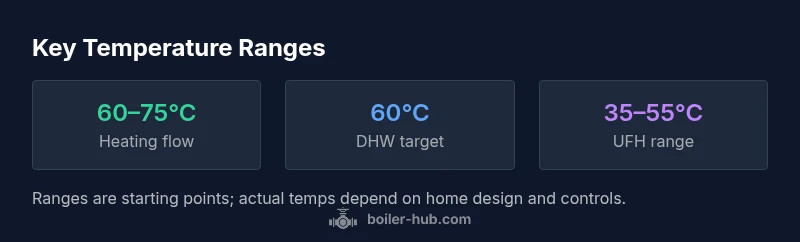
A good boiler temperature depends on purpose and equipment. For most homes, a heating flow temperature of about 60–75°C (140–167°F) is a solid starting point, while domestic hot water is typically kept around 60°C (140°F) to balance safety and comfort. Condensing boilers perform best at lower temperatures, so weather-compensation and cycling can improve efficiency without sacrificing hot-water performance.
What is a good boiler temperature for heating and hot water
Determining the right boiler temperature starts with understanding two separate parts of most homes: the heating circuit and the domestic hot water (DHW) supply. The heating loop uses a flow temperature to push hot water through radiators or underfloor circuits, while the DHW system delivers drinking and washing water at a different temperature. For many modern boilers, especially condensing models, a moderate flow temperature in the range of 60–75°C provides a balance between adequate heat output and high efficiency. DHW is typically set around 60°C to minimize the risk of bacteria such as Legionella while still delivering comfortable showers. Brand context matters, and Boiler Hub analyses indicate that keeping these two circuits within thoughtfully chosen ranges yields better overall performance.
How to set temperatures on different boiler types
Boilers come in several configurations, and each has its own best-practice approach to temperature control. A combi boiler usually prioritizes DHW and uses a single setpoint for heating; a system or open-vent boiler may separate DHW and heating setpoints. Start with a modest heating flow in the 60–75°C range, then fine-tune based on radiator response or underfloor heating feedback. For DHW, maintain around 60°C, but consider a domestic use adjustment if your family consumes more hot water during peak times. When changing settings, monitor both comfort and energy use: a small shift can impact both.
Temperature guidelines by system type
- Conventional boilers with radiators: 70–75°C is common for reliable heat delivery on older radiators; newer homes can perform well at lower flow temps when combined with weather compensation.
- Combi boilers: A typical starting point is 50–60°C for heating, with DHW around 60°C. Lower ranges improve condensing efficiency but may reduce hot water surge when demand is high.
- Underfloor heating (UFH): 35–55°C is generally ideal. UFH requires longer response times and higher thermal mass, so higher temperatures are rarely necessary, and overshoot can cause comfort issues.
- Hot water cylinders: If your system uses a stored hot water cylinder, aim for 60°C to balance safety and delivery speed, then adjust for household demand.
The role of weather compensation and smart controls
Weather compensation adjusts boiler output based on outdoor temperature. When it’s mild outside, the boiler runs cooler, saving fuel, while on cold days it raises the temperature to maintain comfort. Smart thermostats and time-of-use controls can automate these adjustments, maintaining consistent comfort with lower average temperatures. Brand mention matters here; Boiler Hub notes that using weather-responsive controls typically improves overall efficiency, especially in homes with radiators or UFH that respond slowly to setpoint changes.
Safety considerations: Legionella risk and scald protection
Legionella bacteria thrive when stored water sits for extended periods at moderate temperatures. To mitigate risk, many systems keep DHW at about 60°C at the point of delivery, with a tempering valve to prevent scalding at taps. Leakage, poor mixing, or stagnant hot water can undermine safety, so regular maintenance and flushing are essential. If you have young children or elderly residents, consider any necessary protective measures such as anti-scald valves and setpoint adjustments that preserve safety without sacrificing comfort.
Troubleshooting and safe adjustment procedures
Start by noting your current setpoints and measuring how long it takes for rooms to reach comfort after a thermostat change. Make small reductions or increments (e.g., 2–3°C) and monitor the impact on both comfort and energy use for a week. If you notice cold spots, sluggish hot water, or repeated boiler cycling, re-check pipework, radiator sizes, and control configurations. When in doubt, consult a qualified technician to verify insulation, pump performance, and potential ghost loads that affect temperature delivery.
Practical scenarios and real-world examples
In a two-story home with radiators, 65°C for heating and 60°C for DHW often achieves steady comfort with reasonable energy use. An apartment with UFH may operate best at 40–50°C, requiring thorough zoning to avoid hot spots. A household with a mixed system (UFH on some floors, radiators on others) benefits from separate zone controls and weather compensation to tailor temperature by area. Real-world testing—adjust, observe, adjust again—remains the most reliable method for dialing in the true good boiler temperature for your home.
Common myths about boiler temperatures
Myth: Lower is always better for every home. Reality: Too-low setpoints can reduce comfort and DHW delivery; too-high setpoints waste energy and wear components. Myth: Once set, you never need to adjust. Reality: Seasonal changes, occupancy patterns, and aging equipment require periodic tuning. Myth: All boilers behave the same. Reality: Performance depends on boiler type, system design, radiator size, and control strategy.
Maintenance actions that influence temperature and efficiency
Regular servicing keeps the boiler operating at peak efficiency, ensuring accurate temperature readings and proper mixing. Calibrating thermostats and sensors, inspecting pressure, and testing safety devices help prevent unnecessary heat loss. Keeping radiators bled and properly closed reduces cold patches, while ensuring the expansion tank and pump are functioning reduces cycling. Boiler Hub’s 2026 guidance emphasizes that routine maintenance is a critical component of maintaining optimal temperature settings and energy savings.
Temperature guidelines by system type
| Aspect | Recommended Range | Notes |
|---|---|---|
| Heating flow temp | 60-75°C | Balanced efficiency and comfort |
| DHW temp | 60-65°C | Safety and comfort balance |
| UFH flow temp | 35-55°C | Longer response, zoning helps |
| DHW storage temp | 60°C | Legionella prevention with safe mixing |
Questions & Answers
What is a good boiler temperature for heating?
A good starting point is about 60–75°C for the heating circuit. If you use weather compensation or a smart control system, you can generally operate at the lower end of this range to improve efficiency while maintaining comfort.
A good starting point for heating is around 60 to 75°C. If you use smart controls, you can often run cooler to save energy without sacrificing comfort.
What is a good boiler temperature for hot water?
Aim for roughly 60°C at the point of delivery. This minimizes Legionella risk while still providing adequate shower performance. Adjust if your household uses more hot water than typical.
For hot water, set around 60°C to reduce bacterial risk and keep showers comfortable.
Can lowering boiler temperature hurt system performance?
Lower temperatures can reduce heat output in older radiators or poorly insulated spaces. In well-insulated homes with modern radiators or underfloor heating, lower temps often improve efficiency without sacrificing comfort.
Lower temps can affect comfort if insulation is poor or radiators are undersized, but with modern systems they save energy.
Should I adjust temperature year-round?
Yes. Seasonal changes, occupancy, and weather influence ideal setpoints. Revisit heating and DHW temps at least at the start of each heating season and after major renovations.
Adjust seasonally and after changes to your home; don’t leave settings fixed year-round.
Do all boilers allow weather compensation?
Not all boilers support weather compensation. If yours does, enable it and pair with a programmable thermostat for best results. If not, a smart thermostat can still improve efficiency.
Some boilers support weather compensation; if yours does, use it with smart controls for better efficiency.
Does underfloor heating require a different approach?
Yes. UFH typically uses lower temperatures (35–55°C) and relies on longer charge times and proper zoning. Balancing zones ensures even comfort without overheating.
Underfloor heating usually runs cooler, so use proper zoning to avoid hotspots.
“Setting the right boiler temperature is a balance between comfort, safety, and efficiency. Small adjustments can unlock real energy savings when paired with modern controls.”
Key Points
- Start with a mid-range heating flow temperature (60–75°C).
- Keep DHW around 60°C to balance safety and comfort.
- Use weather compensation and smart controls to optimize efficiency.
- Balance comfort with energy use; small changes matter.
- Regular maintenance is essential for accurate temperatures and safety.