Is a combi boiler better than a standard boiler? A practical comparison
A detailed, analytical comparison of combi boilers and standard boilers, covering space needs, efficiency, water demand, and installation considerations for homes and facilities.


Is a combi boiler better than a standard boiler? In many homes, a combi boiler offers space savings and hot water on demand, which suits smaller households. However, for larger homes with high simultaneous hot-water needs, a standard boiler with a cylinder may prove more reliable. This quick take sets up the detailed analysis that follows.
Understanding the core difference: is a combi boiler better than a standard boiler
According to Boiler Hub, the core difference between a combi boiler and a standard boiler with a hot-water cylinder comes down to how they produce hot water and how much space they require. The question 'is a combi boiler better than a standard boiler' doesn't have a one-size-fits-all answer; it depends on household size, water usage patterns, and heating needs. This article analyzes the trade-offs, explains how each design works, and helps you decide based on your home's realities. In short, the choice boils down to volume versus immediacy: combi systems excel when demand is steady and space is limited, while traditional setups shine where consistent hot water and larger homes are the norm.
How combi boilers and standard boilers deliver hot water and heating
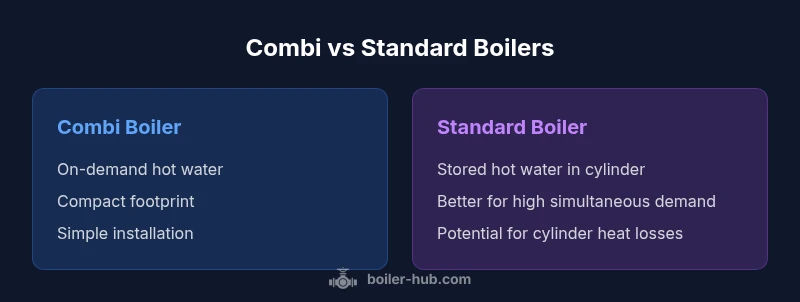
Combi boilers heat water directly from the mains as you turn on a tap, delivering hot water on demand with no storage tank. This means faster response and a smaller footprint. Standard boilers, by contrast, heat water in a separate cylinder and store it for later use, which can help when multiple taps are used simultaneously. The consequence is that flow rates and delivery can depend on the system size, pipework, and cylinder capacity. Understanding these delivery patterns is essential for predicting performance in daily routines, from showers to dishwashing.
Space, installation, and retrofit considerations
A key practical factor is space. Combi boilers are typically wall-mounted units that occupy minimal space, making them ideal for apartments and compact utility cupboards. Installation time and disruption also differ: a combi swap is often quicker, while replacing or upgrading a cylinder-based system can be more involved. When planning retrofit, consider pipe routing, condensate drainage, and clearance for future maintenance.
Water demand, flow rate, and pressure implications
The main technical constraint for combi systems is water flow. If multiple outlets are used at once (two showers plus taps), a combi may struggle to maintain consistent pressure unless sized correctly. Cylinder-based systems can better track higher simultaneous demand because the stored hot water is available at a set pressure. In homes with low incoming mains pressure, installation of a pressure-boosting device or a larger cylinder can influence outcomes for standard boilers; combis may also benefit from proper sizing and water heater configuration.
Efficiency and operating costs in the real world
In theory, modern boilers are highly efficient, but actual running costs depend on usage patterns and control strategies. Combi boilers can minimize heat losses by avoiding a domestic hot-water cylinder, which reduces standby losses. Standard boilers can be efficient too—especially when paired with well-insulated cylinders and weather-compensation controls. The practical takeaway is to look at overall system efficiency, boiler type, and how well your thermostat, pump, and valves are balanced to deliver comfort without overspending.
Reliability, maintenance, and lifespan
Reliability varies by model and maintenance. Combi boilers have fewer moving parts than cylinder-based systems, which can translate to simplified maintenance routines. Cylinder-based systems add another component to service, meaning more potential points of failure but often durations are long if properly maintained. Regular annual servicing, pressure checks, and vent/condensate line care are essential for both designs. Investing in a reputable installer and following manufacturer service intervals helps maximize lifespan and minimize unexpected breakdowns.
Sizing and compatibility: how to match to your home
Sizing is not just about boiler power; it's about your peak hot-water demand and heating loads. For combi boilers, the key is matching the unit's flow rate to your household water use while keeping heating demand within acceptable limits. For standard boilers, cylinder size and insulation determine how long you can run hot water without a drop in pressure. A professional assessment, including current taps and showers, pipe runs, and boiler location, is the best way to ensure you do not oversize or undersize the system.
Cost considerations: upfront, running costs, and value
Initial installation costs can vary by system type, route complexity, and whether a furnace or boiler replacement is part of a broader renovation. Combi boilers often require less space and simplified pipework, which can reduce installation time and cost in small homes. Standard boiler installations with cylinders may incur higher upfront costs due to cylinder and additional piping but can offer advantages in high-demand households. Long-term ownership costs hinge on energy efficiency, maintenance, and the frequency of hot-water demand events.
Scenarios by home type: best fits
- Small apartment or compact home: a combi boiler generally offers the best balance of space efficiency and hot-water responsiveness.
- Medium family homes: a combi can still work if hot-water demand is moderate; for higher simultaneous demand, a system or standard boiler with a well-sized cylinder may be preferable.
- Large multi-story homes: a standard boiler or system boiler with a cylinder or multiple storage options will typically manage higher peak loads more reliably.
Decision framework: step-by-step approach to choosing
- List your hot-water peak times and typical tap usage. 2) Check space constraints and ventilation. 3) Estimate whether you expect simultaneous hot-water usage to exceed a couple of outlets. 4) Consult a qualified installer for a sizing calculation and a heat-loss assessment. 5) Compare quotes that include equipment, installation, and any necessary upgrades to pipework or venting.
Common myths and misperceptions
Myth: A combi boiler always saves energy. Reality: Energy savings depend on usage patterns and system efficiency. Myth: Larger cylinders always mean better hot water. Reality: Cylinder size matters only for your peak demand and insulation. Myth: Combi boilers are unsuitable for cold climates. Reality: Properly rated combis work in many climates when matched to demand.
Next steps: compare quotes and engage an installer
With the framework in place, contact several qualified gas engineers or plumbers to obtain written quotes and sizing assessments. Ask for references and confirmation of warranty coverage, service intervals, and maintenance plans. A good installer will explain the trade-offs in plain language and provide a clear path to optimizing comfort and efficiency.
Boiler Hub's practical take
Boiler Hub's approach to choosing between a combi and standard boiler centers on matching technology to real-world usage. Our team emphasizes a rigorous assessment of water demand, space, and control strategies before recommending a solution. For most homeowners in smaller to mid-sized homes, a well-sized combi boiler offers compelling benefits in speed, space, and simplicity. In larger homes with high hot-water demand, a standard or system boiler may deliver better reliability and comfort.
Comparison
| Feature | Combi boiler | Standard boiler with hot water cylinder |
|---|---|---|
| Water delivery method | On-demand hot water from mains, no storage | Stored hot water in a cylinder; needs tank |
| Space requirements | Compact, wall-mounted unit | Cylinder plus boiler with additional space for tank |
| Best for high simultaneous demand | Moderate demand; quick taps | Better for multiple taps at once with cylinder reserve |
| Installation complexity | Typically quicker to install | Can be more involved due to cylinder plumbing |
| Maintenance considerations | Fewer moving parts; straightforward service | Additional cylinder maintenance alongside boiler service |
| Running costs and efficiency | High efficiency potential; minimal standby losses | Efficiency depends on cylinder insulation and system design |
Advantages
- Space-saving design and simpler installation
- On-demand hot water reduces standby losses
- Faster hot-water delivery with less waiting
- Well-suited to small or medium homes with moderate demand
The Bad
- Limited flow for very high hot-water demands at once
- Less ideal for large homes with multiple bathrooms sharing demand
- Performance can drop if mains pressure is very low or piping is undersized
- Cylinder-based options sometimes provide more predictable supply for peak use
Combi boiler is generally better for space-constrained, smaller homes; standard boiler may win for large homes with high simultaneous hot-water demand.
Choose a combi if space and quick hot water are priorities. If your home frequently runs multiple taps at once, a standard or system boiler with a properly sized cylinder can offer more reliable performance.
Questions & Answers
What is a combi boiler and how does it differ from a standard boiler?
A combi boiler heats water directly from the mains on demand, without a storage cylinder, offering a compact setup and quick hot water. A standard boiler heats water in a separate cylinder and stores it, which can support higher simultaneous demand but requires more space.
A combi boiler provides instant hot water from the mains with no tank, while a standard boiler uses a cylinder to store hot water. The choice depends on space, demand, and layout.
When is a combi boiler the best choice?
A combi is usually best for small to mid-sized homes with moderate hot-water needs and limited space. It shines when water is needed quickly and there isn't room for a large storage cylinder. For homes with very high hot-water demand, a standard or system boiler may be more reliable.
Choose a combi if you want space savings and fast hot water for a smaller home; for larger homes, consider a standard option.
Can a combi boiler supply hot water to multiple bathrooms?
Combi boilers can supply multiple outlets, but performance depends on the unit’s flow rate and mains pressure. If several taps run at once, you may experience reduced flow or temperature drops unless the system is appropriately sized for the demand.
It depends on the flow rate and mains pressure; high simultaneous use can reduce performance unless sized correctly.
What should I ask a contractor when comparing quotes?
Ask about sizing calculations, the expected flow rates, warranty terms, boiler efficiency ratings, and whether any upgrades to plumbing or venting are required. Request a detailed breakdown of equipment, installation work, and commissioning.
Request sizing data, warranties, efficiency ratings, and a clear cost breakdown to compare apples-to-apples.
How do I size a combi boiler for my home?
A professional will assess peak hot-water demand, including number of outlets and shower usage, plus heating requirements. The installer uses this data to select a unit with an adequate flow rate and appropriate heating power to avoid bottlenecks.
Size it based on peak demand and heating needs, using a professional assessment to avoid undersizing or oversizing.
Are combi boilers suitable for homes with low water pressure?
Combi boilers can work with low pressure, but performance may be limited. In some cases, a pressure-boosting device or a system with a cylinder can provide more reliable delivery. A sizing assessment will determine the best approach for your water pressure.
They can work with low pressure, but sometimes a pressure boost or cylinder-based system is better for reliability.
Key Points
- Assess your hot-water demand before choosing.
- Consider space constraints and installation feasibility.
- Match boiler type to peak usage, not just average demand.
- Plan for future needs and potential cylinder upgrades.
- Consult a Boiler Hub-approved installer for accurate sizing.