Difference Between a Boiler and a Combi Boiler: A Practical Comparison
Learn the key differences between a boiler and a combi boiler, how each heats water, space needs and running costs. This guide helps homeowners and facility managers decide which boiler type suits their home, with sizing, installation, and maintenance considerations.


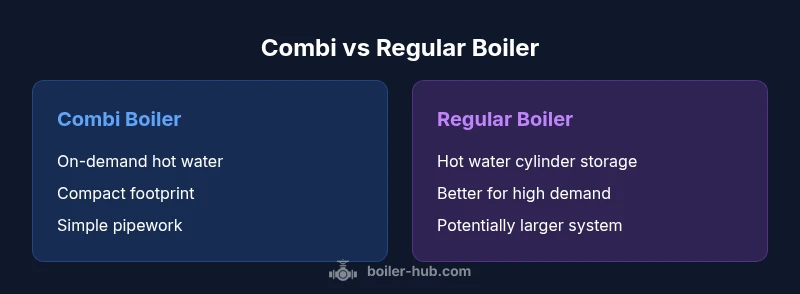
At a glance, the difference between a boiler and a combi boiler is in how they heat and deliver hot water. A combi boiler provides on-demand hot water directly from the mains without a storage tank, while a traditional boiler heats water stored in a cylinder. The choice depends on home size, water demand, and installation constraints.
What is a boiler and what is a combi boiler?
A boiler is a central heating appliance that heats water and provides warmth to radiators. A combi boiler, short for combination boiler, is a compact unit that heats water on demand directly from the mains, eliminating the need for a separate hot water cylinder. According to Boiler Hub, the main distinction lies in how water is heated, stored, and distributed throughout the home. In practice, homeowners encounter two broad families: on-demand systems (combi) and stored-water systems (regular/standard or system boilers). Both achieve the same end—comfortable indoor temperatures—but the path to that comfort differs in design, installation, and usage patterns. Understanding these differences is essential before choosing or upgrading a boiler.
How the hot water and heating circuits differ
In a combi boiler, there is no separate cylinder; water is heated on-demand as you open a tap, and the same heat exchanger serves both heating and domestic hot water. In contrast, a standard boiler works with a separate hot water cylinder (and often a storage tank) that stores heated water for instant draw-off. System boilers fall between these two, using a cylinder but not requiring a feed-and-expansion tank. The distribution network, the size of the water cylinder, and the heating demand shape performance and fuel efficiency. The primary takeaway is that combi boilers minimize space requirements and heat water when needed, whereas regular boilers prioritize high-volume hot water and reliable delivery during peak demand.
Space, installation, and piping considerations
Space matters with boilers. Combi boilers are typically compact and mount on a wall, making them ideal for apartments or homes with limited space. Regular (or traditional) boilers require room for the boiler itself plus a separate hot water cylinder, which can demand a cupboard or dedicated cabinet. System boilers sit between these, using a cylinder but often with simpler venting than a full traditional system. Installation considerations include venting requirements, flow and pressure expectations, and how the unit will be integrated with existing radiators and piping. For homeowners, the layout of the utility space and the position of bathrooms influence whether a combi or a cylinder-based system will be smoother to install and maintain.
Sizing, flow rates, and performance expectations
Sizing a boiler involves matching heat output to your home’s needs and ensuring adequate hot water delivery. Combi boilers excel when demand is moderate and space is tight because they heat water instantly at the tap. Regular boilers with a cylinder can provide higher total hot water capacity, which is advantageous if multiple taps or showers operate simultaneously. Factors such as the number of bathrooms, radiator size, insulation quality, and peak usage times determine whether you should favor a combi or a regular boiler. Performance hinges on input rating, pipe sizing, and, crucially, mains water pressure, which dictates how quickly hot water can reach the tap.
Energy efficiency and running costs
Modern boilers are designed to be highly efficient, with condensing technology that recovers heat from exhaust gases. The overall efficiency depends on the boiler model, its installation, and how it’s used in the home. Combi boilers can minimize standby heat loss by avoiding storage tanks, but effectiveness depends on consistent water pressure and demand patterns. Cylinder-based systems may incur heat losses from stored water, especially if not well insulated. In practice, a properly sized, well-installed boiler of either type can deliver comparable annual running costs, but real-world savings hinge on usage habits, system design, and maintenance. Boiler Hub's analysis highlights that the best choice often aligns with home size, water demand, and existing plumbing.
Real-world scenarios: small home vs large home
For a small apartment with a single bathroom, a combi boiler frequently delivers the simplest solution: space-saving, quick hot water on demand, and straightforward installation. In larger homes with multiple bathrooms and high simultaneous hot water demand, a regular boiler (with a cylinder) or a system boiler may be a better fit, because it can sustain robust hot water delivery across several outlets. In retrofit projects, the existing pipework, water pressure, and the ability to service the cylinder influence the decision as much as the desired comfort level. Each scenario underscores that there is no one-size-fits-all answer; sizing and placement matter as much as the boiler type itself.
Maintenance, reliability, and lifecycle costs
Maintenance requirements vary by model and configuration, but both combi and regular boilers demand regular servicing to maintain efficiency and safety. Combi boilers have fewer moving parts and less bulky equipment, which can simplify maintenance. Cylinder-based systems with a hot water tank include more components (cylinder, expansion vessels, feed tanks) that require inspection. Lifespan and reliability depend on build quality, installation quality, and water quality; regular servicing helps identify issues like lime scale buildup, circulating pump wear, or expansion-tank problems before they cause outages. Boiler Hub emphasizes that proper sizing and professional installation are as important as the boiler type itself.
Market insights: adoption trends and what Boiler Hub analysis shows
Market trends show varied adoption depending on region, house size, and homeowner priorities. In urban, space-constrained homes, combi boilers are popular for their compact footprint and on-demand water. In family homes with higher hot water usage, regular or system boilers can offer more robust performance. Boiler Hub’s analysis (2026) indicates that choosing between these types should be guided by water pressure, household size, insulation quality, and future plans for expansion. The key takeaway is to tailor the choice to usage patterns rather than relying on a single rule of thumb.
Practical next steps: how to decide and plan
- Map your household demand: number of bathrooms, simultaneous showers, and peak evening usage. 2) Measure or estimate your mains water pressure; this affects flow and comfort with a combi. 3) Assess space constraints and venting needs. 4) Consult a qualified heating engineer to perform a heat-loss calculation and provide sizing guidance. 5) After sizing, compare installation costs, maintenance expectations, and warranty terms. With these steps, you can choose a boiler type that aligns with both your comfort needs and budget.
Final thoughts: why the right match matters
The choice between a boiler and a combi boiler is less about one being universally better and more about fitting the system to your home’s layout, water pressure, and usage patterns. A correctly sized and installed unit delivers reliable heat and hot water while minimizing energy waste. As Boiler Hub emphasizes, the goal is reliable performance, not just the latest technology.
Quick-reference checklist for homeowners
- Do you have space for a hot water cylinder? If yes, a regular boiler could be suitable.
- Is your water pressure high and do you need hot water instantly at multiple taps? A combi boiler can work well in this scenario.
- Will your home require high water demand simultaneously? Consider a cylinder-based system for more capacity.
- Has a professional sizing analysis been performed? If not, hire a pro to do a load calculation before purchasing.
Comparison
| Feature | combi boiler | regular/standard boiler |
|---|---|---|
| Hot water production | On-demand, from mains, no cylinder | Stored hot water in a cylinder (hot water tank) |
| Space requirements | Compact, wall-mounted commonly | Requires space for boiler plus cylinder |
| Water pressure and flow | Typically strong flow at mains pressure | Flow can be reduced by cylinder size and system design |
| Installation and maintenance | Often simpler in small homes; fewer components | More complex due to cylinder, venting, and controls |
| Best for | Small to mid-sized homes with moderate hot water needs | Larger homes with high simultaneous hot water demand |
Advantages
- Compact footprint ideal for limited spaces
- On-demand hot water reduces standby heat losses
- Faster installation in small homes
- Lower plumbing complexity in new builds
The Bad
- Limited hot water when multiple taps are used simultaneously
- Less suitable for very large homes with high simultaneous demand
- Dependence on mains pressure; low pressure reduces performance
- Potentially higher replacement cost if upgrading components
Combi boilers are generally the better fit for small to medium homes; regular boilers suit larger homes with high demand.
Choose a combi boiler for compact spaces and on-demand hot water. Opt for a regular boiler if your home has many bathrooms or high peak demand; ensure proper sizing and professional installation to maximize efficiency.
Questions & Answers
What is the main difference between a boiler and a combi boiler?
The main difference is in water delivery: a combi boiler heats water on demand with no storage tank, while a standard boiler heats water that is stored in a hot water cylinder. This affects space requirements, response times, and suitability for multiple bathrooms.
A combi heats water on demand without a storage tank, while a standard boiler uses a hot water cylinder. This changes space needs and whether you can run several taps at once.
Which boiler type is better for a small apartment?
In small apartments, a combi boiler is usually the best option because it is compact and delivers hot water on demand without needing a storage tank. It simplifies installation and leaves more usable space.
For a small apartment, a combi boiler is typically best because it's compact and provides on-demand hot water without a tank.
Can a combi boiler supply hot water to two showers at once?
A combi boiler can supply hot water to two showers at once, depending on the unit’s flow rate and your mains pressure. If demand is very high, you may notice a reduced flow or temperature drop.
It can, but it depends on the boiler’s flow rate and your water pressure. High simultaneous demand can reduce flow.
Do combi boilers require a cold-water storage tank?
No, combi boilers do not require a separate cold-water storage tank. They take water directly from the mains and heat it on demand.
No separate cold-water tank is needed with a combi boiler; it heats directly from the mains.
How do I size a boiler for my home?
Sizing depends on the number of bathrooms, radiator count, insulation, and peak usage. A professional heat-loss calculation is recommended to choose the right boiler output and cylinder size (if applicable).
Size is based on your home's heat requirements and hot water demand; have a professional calculate it.
Are combi boilers more energy-efficient than regular boilers?
Efficiency depends on the model and usage. Modern condensing boilers are efficient, but actual energy savings hinge on sizing, demand, and how well the system is installed and maintained.
Energy efficiency varies by model and use; modern boilers are efficient, but proper sizing and maintenance matter most.
Key Points
- Assess home size and hot water demand first
- Choose combi for compact spaces; regular for high demand
- Check mains water pressure before deciding
- Get a heat-loss calculation from a pro
- Maintenance and sizing are as important as the boiler type