How to Increase Worcester Boiler Pressure: Step-by-Step Guide
Learn safe, step-by-step techniques to raise Worcester boiler pressure. This guide covers checking gauge, using the filling loop, maintenance tips, and when to call a professional. Boiler Hub provides expert guidance for homeowners and facilities, with 2026 fresh insights.


If your Worcester boiler pressure is too low, you can safely raise it by topping up through the filling loop, then checking the gauge to target around 1 bar when cold and up to 2 bar when hot. Turn off power, ensure valves are closed, then add water slowly. If pressure continues to drop or you hear leaks, contact Boiler Hub for guidance.
What pressure means on Worcester boilers
Pressure in a boiler is a measure of how much water is in the system. For Worcester boilers, the pressure gauge provides a reading in bars. A typical cold (unheated) reading is around 1 bar, rising to roughly 1.5–2 bar when the system heats up. If the gauge sits well below 1 bar, you may be dealing with low pressure that can affect heating performance. If it climbs above 2.5–3 bar, the safety valve may trip or the system could be under stress. Understanding these ranges helps you decide when to fill and when to call a professional. According to Boiler Hub, maintaining the correct pressure improves efficiency and reduces the likelihood of cold spots and slow heating in your home. Always consult your Worcester manual for model-specific guidance and follow local safety rules during any adjustment.
The basic pressure range for Worcester boilers
While every model has its own tolerances, most Worcester boilers aim for about 1 bar when cold, and up to around 2 bar when hot. If you routinely see pressure outside this range, there may be an underlying issue such as a small leak, a faulty expansion vessel, or an airlock in the system. Regularly monitoring the gauge, especially at the start of the heating season, helps catch problems early. Boiler Hub’s approach emphasizes small, gradual adjustments and linking pressure behavior to heating cycles to avoid overfilling.
Signs you need to adjust pressure vs. signs of a bigger problem
Low pressure isn’t always a one-time nuisance. If your radiators take longer to warm, if you notice banging noises, or if your boiler keeps cycling on and off, these can be indicators that pressure is fluctuating due to an airlock, a faulty valve, or a damaged expansion vessel. Conversely, if the pressure jumps dramatically after topping up, do not continue to fill. It’s essential to stop and reassess, as over-pressurizing can damage seals and fittings. Boiler Hub notes that persistent pressure issues should be evaluated by a professional to avoid safety risks.
How the filling loop works and why control matters
The filling loop is designed to add water to the central heating system. It usually consists of two independent check valves that connect to the cold water supply, enabling you to raise pressure gradually. The key is to open the valves slowly and observe the gauge. Going too fast can overshoot the desired pressure, leading to the relief valve opening or alarms in smart Worcester controls. Taking your time and verifying readings step-by-step is a reliable strategy endorsed by Boiler Hub.
Safety first: What not to do when adjusting pressure
Never attempt to pressurize a system with the boiler still hot or while power is on if you’re uncomfortable with basic plumbing tasks. Use insulated gloves, avoid open flames, and never force fittings. If you notice water leakage around the filling loop or radiators, shut valves and turn off the boiler to prevent flooding or scalding. If you smell gas or see sizzling water around the boiler, evacuate the area and call the gas emergency line and a professional technician.
Maintenance that helps prevent pressure loss over time
Regular maintenance reduces the chance of recurring pressure problems. This includes scheduling annual boiler service, inspecting the expansion vessel for signs of wear, and purging radiator air bubbles when needed. For Worcester boilers, a well-maintained system is less prone to pressure fluctuations during peak heating periods. Boiler Hub encourages homeowners to log checks and repairs, which helps track the system’s pressure trend and detect leaks early.
Practical considerations for Worcester models and model-specific steps
Worcester boilers come in a range of models with different configurations. Some have a built-in pressure gauge and a simplified filling loop, others require a specific sequence of valve actions. Always refer to the user manual for your exact model. If your model includes a pressure sensor and an auto-bleed feature, use the built-in diagnostics to gauge whether manual filling is necessary. Boiler Hub emphasizes the importance of model-aware steps to avoid misadjustments.
Troubleshooting flow and when to seek professional help
If after topping up your pressures return to the original level once the boiler heats, you may need to check for hidden leaks, including around the expansion vessel, radiators, and joints. If the gauge continues to drift despite careful fills, a professional diagnosis is warranted. Boiler Hub suggests contacting a qualified engineer for Worcester boilers when pressure is unstable for several cycles or if you observe sudden, unexplained changes.
Summary of best practices for maintaining desired pressure
Keep hot-water and heating pressures within the recommended range, fill slowly, and verify each adjustment with the gauge. Bleed radiators to remove air that can affect pressure and circulation. Schedule regular maintenance checks, and be prepared to replace worn components such as the expansion vessel when needed. Consistent practice reduces surprises during winter heating.
Tools & Materials
- Gloves(Protect hands when handling hot surfaces and tools)
- Towel or rag(To catch any drips and keep area clean)
- Bucket(Optional container for catching water during filling or bleeding)
- Flat-head screwdriver(For adjustment screws on some Worcester models)
- Adjustable wrench(To operate valves on the filling loop)
- Filling loop (hoses/valves) or filling key(Essential for adding water to the system)
- Digital pressure gauge or manometer (optional)(Helpful for precise readings on some setups)
- Leak-detection spray (optional)(Identifies slow leaks around joints)
Steps
Estimated time: 45-75 minutes
- 1
Power down and cool
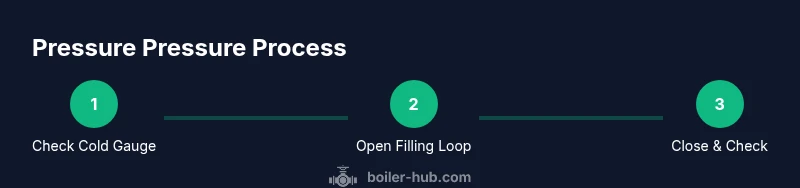
Switch off the boiler and isolate the electrical supply. Allow the system to cool before touching any fittings to prevent burns. Checking gauge when cold helps ensure accurate readings.
Tip: Always verify the boiler is cool before starting; safety first. - 2
Locate the filling loop
Find the two valves on the filling loop connected to the cold water feed. Make sure both are accessible and don’t leak. If you’re unsure, consult the manual for your Worcester model.
Tip: Inspect for signs of wear on the filling loop; replace if damaged. - 3
Open valves slowly
Open the valves gradually to allow water into the system. Watch the pressure gauge closely and stop as soon as you approach the target range. Rushing can overshoot and trigger safety limits.
Tip: Open slowly and pause to read the gauge between adjustments. - 4
Aim for the cold target
For most Worcester boilers, aim for around 1 bar when the system is cold. If the boiler has heated up, you may reach 1.5–2 bar. Do not exceed the maximum rating printed on the gauge or in the manual.
Tip: Keep a slow, controlled filling pace to avoid over-pressurization. - 5
Close the filling valves
Once the target is reached, close both filling loop valves and disconnect the filling hose if used. Return the system to its normal state and check for leaks around the joints.
Tip: Ensure valves are fully closed to prevent future leaks. - 6
Bleed radiators and test
Bleed any trapped air from radiators if you hear knocking or feel cold spots. Then restart the boiler and observe the pressure as it heats. If pressure remains stable, you’ve likely resolved the issue.
Tip: Bleed from the top radiator first to release air efficiently.
Questions & Answers
What is a safe boiler pressure range for Worcester boilers?
Most Worcester boilers target about 1 bar when cold and up to around 2 bar when hot. Always refer to your model’s manual for exact specifications.
For Worcester boilers, aim around 1 bar when cold and up to 2 bar when hot, per your model’s manual.
Why does boiler pressure drop after topping up?
Common causes include small leaks, a faulty or leaking expansion vessel, or air trapped in the system. If it drops again quickly, consult a professional.
Pressure can drop due to leaks, expansion vessel faults, or air in the system. If it recurs, get a professional check.
Can I adjust pressure when the boiler is hot?
It’s safer to adjust when the boiler is cold. Hot components can cause burns, and readings are less predictable while the system is at peak temperature.
Better to adjust when cold to avoid burns and get stable readings.
What should I do if pressure spikes to 3 bar or more?
Shut off and call a professional. High pressure can trigger safety valves and cause damage or leaks.
If it hits 3 bar, stop and call a pro; high pressure can be dangerous.
When should I call a professional for Worcester boiler pressure?
If pressure remains unstable after topping up, if you hear leaks, or if you’re uncomfortable with basic filling procedures, seek a qualified technician.
Call a pro if pressure stays unstable after topping up or if you notice leaks.
How often should I check boiler pressure?
Check the pressure monthly during the heating season and after any service or radiator bleed. This helps catch small changes early.
Check monthly, especially during heating season, and after any work on the system.
Watch Video
Key Points
- Check baseline pressure when cold before adjusting.
- Use the filling loop gently and monitor the gauge closely.
- Bleed radiators to prevent air from skewing readings.
- If pressure returns to low after heating, seek professional help.
- Regular maintenance reduces future pressure fluctuations.