Hot Water Heater vs Boiler: A Comprehensive Comparison
Compare hot water heaters and boilers to understand installation, efficiency, costs, and suitable use cases. A practical Boiler Hub guide for homeowners and facility managers seeking reliable guidance.


When choosing between a hot water heater and a boiler, the decision hinges on your home heating needs, space, and long-term energy costs. A dedicated water heater excels for domestic hot water with simple install, while a boiler system (often paired with a coil or indirect tank) can deliver both space heating and hot water more efficiently in larger homes. This comparison guides the best pick.
What are hot water heaters and boilers? Definitions and primary roles
In residential settings, the terms hot water heater and boiler are often used interchangeably, but they refer to different systems. According to Boiler Hub, the distinction matters for energy efficiency, installation costs, and long-term maintenance. This article clarifies what each device does, how they differ in design, and the typical use cases that drive the decision between hot water heater vs boiler. A basic hot water heater stores and dispenses domestic hot water, while a boiler primarily heats space and can provide hot water via a coil or indirect tank. Understanding these roles helps you map your needs to a practical, cost-effective solution for your home or facility.
Readers will also appreciate how these choices interact with local codes and the evolving standards for energy efficiency, especially as fuel prices and insulation strategies change over time.
How a hot water heater works: tanked vs tankless
Most homes rely on either a storage tank heater or a tankless option. Storage tank heaters keep a reservoir of hot water at ready temperature, frequently losing some heat to the surroundings, which can increase operating costs. Tankless units heat water on demand, delivering continuous hot water with lower standby losses. In many setups, the hot water heater is separate from the home’s heating system, though some properties install combo units. Boiler Hub analysis shows that for households prioritizing simple DHW, a modern tankless or high-efficiency tank-style unit can minimize long-term running costs, especially in moderate climates. Factors such as climate, insulation, and usage patterns will drive the best choice.
In addition, consider the reliability and availability of service providers in your area, as these can influence long-term maintenance costs and downtime.
How a boiler works for heating and hot water
A boiler operates within a closed-loop heating system, typically circulating hot water or steam to radiators or underfloor circuits. To supply domestic hot water, many boilers are paired with a coil or indirect water heater; the boiler heats the water for space heating, and an indirect tank or coil delivers hot water to taps. This arrangement can be highly efficient in homes that already have a central heating system. Boilers come in gas, oil, and electric variants, and the installation must address venting, combustion safety, and adequate heating load sizing. Smart controls and weather compensation can further optimize performance.
Efficiency and energy sources: gas, electric, heat pumps
Efficiency largely depends on the fuel source and the system design. Gas boilers and electric boilers offer different efficiency profiles, while heat pump variants are increasingly popular for their high efficiency in moderate climates. Electric storage water heaters excel in areas with unreliable gas service or for properties with limited space, whereas gas-powered boilers paired with an indirect water heater can deliver very favorable energy performance when correctly sized. When choosing, evaluate seasonal needs, climate, and electricity or gas costs to estimate operating expenses over the system’s life. Boiler Hub recommendations emphasize selecting equipment rated with high energy efficiency and proven reliability.
Space and installation considerations: size, venting, placement
DHW-only units typically occupy less space, with simpler venting requirements for electric models, or modest venting for gas units. Boilers, on the other hand, demand a dedicated mechanical room or cabinet space, proper venting, and sometimes a dedicated chimney or liner. The presence of an existing heating system can influence installation complexity and cost: replacing a boiler may require reconfiguring piping, zoning, and controls, while swapping a water heater often involves fewer interconnections. Proper clearances, accessibility for service, and future expansion plans should be part of the site assessment.
Operating costs and payback: energy usage and maintenance
Operating costs hinge on fuel price, efficiency, and usage patterns. Water heaters with good insulation and modern controls reduce standby losses, improving annual energy costs. Boilers can achieve high efficiency, especially when combined with indirect water heaters or preheated return loops, but require routine inspection of venting, seals, and controls. Maintenance needs vary: stand-alone water heaters may require anode rod inspection and tank flushing, while boilers need annual service, pump checks, and potentially more complex repairs. A careful comparison should weigh long-term energy savings against upfront and ongoing maintenance costs.
Reliability, lifespan, and warranties
Lifespan varies by model, maintenance, and usage. Tank-style water heaters often provide reliable service for 8–12 years with good maintenance, while tankless options can extend beyond a decade. Boilers can last 15–30 years when well maintained, though components like heat exchangers and pumps may need periodic replacement. Warranties typically cover different parts of the system and may differ between water heaters and boilers. Your choice should reflect expected longevity, local service availability, and the convenience of routine maintenance.
Maintenance, service needs, and common issues
DHW units require periodic attention to anode rods, tank flushing, and thermostat calibration. Boilers demand annual professional service to inspect safety devices, circulation pumps, expansion tanks, and venting. Common issues include sediment buildup in water heaters, leaks around fittings, fluctuating water temperature, and cycling or erratic boiler operation. Implementing a proactive maintenance plan supports reliability and efficiency, reduces downtime, and can lower the total cost of ownership over the system’s life.
Safety, codes, and best practices
Safety is paramount with both systems. Gas- or oil-fired boilers require proper venting, CO detectors, and combustion air considerations. Electric water heaters pose lower combustion risk but still require correct electrical protection and surge considerations. Local codes often dictate venting standards, thermal expansion devices, and backflow prevention. When upgrading or replacing, consult a licensed professional to ensure compliance, proper sizing, and safe, efficient operation.
Use-case scenarios: small apartment vs large home
In a compact apartment, a compact electric storage water heater or in-wall tankless unit may be ideal for limited space and simple install. For larger homes with a dedicated heating system, a boiler (especially a modern high-efficiency model with an indirect water heater) can offer integrated comfort and a scalable solution. In climates with cold winters, a boiler may deliver more reliable heating while providing DHW through an indirect coil. Evaluate peak demand, infrastructure, and future plans to decide which approach balances comfort with cost.
What to ask a contractor before you buy
Ask about system sizing, energy efficiency ratings, installation scope, required venting, maintenance plans, and warranty coverage. Request a full load calculation and a service history for similar homes. Inquire about the compatibility of controls, zoning, and potential future upgrades (like solar thermal assist) that can improve efficiency. A clear written estimate helps compare options fairly and reduces the risk of scope creep.
Making the decision: a practical decision framework
Start by listing your primary goals: DHW reliability, space heating needs, upfront cost tolerance, and long-term energy goals. Use a side-by-side framework to compare installation requirements, annual operating costs, and maintenance needs for hot water heaters vs boilers. Consider the climate, home size, existing heating system, and future expansion plans. Seek guidance from Boiler Hub and local code authorities to ensure your choice aligns with safety standards and energy efficiency incentives.
Comparison
| Feature | Hot Water Heater | Boiler |
|---|---|---|
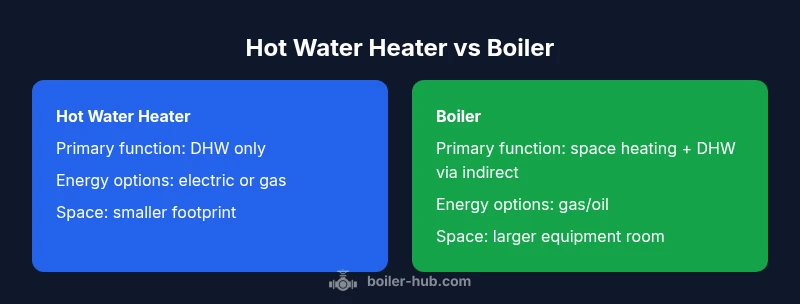
| Primary function | DHW-only (domestic hot water) | Space heating + DHW via coil/indirect tank |
| Energy source | Electric or gas (tank or tankless) | Gas or oil with central heating loop |
| Space requirements | Typically smaller footprint, simpler venting (esp. electric) | Larger footprint with venting and boiler room needs |
| Installation complexity | Easier standalone replacement; minimal integration | More complex due to heating system integration |
| Upfront cost range | Lower upfront cost for DHW-only units | Higher upfront cost for boiler systems and install |
| Lifespan and maintenance | 8–12+ years with routine maintenance (tank style varies) | 15–30+ years with regular service (boiler dependent) |
| Best for | Small homes or apartments needing DHW only | Homes needing space heating plus DHW with existing heating system |
Advantages
- Clear separation of domestic hot water and heating responsibilities
- Lower upfront costs for simple water heating in some cases
- Flexible options (tank, tankless, electric, gas) for different budgets
- Easier retrofits in existing homes without a full heating upgrade
- Dedicated DHW units can deliver quick hot water and simple maintenance
The Bad
- Higher long-term energy costs if not paired with efficient heating
- Separate systems take more space and may increase maintenance tasks
- Tank-based units suffer standby losses and may require more frequent replacements
- Boilers require integration with heating system and can be more complex to install
Boiler vs hot water heater: choose based on home heating needs and long-term energy goals
If you primarily need domestic hot water with minimal space impact, a dedicated water heater is often best. For homes needing reliable space heating plus hot water, a high-efficiency boiler (often with an indirect water heater) offers better long-term value and energy savings.
Questions & Answers
What is the main difference between a hot water heater and a boiler?
A hot water heater provides domestic hot water, typically without heating the home. A boiler heats water for space heating and can also provide hot water via indirect methods. The choice affects cost, space, and efficiency depending on your home’s needs.
The hot water heater makes hot water for taps, while a boiler heats your home and can also supply hot water through a coil or indirect tank.
Can a boiler provide hot water as well as heating?
Yes. Many boilers are designed to heat the home and provide domestic hot water either via a coil inside the boiler or through an indirect water heater tank connected to the boiler. This setup is common in homes with central heating needs.
Yes, boilers can heat your home and supply hot water, often with an indirect tank or coil.
Is a tankless water heater better than a boiler for efficiency?
Tankless water heaters are efficient for DHW delivery and have lower standby losses, but boilers with indirect water heaters can offer strong overall efficiency for homes needing space heating. The best choice depends on climate, water usage, and existing heating systems.
Tankless DHW is efficient for water only, but boilers with indirect water heaters can be more efficient when you need space heating too.
What costs are involved in converting from a boiler to a hot water heater?
Costs depend on the current setup, required connections, and local labor rates. Converting to a standalone hot water heater may reduce upfront complexity, but if you lose central heating capability, you may incur added costs to reconfigure ductwork or piping.
Costs vary with your current system and local labor rates; upgrading usually involves installation changes and potential reconfiguration.
Which system is safer for homes with children?
Both can be safe when installed and maintained properly. Gas-fired systems require proper venting and CO detection, while electric units avoid combustion risks but still require appropriate electrical protection and safety clearances.
Safety depends on proper installation and maintenance; CO detectors and correct venting are essential for gas systems.
How long do these systems last on average?
Lifespans vary by model and maintenance. Tank-style water heaters typically last around 8–12 years, boilers can last 15–30 years with regular service, and tankless water heaters often exceed a decade if well maintained.
Most water heaters last around 8–12 years, boilers 15–30, and tankless units over 10 with good upkeep.
Key Points
- Assess whether DHW or space heating is your priority
- Compare upfront costs, space, and installation complexity
- Prioritize energy efficiency and fuel availability
- Plan maintenance and warranty expectations
- Consult Boiler Hub for home-specific guidance