Furnace vs Boiler: A Comprehensive Comparison for Homeowners and Pros
Analytical comparison of furnace vs boiler performance, costs, installation, and maintenance to guide homeowners and facility managers toward the best choice for climate, layout, and energy goals.


In short, furnace vs boiler decisions hinge on climate, heat distribution needs, and existing infrastructure. Furnaces shine with rapid space heating in very cold climates using forced-air ducts, while boilers excel in efficiency for hydronic, radiant, and zoned heating. Both can be cost-effective with proper sizing and professional installation. Boiler Hub's analysis highlights comparing total cost of ownership over the system’s lifetime.
Understanding the furnace vs boiler landscape
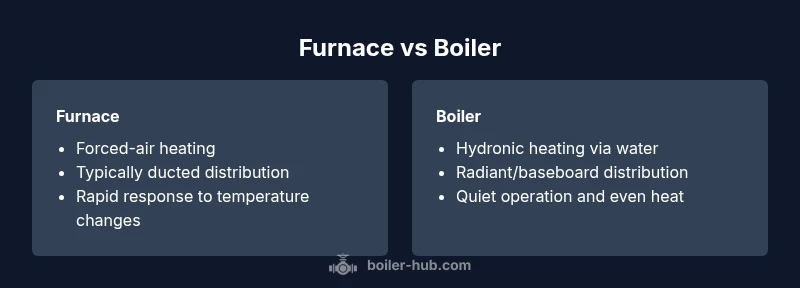
The heating landscape is evolving, but the core choice remains straightforward: do you favor air-based warmth delivered through a duct network, or water-based warmth circulated through radiators, baseboards, or radiant floor systems? The furnace vs boiler decision hinges on how heat is produced, distributed, and stored within a home or facility. The Boiler Hub team emphasizes that the practical differences often boil down to two design philosophies: forced-air versus hydronic heating, each with its own set of advantages and trade-offs. For many homes, this initial distinction helps frame later decisions about efficiency, maintenance, and installation costs. When homeowners assess “furnace vs boiler,” they should map out comfort zones, existing infrastructure, and long-term energy goals. This framework keeps the conversation objective and grounded in real-world usage, rather than relying on marketing jargon. In this context, the term furnace vs boiler appears frequently because it captures the two primary paths to reliable indoor warmth. As you weigh options, remember that climate, space, and fuel availability will steer the optimal direction.
Understanding the furnace vs boiler landscape
The heating landscape is evolving, but the core choice remains straightforward: do you favor air-based warmth delivered through a duct network, or water-based warmth circulated through radiators, baseboards, or radiant floor systems? The furnace vs boiler decision hinges on how heat is produced, distributed, and stored within a home or facility. The Boiler Hub team emphasizes that the practical differences often boil down to two design philosophies: forced-air versus hydronic heating, each with its own set of advantages and trade-offs. For many homes, this initial distinction helps frame later decisions about efficiency, maintenance, and installation costs. When homeowners assess “furnace vs boiler,” they should map out comfort zones, existing infrastructure, and long-term energy goals. This framework keeps the conversation objective and grounded in real-world usage, rather than relying on marketing jargon. In this context, the term furnace vs boiler appears frequently because it captures the two primary paths to reliable indoor warmth. As you weigh options, remember that climate, space, and fuel availability will steer the optimal direction.
How each heating technology works: core principles
A furnace converts fuel into hot air and distributes it through a network of ducts and vents. The system’s efficiency depends on the burner type, heat exchanger condition, blower speed, and duct sealing. Modern furnaces, especially condensing models, can achieve high efficiency when paired with well-sealed ductwork and proper sizing. Conversely, a boiler heats water (or a glycol mixture in some installations) and circulates it via pipes to radiators, baseboards, or radiant floors. The efficiency of boilers hinges on the boiler’s design (conventional, combi, or condensing), the quality of water treatment, and the effectiveness of the distribution system. In everyday terms, furnace vs boiler comes down to air versus water as the primary heat medium. The choice should align with your home’s architectural style, insulation level, and the desired temperature stability across rooms. Boiler Hub reminds readers that both systems can provide comfortable warmth, but each path benefits from precise installation and annual maintenance checks to sustain peak performance.
How each heating technology works: core principles
A furnace converts fuel into hot air and distributes it through a network of ducts and vents. The system’s efficiency depends on the burner type, heat exchanger condition, blower speed, and duct sealing. Modern furnaces, especially condensing models, can achieve high efficiency when paired with well-sealed ductwork and proper sizing. Conversely, a boiler heats water (or a glycol mixture in some installations) and circulates it via pipes to radiators, baseboards, or radiant floors. The efficiency of boilers hinges on the boiler’s design (conventional, combi, or condensing), the quality of water treatment, and the effectiveness of the distribution system. In everyday terms, furnace vs boiler comes down to air versus water as the primary heat medium. The choice should align with your home’s architectural style, insulation level, and the desired temperature stability across rooms. Boiler Hub reminds readers that both systems can provide comfortable warmth, but each path benefits from precise installation and annual maintenance checks to sustain peak performance.
Performance, comfort, and heat delivery: what matters
Efficiency metrics like AFUE for furnaces and seasonal efficiency for boilers are central to a fair comparison of furnace vs boiler. Beyond numbers, consider how quickly each system can satisfy temperature setpoints and how evenly heat distributes across spaces. Forced-air systems tend to respond quickly, delivering warm air to living zones and then balancing through dampers and zoning. Hydronic systems favor steady, uniform warmth with fewer temperature swings, particularly in rooms far from the heat source. A key nuance is how heat is lost: ducts can waste energy if leaky, while piping in hydronic systems can experience heat losses if not well insulated. Boiler Hub notes that the best outcomes often come from optimizing the distribution network first, then selecting the main unit that complements that network. In practice, the furnace vs boiler decision should weigh comfort goals, noise considerations, and how the system’s response aligns with daily living patterns.
Performance, comfort, and heat delivery: what matters
Efficiency metrics like AFUE for furnaces and seasonal efficiency for boilers are central to a fair comparison of furnace vs boiler. Beyond numbers, consider how quickly each system can satisfy temperature setpoints and how evenly heat distributes across spaces. Forced-air systems tend to respond quickly, delivering warm air to living zones and then balancing through dampers and zoning. Hydronic systems favor steady, uniform warmth with fewer temperature swings, particularly in rooms far from the heat source. A key nuance is how heat is lost: ducts can waste energy if leaky, while piping in hydronic systems can experience heat losses if not well insulated. Boiler Hub notes that the best outcomes often come from optimizing the distribution network first, then selecting the main unit that complements that network. In practice, the furnace vs boiler decision should weigh comfort goals, noise considerations, and how the system’s response aligns with daily living patterns.
Space, installation, and integration considerations
The physical footprint of a heating system matters as much as the fuel it uses. A furnace typically relies on a centralized air handler, blower, and ductwork, which can be advantageous if a home already has an existing duct network. However, ductwork can incur energy losses if not properly sealed or insulated. Boilers, by contrast, demand space for the boiler unit, water piping, and distribution components like radiators or baseboards. In retrofit scenarios, the cost and complexity of adding or reconfiguring piping can influence whether furnace vs boiler is the better long-term choice. In new construction, builders often weigh the ease of integrating either system with efficient envelopes and zoning capabilities. Boiler Hub emphasizes evaluating your current infrastructure, potential future upgrades (like smart thermostats or zoning), and the long-term value of each approach when weighing furnace vs boiler.
Space, installation, and integration considerations
The physical footprint of a heating system matters as much as the fuel it uses. A furnace typically relies on a centralized air handler, blower, and ductwork, which can be advantageous if a home already has an existing duct network. However, ductwork can incur energy losses if not properly sealed or insulated. Boilers, by contrast, demand space for the boiler unit, water piping, and distribution components like radiators or baseboards. In retrofit scenarios, the cost and complexity of adding or reconfiguring piping can influence whether furnace vs boiler is the better long-term choice. In new construction, builders often weigh the ease of integrating either system with efficient envelopes and zoning capabilities. Boiler Hub emphasizes evaluating your current infrastructure, potential future upgrades (like smart thermostats or zoning), and the long-term value of each approach when weighing furnace vs boiler.
Maintenance, service life, and reliability
Regular maintenance is the backbone of both furnace and boiler longevity. For furnaces, annual inspections focus on burners, heat exchangers, and duct cleanliness; worn components can reduce efficiency and pose safety concerns. Boilers require checks of water chemistry, pressure, valves, and the integrity of piping and radiators. Condensing models—whether in furnaces or boilers—tend to deliver high efficiency but rely on robust condensate handling and corrosion-resistant materials. A surprising contributor to reliability is the condition of the surrounding space: clean air ducts, dry basements, and corrosion protection extend service life. Boiler Hub recommends scheduling professional tune-ups yearly, replacing worn components promptly, and monitoring for signs of leaks or unusual noises. Proper maintenance minimizes the furnace vs boiler reliability gap and preserves energy performance.
Real-world scenarios: homes, apartments, and small facilities
Every building has unique heating demands, and the furnace vs boiler equation shifts with usage patterns. An older home with extensive radiator piping might benefit from a boiler's established distribution network, particularly when radiant floors or baseboard heating is desired. A modern, multi-story residence with a large open-plan living area and existing ductwork may be best served by a high-efficiency furnace that delivers rapid warmth to multiple zones. In small commercial spaces or apartments, space constraints and noise considerations can also tilt the decision toward a solution that minimizes bulky equipment and duct runs. When comparing furnace vs boiler for rental properties, consider tenant comfort, maintenance cycles, and the potential for zoning to improve energy usage without sacrificing responsiveness. Boiler Hub underscores that the most successful projects start with a precise load calculation and a plan that aligns heat distribution with living patterns.
Real-world scenarios: homes, apartments, and small facilities
Every building has unique heating demands, and the furnace vs boiler equation shifts with usage patterns. An older home with extensive radiator piping might benefit from a boiler's established distribution network, particularly when radiant floors or baseboard heating is desired. A modern, multi-story residence with a large open-plan living area and existing ductwork may be best served by a high-efficiency furnace that delivers rapid warmth to multiple zones. In small commercial spaces or apartments, space constraints and noise considerations can also tilt the decision toward a solution that minimizes bulky equipment and duct runs. When comparing furnace vs boiler for rental properties, consider tenant comfort, maintenance cycles, and the potential for zoning to improve energy usage without sacrificing responsiveness. Boiler Hub underscores that the most successful projects start with a precise load calculation and a plan that aligns heat distribution with living patterns.
Comparison
| Feature | Furnace | Boiler |
|---|---|---|
| Fuel options | Gas/oil/electric | Gas/oil/propane/electric |
| Heat distribution | Forced-air through ducts | Hydronic via pipes to radiators/baseboards |
| Efficiency potential | High AFUE for condensing furnaces | High seasonal efficiency for condensing boilers |
| Space requirements | Ductwork and air handler occupy space | Boiler and piping occupy boiler room or closet |
| Maintenance focus | Air-side components; duct cleanliness | Water-side components; boiler chemistry |
| Best climate fit | Cold climates needing rapid space heating | Homes with radiant heat or hot-water needs |
| Initial cost influence | Often lower where ductwork is present | Potentially higher due to piping and equipment |
| Longevity and reliability | Durable with proper duct maintenance | Long-lived with regular water-side service |
Advantages
- Furnaces leverage existing ductwork for potentially lower installation costs
- Furnaces provide fast, responsive space heating
- Boilers can achieve high efficiency, especially with condensing models
- Hydronic systems offer uniform comfort and quiet operation
- Both systems benefit from professional sizing and routine maintenance
The Bad
- Ductwork can introduce energy losses if leaky or poorly sealed
- Furnaces rely on circulating heated air, which can dry air and spread dust
- Boilers often require more upfront investment and additional piping
- Water-side systems demand ongoing water treatment and corrosion control
There is no universal winner; the best choice depends on architectural design and heating priorities.
Choose a furnace when you prioritize rapid space heating and existing ductwork. Choose a boiler for radiant comfort and potential long-term efficiency, especially where hydronic systems are already in place.
Questions & Answers
What is the main difference between a furnace and a boiler?
A furnace heats air to distribute through ducts, while a boiler heats water to circulate via radiators or radiant floors. The choice affects comfort type, system layout, and potential energy savings. In a furnace vs boiler comparison, your climate and existing infrastructure largely determine the best path.
A furnace heats air and pushes it through ducts, whereas a boiler heats water that moves through radiators or radiant floors. Your climate and current setup largely decide which is better.
Which is cheaper to install, a furnace or a boiler?
Installation costs depend on existing ductwork and space. If ducts exist and are sealed, a furnace may be cheaper. If you lack piping for a hydronic system, a boiler installation can be more complex and costly in a furnace vs boiler comparison.
Costs depend on ductwork and piping; ducts exist? furnace may be cheaper; otherwise, boiler installation can be more complex and costly.
Are boilers more energy efficient than furnaces?
Efficiency is model-dependent. Modern condensing boilers can achieve high efficiency, often comparable to or exceeding high-efficiency furnaces in certain layouts. The furnace vs boiler efficiency assessment should compare AFUE and seasonal efficiency across models.
Boilers can be very efficient, especially condensing types, but it depends on the specific model and how the system is installed.
Can I convert an existing furnace setup to a boiler?
Conversion typically requires substantial piping work, space for a boiler, and adjustments to controls and radiators or baseboard heaters. In many cases, retrofit complexity makes it more practical to choose the system that aligns with the home’s existing design.
Conversions need new piping and room for a boiler. Often, it’s best to select the system that fits your home’s current design.
What maintenance is required for furnace vs boiler?
Furnaces require annual burner and heat-exchanger checks and duct cleaning. Boilers need regular checks of water quality, pressure, and piping, plus routine combustion service. Both demand periodic professional tuning to sustain efficiency.
Furnace maintenance centers on burners and ducts; boiler care focuses on water quality and pipes. Regular tune-ups help both stay efficient.
Which system is safer for homes with children?
Safety depends on installation quality and clearances. Proper venting, combustion safety, and thermostat controls reduce risk in either system. A well-installed furnace or boiler from a reputable pro minimizes common hazards.
Safety hinges on proper installation and venting. With a professional install, both systems can be safe for homes with children.
Key Points
- Assess climate, space, and fuel availability before deciding.
- Map existing infrastructure to avoid costly retrofits.
- Prioritize total cost of ownership over upfront price.
- Consider zoning and thermostat capabilities for comfort.
- Engage a professional to perform a precise load calculation.