Boiler vs Water Heater: An Analytical Comparison for Homes and Facilities
An analytical comparison of boilers and water heaters, covering operation, efficiency, costs, installation, and safety to help homeowners and facility managers choose wisely.


Boiler vs water heater: boilers deliver space heating and hot water, while water heaters focus on hot water only. The right choice depends on your heating load, space, and long-term costs. This guide compares operation, efficiency, installation, and safety to help you decide.
What is a boiler and how it differs from a water heater
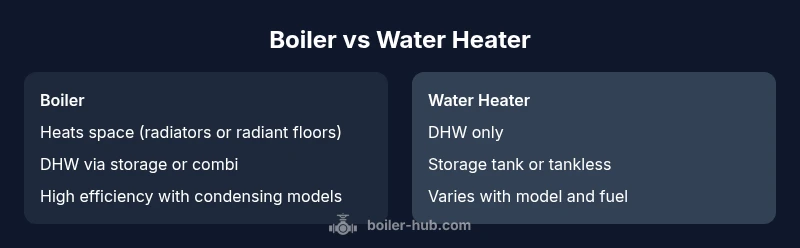
In both residential and light commercial settings, you’ll encounter two common routes for hot water and space comfort: boilers and dedicated water heaters. Understanding the core difference is essential for choosing the right system. According to Boiler Hub, the decision hinges on whether you need space heating in addition to domestic hot water. In a typical home, a boiler can drive a central heating system (radiators or radiant floors) and may also supply hot water through a storage or combi setup. A standalone water heater, by contrast, focuses on heating domestic hot water for taps and appliances. The result is a fundamental split: boilers are multi-purpose, water heaters are single-purpose. This distinction informs everything from energy planning to retrofit feasibility and long-term maintenance.
For homeowners and facility managers, the practical takeaway is clear: if you require space heating, a boiler-based solution often makes sense; if you only need hot water, a dedicated water heater can be simpler and cheaper to install. The choice is not just about upfront cost but about how your building uses heat across the year and how you plan to upgrade in the future.
How a boiler works (with hydronic heating) vs a traditional water heater
A boiler operates as the heat source for a hydronic (water-based) heating system. It heats water and circulates it through a network of pipes to radiators, baseboard heaters, or radiant slabs. When you open a hot tap, a separate domestic hot water (DHW) circuit can draw heated water from a storage tank, a heat exchanger, or a combi configuration that delivers DHW on demand. Water heaters, on the other hand, are stand-alone devices that heat water for taps and appliances. They can be storage-tank units or tankless (on-demand) systems. In most installations, a water heater does not provide space heating unless it’s part of a combined system. Comparing the two helps you assess whether you need integrated comfort or a focused DHW supply.
From a practical perspective, a boiler’s piping and controls influence how evenly your home heats and how quickly you get hot water. Tank-based water heaters tend to have more predictable temperature control and fewer mixing issues at the point of use, but they don’t contribute to ambient heat like a boiler does. The choice affects zoning, piping complexity, and how you space heat sources across seasons.
Efficiency and energy costs: energy source and efficiency ratings
Efficiency is a central driver in the boiler vs water heater decision, but it’s not a single-number comparison. Boilers, especially modern condensing models, have a high potential for efficient operation by reclaiming latent heat from exhaust gases. Water heaters vary considerably by model and fuel type: gas, electric, and solar-assisted options each carry different efficiency profiles. The critical factor is how well the system matches your load profile. Boiler Hub Analysis, 2026 shows that when a home has a substantial heating load, a high-efficiency boiler can reduce total energy consumption over the heating season, improving long-term cost of ownership. For water heaters, high-efficiency gas or electric tankless options can provide strong performance where space and consumption patterns are predictable. Overall, the cheapest unit to purchase may not be the cheapest to operate over a decade—the right choice depends on usage patterns, climate, and energy prices.
To compare fairly, evaluate the system’s efficiency class, standby losses, and heat exchanger performance. Look for condensate recovery in boilers and for energy-saving features such as smart thermostats and zoning controls. If you live in a climate with long heating seasons, the efficiency advantage shifts toward boilers; in milder climates or apartments with modest hot water demand, a compact water heater could be more cost-effective in practice.
Space, installation, and retrofit considerations
Space considerations and installation complexity are often overlooked until the project is underway. Boilers typically require a dedicated mechanical room or closet with venting, combustion air, and a network of radiators or radiant heating loops. Water heaters demand less space and can be simpler to service, especially in retrofit scenarios where there is no existing hydronic system. If you’re upgrading from a conventional storage water heater, a boiler retrofit implies adding piping, expansion tanks, circulator pumps, and controls, which carries both time and labor costs. For newer buildings, a combi boiler can consolidate DHW and space heating in a single unit, saving space but increasing initial cost and installation planning. The decision hinges on available floor area, existing infrastructure, and the potential for future expansion of heating zones.
Maintenance, lifespan, and downtime expectations
Maintenance needs and expected lifespan are central to total cost of ownership. Boilers generally require annual professional service to inspect burners, pumps, heat exchangers, and venting. In properly maintained systems, boilers can last many years or decades, particularly if they are high-quality condensing models paired with good water treatment. Water heaters also require routine checks but tend to be simpler to service. Storage tanks need periodic anode rod maintenance and periodic tank flushing to reduce mineral buildup and corrosion risk. Tankless water heaters reduce standby losses and may offer long lifespans if correctly sized and maintained, but they can be more sensitive to flow rates and mineral content. Downtime is mainly tied to component failures (circulators, valves, or heat exchangers) and to the quality of installation; regular maintenance substantially reduces unexpected downtime.
Fuel choices, emissions, and future-proofing
Fuel choice matters for emissions, energy efficiency, and long-term operating costs. Boilers commonly run on gas, oil, or electricity, while water heaters come in gas, electric, or solar-assisted variants. In terms of emissions, natural gas-fired systems produce lower carbon emissions per unit of heat than oil-based counterparts, though electricity-based solutions depend on the local grid mix. For facility managers planning for future regulation or energy pricing, boilers—especially high-efficiency condensing models—often offer better alignment with decarbonization goals because they can be paired with low-carbon fuels and advanced controls. Tankless or hybrid configurations can provide flexibility for future upgrades, such as solar thermal integration or heat pump-assisted water heating. The choice should consider not only current energy costs but how your building’s energy plan evolves over time.
Safety, codes, and installation standards
Safety and code compliance are non-negotiable in any heating system decision. Boilers require proper combustion air, venting, and clearance, with strict adherence to local building codes and inspection protocols. Water heaters also require venting or electrical safety provisions, especially gas and electric tank or tankless units. When evaluating options, verify compatibility with your existing gas lines, electrical panel capacity, and the availability of service technicians with boiler or water heater certifications. Substantial retrofits may trigger permitting requirements and inspections; this is a critical factor in total project timelines and budgets. The right choice aligns with safety standards, available skilled labor, and long-term reliability.
Decision framework: when a boiler is best, when a water heater wins
Use a simple decision framework to guide your choice: assess your heating load, space, and long-term goals. If you need space heating in addition to domestic hot water, a boiler-based system or a combi boiler is often the best route. If your primary need is reliable hot water with minimal integration into a heating system, a dedicated water heater or a compact combi unit may suffice. Consider the total cost of ownership, including installation, maintenance, fuel costs, and potential future upgrades (such as radiant heating or solar integration). A formal energy audit and a cost-benefit analysis over a 10–15 year horizon can make the decision clearer and reduce post-installation regret. The Boiler Hub team emphasizes evaluating realistic heating and hot water loads, not just the upfront price, to identify long-term value.
Common myths debunked
Myth 1: Boilers are always more efficient than water heaters. Reality: Efficiency depends on the model and fuel; a high-efficiency water heater can be competitive in certain scenarios. Myth 2: A water heater can’t be extended to support space heating. Reality: Some setups (combi or hybrid) can supply DHW while contributing to space heating with proper design. Myth 3: All boilers require a big footprint. Reality: Modern compact boilers and wall-mounted systems can fit into small mechanical rooms with smart zoning. Dispel myths by comparing performance data from manufacturers and independent tests.
Real-world scenarios: residential, multi-family, and commercial
In single-family homes with moderate hot water use and no space heating needs, a high-efficiency water heater or a small combi unit may be cost-effective and space-saving. In multi-family buildings or homes with radiant heating, a centralized boiler with a well-planned distribution system often proves more economical and scalable. For commercial spaces with high hot water demand, a boiler-based plant can deliver reliable heating and DHW through a centralized loop, while providing zoning flexibility. The best approach for any scenario is to model load, predict seasonal costs, and plan for future expansion, rather than choosing based on initial sticker price alone.
Comparison
| Feature | Boiler | Water Heater |
|---|---|---|
| Primary function | Heats space and domestic hot water in many setups | Heats only domestic hot water |
| Typical installation | Part of central heating with radiators or radiant floors | Standalone unit for hot water outlets |
| Energy efficiency focus | High potential with condensing boilers; efficiency depends on installation | Efficiency varies by fuel type and design (gas/electric; storage vs tankless) |
| Equipment cost | Higher upfront due to boiler, piping, and controls | Typically lower upfront for simple DHW units |
| Space and footprint | Larger footprint; requires boiler room or dedicated area | Compact or wall-mounted options available |
| Maintenance | Annual service; more complex hydronic loops | Routine checks; often simpler maintenance |
| Lifespan | Can last decades with proper maintenance | Lifespan varies; often 8-15 years depending on type |
| Best for | Homes needing heating plus hot water; radiant systems | DHW-focused homes or small spaces |
Advantages
- Unified system for space heating and hot water (boiler)
- Potential for high efficiency with condensing models
- Longer lifespan with proper maintenance
- Strong compatibility with radiant heating systems
The Bad
- Higher upfront cost and more complex installation
- Requires space for boiler room and piping
- Maintenance can be more involved than a basic water heater
Boiler generally offers greater overall value for homes needing space heating, while a water heater is simpler and cheaper upfront for hot water-only needs.
The Boiler Hub team recommends weighing heating load and long-term costs. Boilers excel when space heating is required, while water heaters are often the smarter choice for hot water only and smaller spaces.
Questions & Answers
What is the main difference between a boiler and a water heater?
A boiler can heat space and water, powering a central heating system, while a water heater primarily provides domestic hot water. Your choice depends on whether you need heating in addition to hot water.
Boiler heats space and water; water heater heats water only. Your decision hinges on whether you need space heating as well.
Can a boiler replace a water heater in a home?
Yes, if you have or plan to install a hydronic heating system, a boiler (often with a combi or system setup) can supply domestic hot water. Some homes may require plumbing or venting upgrades.
If you have space heating needs, a boiler can replace a separate water heater, but expect some plumbing work.
Are boilers more energy-efficient than water heaters?
Boilers can be highly efficient, especially condensing models, when paired with proper insulation and controls. Water heaters vary by design and fuel, with some high-efficiency options matching boilers in real-world use.
Boilers can be very efficient, especially newer condensing models; some water heaters are also very efficient depending on design.
What are typical installation costs for boiler vs water heater?
Costs vary widely by size, fuel, and local labor. Generally, boilers involve higher upfront costs due to equipment, installation, and potential piping work, while water heaters are simpler and cheaper to install.
Boilers usually cost more upfront due to equipment and installation complexity, while water heaters are simpler and cheaper to install.
Which system is better for multi-family buildings?
Boilers are commonly chosen for multi-family buildings because they centralize heating and hot water; water heaters may serve individual units but scale less efficiently.
In multi-family settings, boilers often offer better efficiency and control across units.
What maintenance tasks do boilers require?
Boilers typically need annual professional service, vent inspection, and occasional cleaning of heat exchangers. Water heaters require less intensive maintenance but still benefit from periodic checks.
Boilers need annual servicing; water heaters require less frequent checks but still benefit from maintenance.
Key Points
- Assess whether you need space heating in addition to hot water
- Consider long-term energy costs and maintenance
- Boilers suit radiant heating and larger homes; water heaters suit smaller, hot-water-focused setups
- Hybrid/combination units can offer compact solutions for some homes
- Plan for future expansion and look beyond upfront price to total cost of ownership