Boiler vs Tankless Water Heater: A Side-by-Side Guide
Discover the key differences between boilers and tankless water heaters. This analytical comparison covers efficiency, space needs, costs, reliability, and best-use scenarios for homeowners and facility managers.


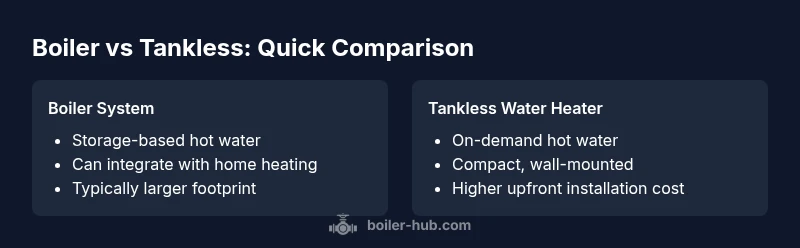
When deciding between a boiler and a tankless water heater, consider your peak-hot-water demand, space constraints, and long-term costs. Boilers provide steady hot water and can support whole-home heating, while tankless units heat water on demand with a compact footprint and potential energy savings when demand is intermittent. The best choice depends on usage patterns, installation space, and whether you prioritize upfront costs or ongoing energy efficiency.
Understanding boiler vs tankless water heater: what each does
A boiler is a central heating appliance that also provides hot water, storing or generating heat to warm radiators and domestic water. In many homes, a boiler combines space heating with a domestic hot-water coil or indirect water heater, delivering hot water in a predictable manner. A tankless water heater, by contrast, heats water on demand as it passes through a heat exchanger, with no large storage tank. The term “boiler vs tankless water heater” captures two distinct approaches to meeting hot-water needs: one relies on storage and often part of a home’s heating system, while the other emphasizes continuous flow and compact installation. In practice, selection hinges on how you use hot water, your space, and your tolerance for upfront costs versus long-term energy savings. According to Boiler Hub, understanding the structural differences helps homeowners and facility managers tailor their choice to usage patterns and system compatibility.
How each system works in practice
For a traditional boiler system, hot water is generated in a central unit and circulated through pipes to radiators or underfloor heating, with domestic hot water often supplied via a storage tank or indirect coil. When a faucet is opened, hot water is released from the tank or coil, and the boiler recharges the tank as needed. Tankless water heaters heat water directly as it flows through a heat exchanger, which means there is no standby storage. Gas-fired tankless units usually require venting and a dedicated gas line, while electric variants avoid combustion vents but need a sizeable electrical supply. In both cases, performance depends on inlet water temperature, flow rate, and the heater’s capacity. The Boiler Hub Team emphasizes that real-world operating costs are shaped not only by efficiency ratings but by daily use patterns and maintenance.
Space, installation, and retrofit considerations
Space efficiency often drives the decision. Tankless units are compact, wall-mounted devices that free up crawl spaces and basement floor area, making them ideal in tight homes or retrofit projects. Boilers, especially those tied to a full heating system, can require more space and careful venting, but they integrate neatly with central heating and can simplify multi-purpose installations. Electric tankless heaters may be simpler to install in homes with adequate electrical service, while gas-fired models demand proper venting, gas supply upgrades, and clearance for combustion appliances. For existing heating systems, the compatibility of a replacement unit matters: a boiler-based setup can leverage your current distribution network, whereas replacing with tankless might necessitate separate plumbing for hot water and a redesign of the pipe layout. The Boiler Hub guidance highlights planning steps, including evaluating space, ventilation, and the feasibility of augmenting or replacing heating equipment.
Costs you should expect: upfront, operating, and lifecycle
Upfront costs vary significantly between boilers and tankless systems. A traditional boiler plus indirect water heating typically involves modest equipment costs but may require additional components and labor for installation, venting, and piping. Tankless water heaters usually command higher initial costs due to the unit price and the complexity of installation, particularly for gas-fired models that require proper venting and sometimes a dedicated gas line upgrade. Operating costs hinge on usage patterns: boilers can be highly efficient for homes with substantial hot-water and space-heating needs, while tankless units excel in households with intermittent hot-water demand and limited space. Long-term lifecycle costs depend on maintenance, the quality of components, and the ease of replacement. Boiler Hub Analysis, 2026 notes that maintenance practices and local utility rates are large drivers of total cost over time.
Efficiency, energy savings, and environmental impact
Efficiency is not a single metric; it includes standby losses, heat-detection, and how effectively the unit meets demand. Tankless water heaters typically offer high energy efficiency by eliminating standby losses, but actual savings depend on how often hot water is used and at what flow rate. Boilers can be efficient when paired with modern modulating burners and well-insulated piping, yet standby losses from stored hot water can erode savings if the system is oversized or poorly insulated. The environmental footprint also depends on fuels (gas, oil, electric), venting efficiency, and the energy mix in your region. Boiler Hub emphasizes selecting equipment with appropriate sizing and ensuring regular maintenance to maximize efficiency gains.
Reliability, maintenance, and lifespan
Reliability depends on build quality, installation quality, and maintenance. Tanks and coils in boiler-fed systems may require periodic inspection for corrosion and mineral buildup, with long service lives when properly maintained. Tankless units have fewer moving parts and a longer potential lifespan when kept clean and free of scale, yet they can be more sensitive to hard water if not properly treated. Routine service intervals, descalers for mineral-rich water, and timely vent checks (for gas models) are essential. The Boiler Hub Team notes that predictable maintenance reduces the risk of sudden failures and helps preserve efficiency over time.
Which scenario suits which system: best-for charts
- Best for boiler systems: Homes with high simultaneous hot-water demand and existing central heating, extreme winter climates, or where you want a single appliance handling space heating and water heating. A boiler-based setup benefits from simplification of piping and the potential to use a single fuel source.
- Best for tankless water heaters: Small to medium homes, spaces with limited installation foot-print, single or staggered hot-water needs, or where you want a dedicated water-heating solution with very little standby loss. Electric tankless units pair well with abundant electrical capacity, while gas-fired variants require careful venting and gas supply planning.
Real-world tips for homeowners and facility managers
- Assess peak demand: Map typical shower, laundry, and appliance usage to estimate flow requirements. 2) Check water quality: Hard water reduces efficiency and lifespan; install a water-conditioning or descaling plan if needed. 3) Plan for space: Measure available wall space and consider future expansion or renovation. 4) Factor utility rates: Local energy prices influence long-term savings; prefer more efficient units in high-rate regions. 5) Budget for maintenance: Set aside funds for annual checks, descaling, and potential component replacements. 6) Engage qualified professionals: Work with licensed plumbers or HVAC technicians to ensure proper sizing, venting, and code compliance. Boiler Hub’s guidance emphasizes a professional assessment to avoid undersizing or oversizing, which undermines efficiency and reliability.
Decision framework: how to evaluate your home or building
A rigorous decision framework blends demand analysis with space, cost, and risk tolerance. Start with a demand forecast: estimate the maximum hot-water draw during peak usage periods. Then evaluate space constraints, venting requirements, and electrical/gas capacity. Compare lifecycle costs using conservative maintenance estimates and local utility rates. Finally, run a simple sensitivity check: how would costs change with a minor shift in usage or a change in fuel prices? This approach helps ensure the chosen system aligns with both current needs and future plans.
Comparison
| Feature | Boiler system | Tankless water heater |
|---|---|---|
| Storage/flow characteristics | Stores hot water in a tank or supports a combined heating system | Heats water on demand with no storage |
| Space footprint | Typically bulkier; may require dedicated equipment room | Compact, wall-mounted unit with minimal footprint |
| Installation complexity | Can leverage existing heating infrastructure; venting and piping must be coordinated | Electrical or gas venting needs; more flex in placement but higher upfront labor |
| Efficiency potential | Efficient when well-sized and paired with modern components; standby losses present with storage | High efficiency with on-demand operation; savings depend on usage pattern |
| Lifespan and maintenance | Subject to corrosion and coil wear; typical service life tied to system components | Fewer moving parts but potential scale buildup; regular descaling improves longevity |
| Best-use scenarios | High simultaneous demand; built-in heating system; space for equipment | Limited space; intermittent hot-water needs; compact installation |
Advantages
- Can leverage existing heating systems for boilers, reducing integration effort
- Tankless offers on-demand hot water and minimizes standby heat loss
- Boilers can provide radiant heating alongside hot water in one system
- Tankless units save space in tight areas
The Bad
- Boilers may have higher standby losses if not properly insulated
- Tankless units can have higher upfront costs and installation complexity
- Maintenance varies by model and water quality, affecting reliability
- Gas-fired tankless models require proper venting and gas supply upgrades
Choose the boiler when you need reliable, simultaneous space heating and hot water; choose tankless when space is tight and usage is variable.
For homes with heavy heating demand or existing boiler systems, boilers can offer integrated comfort. For smaller spaces or variable hot-water needs, tankless units provide on-demand performance with minimal standby losses. The best choice depends on usage patterns, space, and willingness to invest upfront for long-term gains.
Questions & Answers
Which is cheaper upfront, a boiler or a tankless water heater?
Upfront costs vary by model and installation. Boilers often have lower equipment costs but may incur extra venting and piping work, while tankless systems typically cost more to purchase and install due to accessories and venting requirements. A professional assessment helps determine the most cost-effective option for your home.
Boilers usually cost less to buy and install than tankless units, but the exact cost depends on venting and piping needs. A professional assessment will reveal the best option for your home.
Will a tankless water heater provide enough hot water for a family?
Tankless heaters provide on-demand hot water, but their ability to keep up depends on the unit’s flow rate and your simultaneous usage. If multiple fixtures run at once, some models may experience a temperature drop. Sizing and selecting a high-flow unit can mitigate this.
Tankless can meet family needs if you choose a unit with a high flow rate and careful sizing; simultaneous uses may affect temperature.
Do tankless water heaters require more maintenance?
Tankless systems can require more attention to mineral buildup in hard water areas and periodic descaling. Regular service, especially for gas-fired models, helps maintain efficiency and longevity. Water quality and installation quality are major factors.
Yes, tankless units may need more routine maintenance like descaling in hard water areas and annual inspections.
Can I convert an existing boiler to a tankless system?
Converting from a boiler-based system to a tankless setup is possible but involves major plumbing, venting, and potentially electrical work. It’s generally costlier and more complex than staying with the existing system or upgrading the current boiler.
Converting can be done but is usually costly and complex, requiring professional planning.
Are electric tankless systems cheaper to install than gas models?
Electric tankless systems typically have lower installation costs but may require upgrading electrical service. Gas models can offer higher flow but require venting and gas lines. The best choice depends on your home’s utilities and long-term energy costs.
Electric tankless is often cheaper to install but might need a bigger electrical service; gas models need venting.
Which option is better for resale value?
Both options can add value when chosen to match home size and climate. The key is to size correctly and maintain the system. A well-documented, professionally installed system tends to perform better in the eyes of buyers.
A properly sized and well-maintained system tends to boost resale value, regardless of boiler or tankless choice.
How do climate and water temperature affect performance?
In colder climates, inlet water is colder, which can reduce tankless efficiency and require larger heat exchangers. In milder climates, both systems may perform efficiently with moderate energy use. Always size based on local conditions and supplier guidance.
Cold inlet water can challenge tankless units; climate and sizing matter for performance.
Key Points
- Assess peak hot-water demand before deciding
- Boilers suit integrated heating and water needs
- Tankless shines in space-constrained installations
- Maintenance and water quality influence long-term performance
- Choose based on usage patterns, not just price