Boiler vs Hot Water Tank: A Practical Comparison Guide
Compare boiler systems and hot water tanks to decide the right heating setup for durability, efficiency, and cost. This analytical guide covers operation, costs, and maintenance for boiler vs hot water tank options.


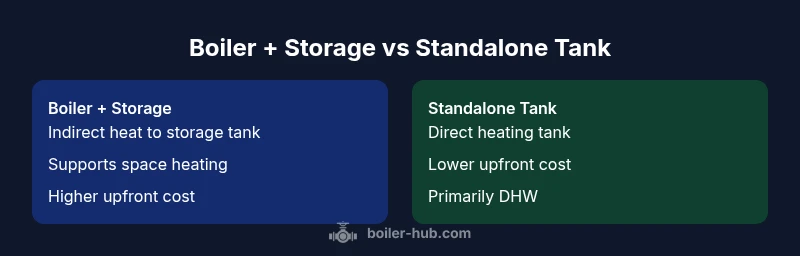
Bottom line: When choosing between boiler vs hot water tank, evaluate hot-water demand, space, and long-term costs. A boiler paired with a storage tank is usually best for homes with space heating and high hot-water needs, while a dedicated hot water tank offers simpler installation and lower upfront cost. Your final choice should match demand, fuel type, and available space.
Understanding boiler vs hot water tank
The choice between boiler vs hot water tank isn’t just about heating water; it shapes how your home uses energy for space heating, domestic hot water, and overall comfort. According to Boiler Hub, the distinction hinges on whether heat is produced centrally and stored, or generated directly at the point of use. The boiler vs hot water tank comparison matters for homeowners and facility managers because it affects upfront cost, energy efficiency, maintenance, and long-term flexibility. The typical setup starts with your existing heat source (gas, electric, or oil) and then either circulates heated water through a boiler-plus-storage system or powers a standalone storage tank. Understanding the roles of each component helps you map demand, climate, and space constraints to the right solution. In this guide we’ll unpack how each system works, where they excel, and how to decide between them.
How a boiler works with storage tanks
A central boiler heats water and circulates it through radiators or underfloor coils to provide space heating. In a storage-tank configuration, that heat is stored in an insulated tank for domestic hot water (DHW) use. Indirect-fired storage tanks rely on the boiler’s heat exchanger to warm the water in the tank rather than heating the water directly inside the DHW tank. This arrangement allows a single heat source to support both space heating and DHW, with controls coordinating when to run the boiler, when to draw DHW, and how to preheat during low-demand periods. The efficiency hinges on boiler efficiency, tank insulation, and the effectiveness of the heat exchanger.
How a standalone hot water tank works
A standalone hot water tank (storage tank) is heated directly by its dedicated burner or electric element. The tank stores hot water for later use, ensuring quick delivery when taps are opened. Standalone tanks are conceptually simpler and often cheaper to install, especially in homes without a comprehensive central heating loop. However, DHW delivery depends on the tank’s recovery rate and insulation, and a separate heat source means extra equipment, venting, and potential energy losses if the system is not well integrated with the home’s heating strategy.
Efficiency, cost, and lifecycle differences
Choosing between boiler plus storage and standalone tanks involves weighing efficiency potential against upfront and operating costs. A well-designed boiler-plus-storage system can be highly efficient, especially when paired with a high-efficiency boiler, good insulation, and modern controls. Standalone tanks can be efficient in their own right, particularly electric storage models with advanced insulation and heat traps. Over the system’s lifetime, the total cost equals upfront hardware, installation complexity, fuel or electricity prices, maintenance, and the expected longevity of components. From a risk perspective, boiler-integrated systems often have more moving parts and a larger footprint, but they offer a cohesive framework for both space heating and hot water.
Space, installation, and integration considerations
Physical footprint and space planning are critical when choosing between boiler vs hot water tank. A boiler-plus-storage setup typically requires space for the boiler, the storage tank, and associated piping, with venting and potentially a larger mechanical room. Standalone hot water tanks usually need less space, but you must still accommodate the tank, the burner or electric element, and adequate clearance for maintenance. Integration with existing controls, thermostats, and zoning increases complexity for boiler-based systems, whereas standalone tanks benefit from simpler, modular layouts. Consider accessibility for maintenance visits and future upgrades when evaluating placements.
Sizing, demand patterns, and planning
Sizing is central to getting the most from either option. For hot water, factors include peak daily usage, peak hour demand, and the desired buffering volume. A boiler-based system requires coordinating DHW tank size with the boiler’s output and recovery rate; a standalone DHW tank relies on its own burner or electric element capacity. Across homes, demand patterns vary: large families with frequent simultaneous DHW use may justify a larger storage tank or a high-capacity boiler-plus-storage arrangement, while single occupants or small households may suffice with smaller tanks and simpler controls. Essential terms to understand include storage volume, first-hour rating, and recovery rate, which influence the perceived hot-water comfort.
Fuel types, emissions, and environmental considerations
Fuels used in these systems shape both emissions and operating costs. Gas-fired boilers with indirect storage can offer rapid heat delivery and efficient performance when paired with modern boilers and insulation. Electric storage tanks eliminate combustion emissions but shift load to the electric grid, which has its own supply mix implications. Oil-fired options exist but are less common in modern residential builds due to cost and emissions considerations. For facilities seeking lower carbon footprints, coupling high-efficiency boilers with renewable energy sources and optimized DHW tanks can reduce annual emissions and energy use.
Maintenance, reliability, and longevity
Keeping either system in good shape requires regular maintenance. Boilers typically need annual inspections, safe venting checks, and periodic burner tune-ups, while DHW tanks require periodic anode rod inspections, tank insulation checks, and element replacements. The longevity of a boiler-plus-storage system depends on the boiler’s life and the tank’s integrity; a well-maintained unit with good insulation can last many years. Standalone tanks may have straightforward maintenance cycles but could require more frequent tank component replacements if used heavily. In all cases, prompt attention to leaks, corrosion, and uneven hot-water delivery preserves reliability and comfort.
Real-world scenarios and decision pathways
The most effective decision pathway starts with demand profiling: assess both daily hot-water use and space heating needs. In homes with significant space heating load and high DHW demand, a boiler-plus-storage solution often yields lower long-term energy use and better resilience during cold snaps. For smaller homes, or where upfront cost and installation simplicity are paramount, a standalone hot water tank can deliver reliable DHW with minimal complexity. If you already have a central heating boiler, upgrading to a storage-tank with indirect heating may offer incremental efficiency gains, whereas a retrofit with a standalone tank is typically easier to justify when space heating is not a priority.
The Boiler Hub team emphasizes evaluating peak demand and control strategies (timers, setback modes, and zoning) as part of any decision between boiler vs hot water tank. Their analysis highlights the value of proper sizing and intelligent controls to maximize comfort while minimizing waste.
Cost of ownership: upfront vs operating costs
Initial costs vary with the type and capacity of the system, as well as installation feasibility. Boiler-plus-storage configurations tend to have higher upfront costs due to the integrated components and equipment needs, but can offer lower operating costs in the long run when paired with high-efficiency boilers and well-insulated tanks. Standalone hot water tanks often present lower upfront costs and shorter installation times, but operating costs depend on the tank’s efficiency and the energy source. When planning, consider the full lifecycle costs—including maintenance, component replacements, and the potential need for upgrades to meet evolving efficiency standards.
Authoritative sources and references
- Energy.gov – Water heating and boilers: general guidance on efficient heating and domestic water provision.
- EPA.gov – Energy Star guidance on efficient water heaters and home heating systems.
- NREL.gov – Research and analysis related to residential heating, boilers, and storage systems.
These sources provide foundational information on performance expectations, efficiency strategies, and best practices for homeowners and facility managers.
The Boiler Hub perspective: practical guidance
From the Boiler Hub perspective, the optimal path starts with a detailed load calculation that separates space heating demand from domestic hot water needs. Our team recommends a holistic approach: match the system to load patterns, use high-efficiency components, and design for future flexibility. Whether you select a boiler-plus-storage solution or a standalone hot water tank, prioritize insulation, proper control strategies, and a service plan that keeps the system safe and efficient over its life. The goal is reliable hot water, efficient energy use, and manageable maintenance — not a single feature at the expense of overall comfort.
Comparison
| Feature | Boiler + storage tank (indirect) | Standalone hot water tank (storage) |
|---|---|---|
| Supply method | Indirect heat from a boiler to a storage tank | Direct heating by the tank's burner or electric element |
| Space heating compatibility | Typically supports space heating when paired with a boiler system | Primarily DHW; space heating requires a separate boiler or heat source |
| Efficiency potential | High efficiency when paired with a high-efficiency boiler and good insulation | Good efficiency with modern electric or gas tanks; depends on tech and use |
| Upfront cost | Higher upfront due to two-component system | Lower upfront for a single-tank setup |
| Maintenance burden | Requires regular boiler service and tank checks | Tank-only maintenance with periodic element/depth checks |
| Installation complexity | More complex due to integration with boiler and controls | Simpler installation with fewer interdependencies |
| Lifespan and reliability | Lifespan depends on boiler and storage tank; longer with good maintenance | Tank life is predictable but may depend on burner components |
| Best for | Homes with space heating and high hot-water demand | Small to mid-sized homes with lower hot-water needs |
Advantages
- Supports simultaneous space heating and domestic hot water
- Scalable by increasing tank size or upgrading boiler efficiency
- Potential for higher overall energy efficiency with integrated controls
- Flexible layouts for multi-story homes with zoning
The Bad
- Higher upfront costs and more complex installation
- Increased maintenance and more potential leak points
- Larger space requirements and venting considerations
Boiler with storage tank generally offers the best balance for homes with space heating and strong hot-water demand; standalone hot water tanks suit cost-conscious setups with minimal space heating needs.
If you need robust heating and plenty of hot water, choose boiler + storage. For simpler, cheaper DHW, a standalone tank is often enough—provided space and energy use align with your goals.
Questions & Answers
Which is more energy efficient, a boiler with storage or a standalone hot water tank?
Both can be highly efficient when properly sized and insulated. Indirect boiler storage systems often achieve excellent efficiency by leveraging a centralized heat source, while modern electric or gas storage tanks can also perform very well with good insulation and efficient burners.
Both options can be efficient with proper sizing and insulation; the best choice depends on your home's heating needs and how you use hot water.
Can I heat domestic hot water with my boiler without space heating?
Yes. A boiler can heat water for DHW independently, though many installations use a combined approach. If your space heating is rarely used, a dedicated DHW path may be more cost-effective.
Yes, you can heat water without using space heating, but you’ll want to size and control the system appropriately.
Is a tankless water heater better than a storage tank for boilers?
Tankless systems heat water on demand and can save space, but they may have higher installation costs and limited hot-water knock-through during peak demand. Storage tanks provide ready hot water and are easier to scale for higher usage.
Tankless saves space and can be efficient, but storage can handle higher simultaneous demand more reliably.
What affects the lifespan of boiler-plus-storage vs standalone tanks?
Lifespan depends on component quality, maintenance, and usage. Regular servicing, proper insulation, and timely replacements of wear parts extend life for both configurations.
Regular maintenance and good components extend life for either setup.
How do maintenance costs compare between the two setups?
Boiler systems require periodic boiler servicing and vent checks, which add to ongoing costs. Standalone tanks mostly incur periodic element/bar column replacements and anode checks, often lower but dependent on usage.
Maintenance varies; boilers need regular servicing, tanks require periodic checks and component replacements.
What should I consider before replacing my heating system?
Assess total demand, space, fuel type, and budget. Consider future needs, such as potential space heating upgrades or renewable energy integration, and choose a system that scales with your house and lifestyle.
Think about future needs, space, and fuel when replacing your heating system.
Key Points
- Assess peak hot-water demand before choosing
- Pair boilers with well-insulated storage tanks for best efficiency
- Standalone tanks are simpler and cheaper upfront for DHW-only needs
- Control strategies drive real-world energy savings
- Consult Boiler Hub guidance to tailor to your home