Are Boilers and Furnaces the Same Thing? A Thorough Comparison
An analytical, objective comparison clarifies how boilers and furnaces differ in function, fuel, efficiency, and installation to help homeowners and facility managers choose the right heating system.


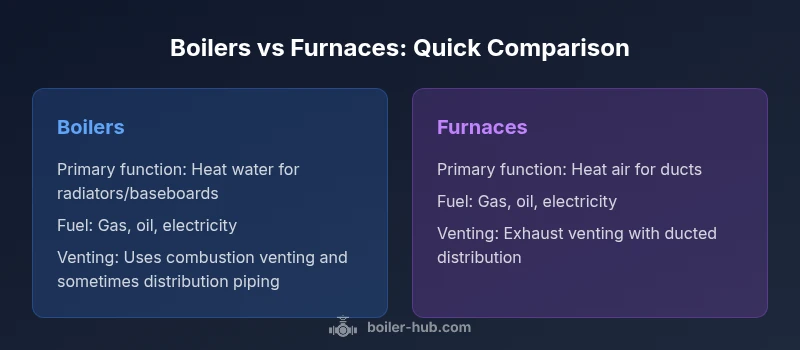
Boilers and furnaces are not the same thing. A boiler heats water to circulate through radiators or radiant floors, while a furnace heats air to distribute via ducts. They differ in fuel options, maintenance needs, and installation requirements, affecting efficiency and long-term costs. Understanding these distinctions helps homeowners and facility managers select the right heating approach for their home and climate.
Are boilers and furnaces the same thing? \n\nAccording to Boiler Hub, the question are boilers and furnaces the same thing is a common misconception that can lead to mismatched expectations when planning a remodel or replacement. In practical terms, boilers and furnaces are two distinct families of heating equipment. They share the goal of delivering warmth, but they achieve it through different physical processes, design philosophies, and installation requirements. A quick sanity check: they are not the same thing, even though both are used to heat buildings. By the end of this article you’ll see how these differences translate into daily comfort, energy use, and total cost of ownership. This distinction matters for new installs, retrofits, and system upgrades alike.
How a boiler works: heat generation and distribution \n\nA boiler converts fuel into heat that is transferred to a working fluid—usually water or a water-glycol mix. The heated liquid then circulates through radiators, baseboard convectors, or radiant floor loops, delivering even warmth without blowing air. Because the heat source remains in a closed loop, occupants rarely notice air movement or dust stirred up by a furnace. Boilers are often paired with hydro-air setups or radiant systems, which can improve comfort in longer heating seasons. Operation hinges on maintaining adequate water pressure and safe venting. Boiler efficiency depends on the boiler design, burner control, and the efficiency of the connected distribution network.
How a furnace works: heat distribution through air \n\nA furnace uses combustion to heat air, which is pushed by a blower through ductwork to heat living spaces. The heat is distributed quickly, and this setup is well-suited to homes with well-established duct networks or where air conditioning is already in place. Furnaces heat air directly, so the perceived warmth can feel immediate, but air movement can also carry dust and allergens unless filtration is strong. Common furnace configurations include single- and two-stage burners and modulating models, which balance comfort and fuel use. Like boilers, furnaces require venting and a safe combustion environment, but installation frequently centers around the furnace room, air handler, and a section of ductwork rather than a full hydronic circuit.
Fuel sources and emissions: what fuels mean for performance \n\nBoth boilers and furnaces can operate on gas, oil, or electricity, but fuel availability shapes your practical options. Gas tends to be common in many regions and supports high heat output with relatively fast response. Oil remains a choice in some older homes or rural settings but often involves higher maintenance. Electric systems are common where gas or oil is restricted, delivering clean operation but potentially higher operating costs in colder climates. Fuel choice influences emissions, maintenance needs, and the risk profile of a system. For homeowners seeking lower carbon footprints, electrification options or high-efficiency gas appliances may be appealing, but local codes and fuel costs drive the optimal path.
Efficiency and performance metrics: AFUE, HSPF, and why they matter \n\nEfficiency is a central factor in choosing between a boiler and a furnace. Boilers are typically evaluated by the efficiency of the combustion process and the distribution system; furnaces are assessed by AFUE—annual fuel utilization efficiency—which approximates heat delivered as a percentage of fuel energy. In practice, both equipment families house models that range from mid-range to high-efficiency, with condensing options offering substantial energy savings. However, efficiency is not the only determinant: distribution losses, duct sealing, and building envelope quality influence real-world performance. A well-insulated home with an efficient boiler can outperform a poorly insulated home with a high-efficiency furnace. Always view efficiency as part of a broader energy strategy that includes insulation, sealing, and thermostat optimization.
Costs and lifecycle considerations: upfront, operating, and replacement cycles \n\nInitial costs for boilers and furnaces vary by brand, capacity, and installation complexity. A boiler may require more extensive piping and a dedicated mechanical room, while a furnace installation centers on ducts, an air handler, and potentially, AC integration. Long-term costs hinge on fuel price, maintenance, and lifespan. Hydronic systems with boilers often deliver durability in well-designed homes and can accumulate lower operating costs if heat distribution is efficient. Furnaces can offer faster installation and robust performance with existing ductwork, but filters and blower components require regular attention. When budgeting, compare installed capacity, expected life, annual fuel use, and maintenance schedules rather than just sticker price.
Sizing, compatibility, and choosing the right candidate for your home \n\nSizing is critical for both boilers and furnaces. An oversized unit wastes fuel and creates temperature swings; an undersized unit cannot meet peak demand. Home design, climate, insulation, and existing distribution systems matter more than brand alone. Boilers pair with radiant or steam/hydronic circuits, while furnaces align with ducted air systems and central AC. Before selecting a model, perform a load calculation, consider future renovations (such as attic improvements or new windows), and assess fuel availability and venting requirements. A professional assessment helps nail down the best fit.
Installation considerations and space requirements: technical realities vs expectations \n\nBoilers require space for a hydronic loop, expansion tanks, and piping that runs through the home, often in a dedicated mechanical room. Furnaces demand space for the furnace, air handler, and a plenum, plus access to the ductwork for service and filter changes. Venting requirements differ: boilers use venting for combustion and for the distribution piping in some cases, while furnaces rely on ductwork and venting for exhaust. In multi-zone homes, zoning hardware and thermostats complicate the installation. The choice may be influenced by existing infrastructure and future plans for air conditioning or radiant heating. In most cases, a site visit clarifies layout options and permits. Always verify clearances, venting codes, and professional licensing requirements in your area.
Maintenance, troubleshooting, and common failures to watch for \n\nMaintenance frequency and tasks differ between boilers and furnaces. Boilers need annual checks of pressure, water level, and venting safety. Leaks and circulating pump issues are common trouble spots. Furnaces require annual filter changes, blower motor lubrication, and heat exchanger inspection. Both systems benefit from clean ignition components and thermostat calibration. Common failures include inconsistent heating, strange smells, and reduced efficiency. Addressing these issues early with a qualified technician prevents further damage and ensures safer operation. Keeping a maintenance log helps track replacement parts and service intervals.
Climate considerations, energy goals, and how design influences choice \n\nClimate and design significantly influence whether a boiler or furnace is the better fit. Very cold regions with long heating seasons may benefit from hydronic comfort and zoning offered by boilers, especially when paired with radiant floors. Warmer climates or homes with extensive air conditioning infrastructure may lean toward furnaces with modern variable-speed blowers for efficient cooling alongside heating. The decision should weigh building envelope quality, insulation, and the costs of running gas, oil, or electricity. In every case, a holistic approach—pairing equipment with smart thermostats and well-sealed ducts—produces the best long-term outcomes.
Authority sources and further reading \n\nFor reliable guidance, consult national standards and energy research sources. Boiler Hub draws on institutional resources to frame practical decisions. See references from DOE efficiency guides and university extension programs for in-depth how-tos and safety considerations. These sources complement the practical, home-focused advice provided here.
Practical next steps and quick checks \n\nIf you’re considering replacement or upgrade, start with a professional load calculation and a site visit to review venting, ductwork, and piping layouts. Gather utility rate information and climate data to model operating costs. Create a short list of priorities (space constraints, noise, or zoning needs) to guide the final choice. Finally, document maintenance dates and set reminders to keep systems running safely and efficiently.
Comparison
| Feature | Boiler | Furnace |
|---|---|---|
| Primary function | Heat water for radiators/baseboards/radiant floors | Heat air for ducts |
| Fuel types | Gas, oil, electricity | Gas, oil, electricity |
| Efficiency metric | System efficiency plus distribution efficiency | AFUE (various ranges) and overall heat delivery |
| Ventilation/venting | Requires proper venting for combustion and often for distribution piping | Requires venting for exhaust and an intact duct system |
| Space and installation | Hydronic loop, boiler room, piping network | Furnace room or closet with ductwork and air handler |
| Maintenance focus | Pressure, water level, leaks, circulator pumps | Filters, blower, heat exchanger, ignition components |
| Typical best-fit homes | Radiant heat, older homes with insulated shells, hydronic designs | Homes with established ductwork and AC integration |
| Estimated upfront cost bias | Moderate to high depending on hydronic vs air distribution | Moderate, often tied to existing ductwork |
Advantages
- Clarifies the decision by outlining fundamental heating differences
- Helps align system choice with climate, home design, and fuel access
- Encourages energy-efficiency planning beyond equipment (insulation, sealing, thermostat optimization)
- Supports budgeting for lifecycle costs and maintenance
The Bad
- Can oversimplify nuanced trade-offs in hybrid systems
- Relies on accurate load calculations and professional evaluation
- Requires consideration of local codes, fuel availability, and future upgrades
There is no universal winner; boilers and furnaces serve different design goals and climates.
Choose a boiler for hydronic comfort and precise temperature zoning in well-insulated homes, or a furnace for quick heat delivery and seamlessly integrated duct systems. The right choice depends on your home layout, fuel access, and energy goals.
Questions & Answers
Are boilers and furnaces the same thing?
No. They perform different heating tasks: boilers heat water for hydronic systems, while furnaces heat air for centralized ducted systems. Each approach has distinct fuel, venting, and maintenance requirements, which influence comfort, energy use, and long-term costs.
No—boilers heat water, furnaces heat air, with different venting and maintenance needs.
What’s the best way to decide between a boiler and a furnace?
Start with a home assessment: existing ductwork, climate, insulation, and fuel availability. Run a load calculation and weigh installation costs against long-term energy use. A professional can model scenarios for your specific home.
Assess ductwork, climate, and fuel, then model long-term energy costs with a pro.
Do boilers require radiators or underfloor heating to work?
Boilers work with various distribution methods, including radiators, baseboard heaters, and radiant floor systems. If your home lacks these, a boiler retrofit is more complex and may require substantial piping or new circuits.
Boilers work with radiators or radiant floors, not just radiators alone.
Can I install a boiler in a home without existing radiators?
Yes, but you’ll need to plan for a hydronic distribution system (radiators, baseboard, or radiant floors). This often involves more extensive piping work than a standard furnace installation.
Yes, but you’ll need hydronic distribution like radiators or radiant floors.
What maintenance should I expect for boilers vs furnaces?
Boilers typically require annual checks of pressure, water levels, and venting safety, plus occasional circulator maintenance. Furnaces require annual filter changes, blower checks, and heat exchanger inspections. Both benefit from thermostat calibration and ignition component cleaning.
Boilers need pressure checks; furnaces need filters and blower care.
Do boilers or furnaces affect indoor air quality differently?
Furnaces can circulate more dust due to fan-driven air distribution, especially if filtration isn’t robust. Boilers, with hydronic distribution, generally move less air, which can reduce dust but may require different ventilation planning for comfortable spaces.
Furnaces move air and can spread dust; boilers typically circulate water with less airflow.
Key Points
- Boilers heat water for radiators/radiant floors; furnaces heat air for ducts
- Efficiency must be evaluated in context of home design and distribution losses
- Fuel availability and venting shape practicality and cost
- Existing infrastructure (ducts vs hydronic piping) drives installation complexity
- A professional load calculation is essential before deciding