Difference Between a Boiler and a Furnace: A Practical Guide
A detailed comparison of boilers and furnaces for homeowners and facility managers. Learn how each system works, their pros and cons, and how to choose based on home design, climate, energy goals, and safety considerations.


The difference between a boiler and a furnace centers on how heat is produced and delivered. Boilers heat water to circulate through radiators or radiant floors, while furnaces warm air and push it through ducts. This distinction affects comfort, installation, and long-term costs. For homeowners evaluating heating options, understanding this difference helps tailor choices to climate, home design, and energy goals.
The difference between a boiler and a furnace
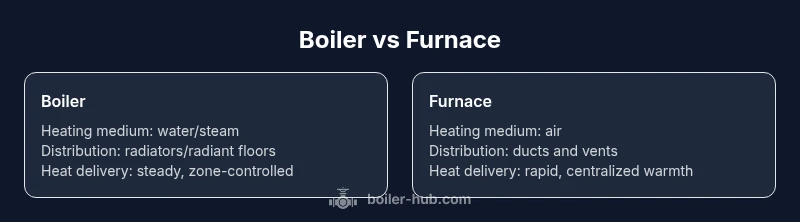
Understanding the difference between a boiler and a furnace is fundamental to choosing the right heating system. Per Boiler Hub's analysis, the distinction primarily lies in heat generation and distribution: a boiler heats a liquid (usually water) that travels through a closed loop to radiators or radiant floors; a furnace generates heat for air and pushes it through a network of ducts. The result is two very different heating philosophies: hydronic comfort versus forced-air warmth. In homes designed around radiators or radiant floor systems, a boiler-based setup can deliver steady, zone-controlled warmth with fewer large air currents. In contrast, a furnace relies on ducts to distribute warm air quickly, which can be advantageous in remodels where ducts already exist or where rapid space heating is a priority. This article compares both approaches across reliability, cost-of-ownership, safety considerations, and practical installation challenges. The goal is to give homeowners and facility managers a clear framework to decide which path aligns with their climate, home layout, and energy objectives. \n
How each system works
Boiler: In a boiler-based system, a burner heats water inside a boiler unit. The hot water or steam travels through pipes to radiators, baseboard heaters, or loops embedded in floors. When the heat is needed, a pump or gravity circulates the fluid, releasing warmth into rooms via convection and radiant transfer. A furnace: A furnace uses a combustion chamber or electric element to heat air. The warmed air is blown by a furnace blower through a network of ducts, delivering warm air to rooms in minutes. Thermostats control both types; however, the feeling of warmth, how fast it arrives, and the least amount of air movement may vary. In colder climates, a well-designed boiler with properly sized radiators can maintain consistent temperatures with lower energy fluctuations. Conversely, in homes with existing ductwork, a furnace can bring rapid comfort and simple air filtration. Understanding the physics of how each system moves heat helps explain why some homes feel evenly warm while others experience drafts or temperature swings. \n
Heating mediums and distribution methods
The core difference lies in what carries the heat and how it is delivered. Boilers rely on water or steam that travels through pipes to radiators, radiant flooring, or baseboard heaters. This hydronic approach yields steady warmth and allows for zoning control, keeping different rooms at different temperatures without wasted air movement. Furnaces heat air and distribute it through a network of ducts. Warm air can reach distant rooms quickly and enhance filtration and air exchange, but it can also create temperature swings if the ductwork is leaky or poorly insulated. Choosing between these paths often comes down to whether your home already has air ducts or you want the comfort of radiant heat. \n
Energy efficiency and cost considerations
Efficiency is not a single metric; it depends on system design, installation quality, and how a home uses heat. Boilers can be exceptionally efficient in hydronic setups, especially when paired with well-insulated radiators or radiant floors. Furnaces can also achieve high efficiency, especially modern condensing models, but their efficiency can be affected by duct losses and filter maintenance. When evaluating long-term costs, homeowners should consider fuel type, maintenance frequency, and potential upgrades to insulation and sealing. Boiler Hub’s guidance emphasizes matching system design to climate and lifestyle to maximize energy savings over time. \n
Installation, space needs, and home compatibility
Installation considerations differ markedly. Boilers require piping, a safe supply of a heat-transfer medium, and either radiators or radiant floor loops. This can demand more upfront planning and space for components, though it often yields quiet, even heat. Furnaces require ductwork plus an indoor air handling unit and usually fit homes with existing duct systems. If ducts need replacement or sealing, the project can become sizable. In older homes, retrofitting a boiler with radiators or repurposing space for radiators may be more involved, while converting a ducted home to radiant systems can be equally complex. The decision can hinge on whether major remodeling is on the horizon. \n
Maintenance, safety, and common failure points
Maintenance quality strongly influences performance and safety for both systems. Boilers typically require annual professional inspection to check piping, valves, and corrosion risk in closed-loop systems. Furnaces demand regular filter changes, blower maintenance, and vent integrity checks to prevent heat losses and ensure safe combustion. Safety considerations include carbon monoxide monitoring for fuel-burning boilers and furnaces, proper venting, and gas supply integrity. Both systems benefit from a routine inspection schedule and prompt attention to leaks, unusual noises, or sudden temperature changes. Boiler Hub notes that proactive maintenance significantly reduces the risk of outages and extends system life. \n
Sizing, climate fit, and lifecycle decisions
Sizing a boiler or furnace accurately is crucial for comfort and efficiency. A too-small unit struggles to meet demand, while an oversized unit cycles excessively and wastes energy. Climate plays a major role: hydronic systems may excel in zones with consistent cold spells and desire for even warmth, while ducted systems can quickly respond to rapid changes in occupancy or outdoor temperatures. Long-term decisions should weigh retrofit feasibility, potential upgrades to insulation, and compatibility with future energy strategies such as hybrid heating. Understanding these factors helps avoid common mistakes and guides a smoother replacement or installation process. \n
Myths, misconceptions, and decision frameworks
Several myths persist around boiler vs furnace choices. Some assume boilers are always quieter; temperature accuracy depends on control strategies and radiators. Others believe furnaces are always cheaper; installation cost often correlates with existing infrastructure. A practical framework begins with inventorying home layout, ductwork status, and radiator or floor heating plans. Consider future renovations, energy prices, and maintenance commitments. The goal is a clear decision path rather than a one-size-fits-all answer. Boiler Hub emphasizes a fact-based approach that weighs comfort, reliability, and total cost of ownership. \n
Practical decision framework: when to pick boiler vs furnace
Start by assessing your home’s heating design: do you have radiators or radiant floors, or are you relying on ducts and vents? Next, consider climate sensitivity and how important zoned comfort is. If you value quiet operation and energy efficiency in a radiantly heated space, a boiler with appropriate radiators or underfloor heating may be the best fit. If you prioritize rapid heat delivery and leverage existing ductwork, a furnace could be the smarter choice. Finally, evaluate installation costs, potential upgrades (insulation, duct sealing), and long-term maintenance commitments. By aligning design, climate, and lifestyle, you can select a system that meets comfort and efficiency goals while minimizing risk and disruption. \n
Comparison
| Feature | Boiler | Furnace |
|---|---|---|
| Heating medium | Water/steam circulated through radiators/radiant floors | Air heated by a burner or electric element |
| Distribution method | Hydronic/radiant or baseboard networks | Forced-air through ducts and vents |
| Distribution speed | Steady, gradual heat transfer | Fast air delivery to rooms |
| Typical installation footprint | Pipes, radiators or radiant loops, possibly boiler room space | Furnace, blower, and ductwork to each room |
| Noise and air movement | Generally quieter at living spaces; potential pipe hum/fan limits | Can be noisier due to blower and duct airflow |
| Maintenance focus | Annual boiler service, corrosion checks, valve inspection | Regular filter changes, duct cleaning, and blower service |
| Energy efficiency considerations | Hydronic efficiency depends on piping design and radiative losses | Furnace efficiency affected by duct losses and insulation |
| Best for | Radiant heat, zoning, and homes without extensive ductwork | Homes with existing ducts or need quick space heating |
Advantages
- Boilers can deliver very even warmth with zoning through radiators or radiant floors
- Furnaces provide rapid heat and work well with existing ductwork
- Both systems can be highly efficient when properly installed and maintained
- Hybrid approaches allow flexible energy strategies (e.g., boilers with heat pumps)
The Bad
- Boilers can require more upfront investment for equipment and radiators or floor loops
- Furnaces can be noisier and may suffer from duct leakage if not sealed
- Ducted systems can have higher ongoing energy losses if not well insulated
Boilers excel for energy-efficient, zoned comfort in radiant setups; furnaces win for rapid heat delivery in ducted homes.
Choose a boiler when you value steady warmth and zoning in a radiant or radiator-based system. Opt for a furnace when fast response and ducted distribution better suit your home and lifestyle.
Questions & Answers
What is the fundamental difference between a boiler and a furnace?
The boiler heats a liquid to circulate through radiators or radiant floors, while the furnace heats air and distributes it through ducts. This leads to different comfort experiences, with boilers often delivering steady warmth and furnaces offering quick space heating. Both systems require proper sizing and professional installation for optimal performance.
A boiler heats water to circulate through radiators or floors, while a furnace heats air and pushes it through ducts for quick warmth.
Which system is more energy-efficient overall?
Energy efficiency depends on design, installation, and usage. Hydronic boilers can be highly efficient with well-insulated radiators or floors, while modern furnaces can achieve high efficiency but may lose energy through ducts if leaks exist. The best choice matches climate, home layout, and maintenance practices.
Efficiency depends on setup. Boilers can be very efficient with good radiators; furnaces are efficient too when ducts are well-sealed.
Is installation easier for a furnace than a boiler?
In many cases, a furnace can be easier to install if a home already has ductwork in place. A boiler installation may require piping, radiators, and sometimes a space planning effort for radiant floor loops. Both require professional sizing and code-compliant venting.
Furnace installation is often easier if ducts exist; boilers may need piping and radiators.
Can you convert from one system to the other?
Conversions are possible but involve significant changes to heating distribution, controls, and space planning. Switching from a boiler to a furnace or vice versa typically requires a major retrofit, professional assessments, and cost considerations.
Conversions are possible but usually require substantial retrofit work.
What safety considerations should I plan for?
Any fuel-burning system requires proper venting and CO detectors. Regular professional inspections reduce risk and help ensure safe operation. Electric systems have fewer combustion risks but still benefit from maintenance and code compliance.
Ensure proper venting and CO detectors; schedule regular professional inspections.
What factors drive the overall cost of ownership?
Cost of ownership depends on initial equipment and installation, maintenance frequency, fuel type, energy prices, and potential upgrades to insulation or ducts. Both boilers and furnaces can be economical long-term with proper sizing and upkeep, but upfront costs and upgrades vary by system.
Total cost includes upfront install, maintenance, and energy usage over time.
Key Points
- Assess your home's heating design (radiant vs. ducted) before deciding
- Consider climate and comfort goals for even warmth or quick heating
- Prioritize system efficiency and potential maintenance costs
- Account for installation costs and upgrades to pipes, radiators, or ducts