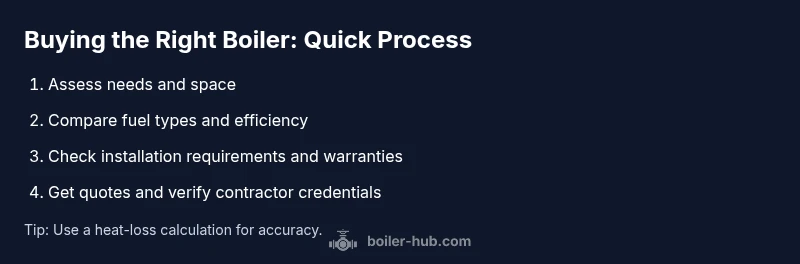
Which boiler should I buy: a complete how-to guide
Learn how to choose the right boiler for your home or facility. This step-by-step guide covers boiler types, sizing, fuel options, efficiency, installation, and quotes to help you buy confidently in 2026.


To decide which boiler to buy, follow these steps: assess your heating load, choose a fuel type, compare high-efficiency options, size the unit correctly, and plan safe installation. Start with a professional heat-loss calculation and verify venting requirements. In most homes, a high-efficiency condensing boiler offers a reliable, long-term solution.
Why this choice matters
If you’re asking which boiler should i buy, the answer starts with a clear view of your home’s heating load, fuel availability, and space constraints. This decision affects comfort, energy bills, and maintenance needs for years to come. According to Boiler Hub, selecting the right boiler matters for efficiency, reliability, and total cost of ownership across the lifespan of the system. In this guide, we’ll outline a practical framework you can use to compare models, installers, and warranties. By choosing thoughtfully, you minimize waste, reduce emissions, and protect your investment over time. Whether you’re replacing an aging unit or sizing a new installation, the right boiler aligns with your climate, occupancy, and comfort goals.
The journey begins with understanding your needs, not just chasing the latest tech. We’ll walk through decision points you can verify with simple checks, so you can answer the question once and for all: which boiler should i buy for this home? This guide prioritizes clarity, actionable steps, and reliable advice you can apply right away.
Understanding boiler types
Boilers come in several common configurations, each with strengths and typical use cases. A combi boiler provides instant hot water and space heating from a single unit, making it ideal for smaller homes with moderate hot-water needs. A system boiler stores hot water in a secondary cylinder, which can handle higher demand and is well-suited to households with multiple bathrooms. A traditional regular boiler uses a separate hot-water cylinder and is often chosen for older homes with existing radiator setups. Hybrid approaches combine a boiler with renewable energy sources for better efficiency. When considering which boiler to buy, evaluate how your family uses hot water, how many radiators you have, and whether you plan future expansions such as a bathroom or living-space addition. Each type also has installation implications, space requirements, and compatibility with your current piping and radiators.
From a practical viewpoint, you’ll want to map your home’s heating patterns. For example, a combi is typically best for smaller homes with consistent demand, while system or regular boilers excel in larger homes with heavy hot-water use or older distribution systems. As you compare models, note the flow rates for hot water and the boiler’s ability to modulate output to match demand. This helps avoid short cycling and maintains steady warmth throughout the residence.
Sizing and load calculation
Sizing a boiler accurately is essential to avoid oversizing (wasted energy and short cycling) or undersizing (insufficient heat). A professional heat-loss calculation (often called a boiler load calculation) estimates how much heating capacity your home requires under design conditions. Start by collecting basic data: insulation quality, window types, ceiling heights, number of rooms, and typical occupancy patterns. If you’re updating a home with an existing heating system, also note current boiler output, radiator sizes, and thermostat behavior. The goal is a unit that meets peak winter loads without exceeding need on milder days.
If you’re DIY-friendly, you can approximate using simple online calculators, but a licensed technician should verify results. When you receive estimates, compare the calculated design temperature against the boiler’s heating curve and modulation range. A correctly sized boiler will run longer cycles and deliver stable temperatures, whereas an oversized unit will repeatedly short cycle, wasting fuel and increasing wear on components.
Fuel options: gas, oil, electric, and hybrids
Your fuel choice has a major impact on running costs, emissions, and maintenance. Gas boilers are the most common in modern homes with reliable gas service and centralized fueling. Oil boilers may be appropriate in rural areas lacking natural gas or in historic properties with existing oil delivery infrastructure. Electric boilers offer a clean, compact solution for homes with limited space or where gas is not available, though they may have higher operating costs in some climates. Hybrids combine a boiler with renewable energy sources or heat pumps to maximize efficiency.
When deciding, weigh availability, installation costs, and long-term energy prices in your region. Consider your home’s occupancy patterns, hot-water demands, and potential future upgrades (insulation, solar, or heat pumps). Also verify that your electrical system and gas supply can support the chosen boiler, including any required vents or flues. Your choice should balance reliability, upfront cost, and ongoing fuel costs.
If your home is in a colder climate with high heating demand, a gas-powered condensing boiler paired with radiators or underfloor heating is typically a robust, cost-effective option. For off-grid homes, electric boilers with a dedicated heat source and energy storage may be viable, but check local pricing and incentives. Remember to factor in how you will service and maintain the boiler over its lifespan.
Efficiency and running costs
Efficiency matters more than ever when buying a boiler. Modern boilers emphasize modulation, condensing technology, and low standby losses. Look for models with high seasonal efficiency and reliability, and compare energy usage indicators across contenders. While upfront cost matters, the long-term savings from reduced fuel use can be substantial. Boiler Hub analysis shows that selecting a high-efficiency boiler can meaningfully reduce energy consumption over the life of the system, especially in homes with moderate to heavy heating loads.
Understand the difference between simple efficiency metrics and real-world performance. A model with strong peak efficiency may not deliver the best annual performance if it cannot modulate smoothly to changing conditions. Also consider the boiler’s response to hot-water demand, its standby energy, and the controls that optimize operation. In some markets, newer regulations or incentives favor certain efficiency tiers, which can influence total cost of ownership over 5–15 years.
Finally, factor in maintenance needs. Efficient boilers still require regular service, clean heat exchangers, and thermostat calibration. A well-maintained system can sustain high efficiency longer and protect against unexpected breakdowns.
Boiler Hub’s research indicates that homeowners who prioritize efficiency and proper sizing tend to experience lower operating costs and fewer service visits over the boiler’s life. This reinforces the value of a thoughtful selection rather than chasing the latest model trend.
Installation considerations and code compliance
Installation quality is as important as the boiler itself. Proper venting must match fuel type and local code requirements, and adequate clearance around the unit ensures safe service access. If you’re replacing an old boiler, ensure the new unit’s exhaust, condensate drainage, and venting align with the existing chimney or flue. Depending on your location, a permit may be required, and a licensed installer should perform gas, electrical, and venting work to maintain warranty coverage.
Discuss condensate piping, pressure relief, and expansion tank requirements with your installer. Faulty venting or improper wiring can create safety hazards, including the risk of carbon monoxide and electrical shocks. Additionally, review warranty terms to understand what aspects the manufacturer covers and for how long. A well-planned installation minimizes downtime, avoids future service calls, and supports consistent performance.
Finally, install CO detectors in living spaces near boilers and fuel storage areas, and ensure clear access to the unit for future maintenance. These safety measures protect occupants and help you verify safe operation from day one.
How to compare quotes and warranties
When you’re ready to compare quotes, use a standardized checklist. Verify that each bid includes heat-loss calculation data, model numbers, efficiency ratings, and expected performance under typical conditions. Ask for references and check installer credentials, including licensing and insurance. Compare warranties carefully: what they cover (parts, labor, and return to service), the duration, and any conditions that could void coverage. A longer warranty can add peace of mind, but it’s only valuable if installation and maintenance meet required standards.
Request detailed invoices that break down equipment costs, labor, permits, and any required upgrades (radiators, piping, or venting). If a quote seems significantly cheaper, investigate why. Hidden costs often appear in unanticipated installation work or outdated technology. A robust, clearly documented proposal helps you evaluate value rather than chasing the lowest price alone. Keep notes on each option and align your choice with your priorities: reliability, efficiency, upfront cost, and ongoing maintenance.
Boiler Hub emphasizes the importance of a transparent, well-documented quote process. A reputable installer will provide clear explanations for each cost and offer a realistic installation timeline with milestones.
Common pitfalls and how to avoid them
Even experienced homeowners fall into traps when buying a boiler. Oversizing is common; it leads to higher upfront costs and inefficient operation. Undersizing is equally problematic, causing inadequate heating, longer boiler run times, and stress on the system. Another pitfall is ignoring venting and combustion air requirements, which can compromise safety and performance. Failing to verify compatibility with existing radiators or underfloor heating can result in limited heat distribution.
To avoid these issues, insist on a formal heat-loss calculation, confirm that the unit can modulate with your water heating needs, and verify venting compatibility. Don’t skip the installation warranty or service plan; regular maintenance is essential for long-term reliability. Finally, beware of high-pressure sales tactics that push you toward a specific brand without transparent testing or independent comparisons.
A thoughtful buyer should gather multiple quotes, verify training and credentials of the installer, and read the fine print on warranties and service terms. This approach helps prevent disappointments after installation and ensures you get the best balance of performance and value.
Quick decision framework for your purchase
Use this concise framework to decide which boiler to buy:
- Define your heating and hot-water needs using a heat-loss calculation.
- Confirm fuel type and space constraints for your home.
- Compare at least three models by type, efficiency, and modulation range.
- Verify venting, installation requirements, and warranty terms.
- Schedule a professional assessment and request a detailed, itemized quote.
With this framework, you can move from uncertainty to a confident purchase without overpaying for features you don’t need. Always prioritize reliability, installation quality, and long-term efficiency, then factor in total cost of ownership when making the final choice.
Next steps and maintenance planning
After selecting a boiler, plan the installation window with your contractor and prepare the space for delivery and setup. Create a maintenance calendar that includes annual service, filter checks (where applicable), and safety inspections. Schedule boiler and venting inspections according to manufacturer recommendations and local codes. Keep an up-to-date record of model numbers, serials, warranty documents, and service history. A proactive maintenance plan helps you extend the life of your boiler, maintain efficiency, and catch issues before they lead to bigger problems. Finally, consider future-proofing: if you anticipate renovations or changes to your home’s heating loads, discuss upgrade paths with your installer so you can adapt without replacing the entire system again.
Tools & Materials
- Heat-loss calculation form or software(Obtain from a licensed professional or use a reputable online tool to determine load)
- Current boiler specifications(Model, BTU rating, fuel type, venting details)
- Home data collection kit(Notebook or device to record insulation, window types, and room usage)
- Measuring tools and documentation(Tape measure, camera or phone to document space and radiators)
- Access to manufacturers' spec sheets(PDFs or printed guides for potential models)
- Basic safety gear for on-site checks(Gloves, safety glasses as needed)
Steps
Estimated time: 4-6 weeks
- 1
Assess needs and perform a heat-loss calculation
Gather data on home size, insulation, local climate, and hot-water demand. Use a trusted online calculator or hire a professional to determine the required boiler size and modulation range. This step prevents oversizing and under-sizing, which impact comfort and efficiency.
Tip: If unsure, schedule a formal heat-loss assessment with a licensed technician. - 2
Identify fuel type and space constraints
Determine whether natural gas, oil, electricity, or a hybrid solution best fits your property. Check available space, venting feasibility, and accessibility for maintenance.
Tip: Ensure your electrical panel and gas supply can support the chosen boiler.” - 3
Choose boiler type based on needs
Select among combi, system, or regular boilers depending on hot-water usage and radiator configuration. Consider future needs such as additional bathrooms or larger living spaces.
Tip: A combi is great for small homes; system or regular suits multi-bath homes. - 4
Check efficiency ratings and controls
Compare seasonal efficiency and modulation capabilities. Look for smart thermostats and zoning options to optimize comfort and energy use.
Tip: Prioritize models with good modulation and reliable control compatibility. - 5
Plan installation logistics
Discuss venting, condensate drainage, space clearance, and permit requirements with your installer. Confirm warranty coverage and service plans.
Tip: Clarify lead times, access requirements, and temporary heat during installation. - 6
Get quotes and make a decision
Request detailed, itemized quotes from licensed installers. Compare equipment specs, warranties, and total cost of ownership to decide.
Tip: Choose the option that offers the best balance of performance, safety, and value.
Questions & Answers
What is the most common mistake when choosing a boiler?
The most common mistake is sizing the boiler incorrectly, leading to inefficiency and poor comfort. Always perform a heat-loss calculation and compare modulation range. Consult a qualified installer to validate your choices.
Sizing a boiler incorrectly is the biggest pitfall. Have a professional confirm your numbers and options before buying.
How do I know which fuel type to choose?
Choose based on fuel availability, long-term cost trends, and local emissions considerations. Gas is typical where available; oil is common in certain areas; electric boilers work well where gas isn’t an option, though electricity costs may vary by region.
Fuel choice depends on what's available in your area and long-term costs. See what’s feasible where you live.
What is a combi boiler and should I buy one?
A combi boiler provides both heat and domestic hot water from a single unit, ideal for homes with limited space and modest hot-water needs. If hot-water demand is high, a system or regular boiler with a separate cylinder may be more suitable.
A combi boiler saves space and usually fits smaller homes, but check your hot-water needs before choosing.
Are warranties important when buying a boiler?
Yes. Warranties cover parts and sometimes labor for a defined period. Read the terms closely, including what voids coverage and what maintenance is required to keep the warranty valid.
Warranties matter; read the fine print and follow maintenance steps to keep coverage.
How long does installation typically take?
Installation duration varies with system type, existing infrastructure, and permitting. Have a clear timeline from your installer and plan for temporary heating if needed.
Installation time depends on the system and home setup; get a written schedule from your installer.
Can I install a boiler myself?
No. Gas and combustion appliances require licensed professionals for safety, building code compliance, and warranty validity. Always hire a qualified installer for boiler work.
Boiler work isn’t a DIY task—leave it to a licensed professional for safety and code compliance.
Watch Video
Key Points
- Define your heating needs before shopping.
- Prioritize high-efficiency models to reduce running costs.
- Size correctly to avoid short cycling and waste.
- Compare quotes and warranties to protect your investment.
- Plan installation with a licensed professional and follow maintenance.