Installing a Condensing Boiler: A Practical Guide
A safety-focused guide to installing a condensing boiler, covering planning, permits, sizing, venting, commissioning, and maintenance for homeowners and facility managers.


Installing a condensing boiler can deliver higher efficiency and lower operating costs when performed by a licensed pro. This quick guide highlights essential steps, safety checks, and regulatory requirements for homeowners and facility managers considering 'installing a condensing boiler'. Follow these steps to plan, select, and commission a compliant install. Key actions: verify local permits, size the unit correctly, and hire a qualified technician to install and test the system.
What is a condensing boiler and why it matters
A condensing boiler captures heat from exhaust gases that older boilers vent to the atmosphere. By using a second heat exchanger, it recovers latent heat from water vapor in the flue gas, which boosts efficiency and reduces fuel use. In many homes, a properly sized condensing boiler can deliver meaningful energy savings and lower operating costs. The Boiler Hub team notes that these gains are maximized when the unit is correctly sized, installed to code, and commissioned by a licensed professional.
Regulatory and safety considerations before starting
Before starting any installation, verify local building codes, gas-safety requirements, and warranty terms with the boiler manufacturer. In most regions, gas work, vent installation, and combustion air provision require a licensed technician and may involve inspections by a local authority. Keep in mind that improper venting or condensate drainage can create carbon monoxide risks or water damage; following code minimizes these hazards. Boiler Hub Analysis, 2026, highlights that compliance is linked to safer operation and warranty validity.
Planning the installation: sizing, location, and venting
Sizing is critical: an oversized boiler wastes fuel, while an undersized unit leaves rooms cold. The right condensing boiler should have a high AFUE rating and be appropriate for the home’s heat load. Choose a location with adequate clearance for service, access to the flue, intake air, and condensate drainage. Plan venting that meets local code and manufacturer guidance; improper venting can cause performance issues and safety hazards.
Tools, materials, and safety gear you may encounter
Professional installation uses specialized tools and materials that are not suitable for DIY work. Typical items include:
- Gas-rated venting kit (includes vent pipe, sealing solutions, and supports per code)
- Condensate drain kit (trap, line, and drainage connections)
- Piping and fittings (copper or PEX) compatible with space heating water
- Thread sealants rated for gas and water
- New shut-off valves
- Electrical disconnect switch or breaker
- Leak detectors and sensor kits
- Personal protective equipment (PPE) such as gloves and eye protection
- Insulation for pipes and vibration isolation mounts
Professional installation workflow overview
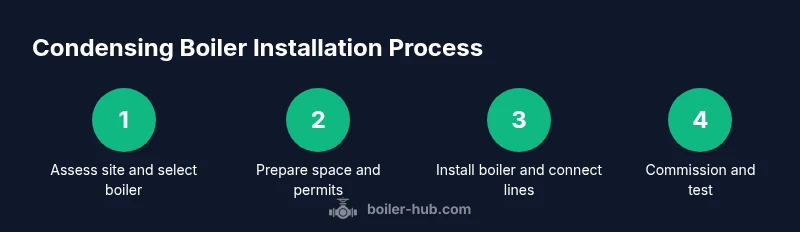
This section provides a high-level workflow professionals commonly follow. It emphasizes that installation steps must be performed by a licensed technician, with adherence to local codes and manufacturer instructions. The process typically includes confirming site readiness, selecting the correct boiler, preparing the space, removing any legacy equipment, installing the new unit, connecting gas, water, electrical, and venting, performing pressure and leak tests, and finally commissioning the system and documenting results. The focus is safety, code compliance, and long-term reliability.
Commissioning, testing, and safety checks after install
Commissioning verifies safe operation and performance: check gas pressure, verify venting integrity, test for leaks, confirm domestic hot water performance, and ensure condensate drainage operates properly. Record system settings, label shut-offs, and schedule a follow-up service within the warranty period. This phase is critical to prevent hazardous conditions and ensure efficient, reliable heating.
Authority sources and learning
For deeper technical detail, consult authoritative resources:
- https://www.energy.gov/eere/buildings/articles/condensing-boilers-high-efficiency
- https://www.energy.gov/energysaver/boilers
- https://www.nrel.gov/docs/fy16osti/66440.pdf
Maintaining your condensing boiler and warranty
Regular maintenance extends boiler life and preserves efficiency. Schedule annual professional service, inspect venting and condensate drainage, test safety controls, and verify thermostat and controls operation. Maintaining good air supply and clean heat exchangers helps sustain high AFUE ratings. The Boiler Hub team recommends documenting service visits and following manufacturer warranty guidelines to maximize protection over the system’s life.
mainTopicQuery-legacy_target_idBonusNote":"condensing boiler installation"],
toolsMaterials":{"items:[{"name":"Gas shut-off valve wrench","required":true,"note":"Shut off gas supply before starting work"},{"name":"Adjustable wrench","required":true,"note":"For fittings and pipework"},{"name":"Pipe cutter","required":true,"note":"For copper/PEX piping connections"},{"name":"Torque wrench","required":true,"note":"Torque-rated fittings to spec"},{"name":"Gas-rated vent kit","required":true,"note":"Includes vent pipe, seals, and supports"},{"name":"Condensate drain kit","required":true,"note":"Trap, drain line, and connections"},{"name":"Piping and fittings (copper/PEX)","required":true,"note":"Appropriate for heating system water"},{"name":"Thread sealants rated for gas and water","required":true,"note":"Gas-rated sealant only"},{"name":"New shut-off valves","required":true,"note":"Accessible locations for service"},{"name":"Electrical disconnect switch or breaker","required":true,"note":"Provide safe isolation"},{"name":"Leak detection tools","required":true,"note":"Gas and water leak detectors"},{"name":"Personal protective equipment (PPE)","required":true,"note":"Gloves, eye protection, and respiratory gear if required"}]},
stepByStep":{"steps":[{"number":1,"title":"Verify licensing and permits","description":"Confirm that the installer holds the required licenses for gas work and heating systems. Check local permit requirements and obtain approvals before any work begins. This ensures compliance and warranty validity.","tip":"Double-check license numbers with the issuing authority to avoid invalid work claims."},{"number":2,"title":"Confirm load calculation and boiler selection","description":"Have a professional perform a load calculation and select a boiler with appropriate AFUE and output for your climate. Correct sizing prevents short cycling and wasted fuel.","tip":"Ask for a copy of the calculation and boiler spec sheet for records."},{"number":3,"title":"Prepare site and shut off utilities","description":"Prepare the installation area, ensuring clear access, proper ventilation, and safe utility shut-offs. Verify gas, water, and electrical supplies are isolated as needed.","tip":"Mark all shut-offs and document lockout procedures before work starts."},{"number":4,"title":"Remove old boiler and drain system safely","description":"If replacing an existing unit, safely disconnect and drain the system following local codes. Preserve drainage slope and protect the surrounding area from spills.","tip":"Dispose of old equipment per local regulations and warranty terms."},{"number":5,"title":"Mount and connect the condensing boiler","description":"Secure the new unit to its mounting surface, install supports, and connect water, gas, and electrical lines per the manufacturer’s instructions and code.","tip":"Use vibration isolation to reduce noise and wear."},{"number":6,"title":"Vent, condensate, and gas line connections","description":"Install the venting and condensate drainage per manufacturer guidelines and local codes. Perform initial leak and pressure checks before powering the unit.","tip":"Seal all joints and verify proper slope on condensate lines."},{"number":7,"title":"Commission, test, and document","description":"Power up the system, perform safety checks, and document settings, test results, and warranty information. Schedule a follow-up service and provide user handover.","tip":"Keep a log of maintenance and test results for warranty compliance."}],"estimatedTime":"8-16 hours"},
tipsList":{"tips":[{"type":"warning","text":"Gas and venting work can be hazardous. Always hire a licensed professional."},{"type":"pro_tip","text":"Keep all manuals, warranties, and permits in a dedicated project binder."},{"type":"note","text":"Ensure proper ventilation and condensate drainage to prevent moisture issues."}]},,
keyTakeaways":["Hire a licensed pro for safety and code compliance.","Size and venting impact efficiency and reliability.","Plan condensate drainage and ensure accessible service points.","Commission the system and schedule annual maintenance.","Document warranties and maintain records for support."],
videoEmbed":{"videoQuery":"how to install a condensing boiler tutorial"},"faqSection":{"items":[{"question":"Is installation of a condensing boiler legal without a licensed professional?","questionShort":"License required","answer":"In most jurisdictions, gas boiler installation requires a licensed professional and may require permits and inspections. Installing without proper licensing can violate codes and void warranties.","voiceAnswer":"Generally you must hire a licensed professional and obtain the necessary permits.","priority":"high"},{"question":"What safety checks occur after installation?","questionShort":"Safety checks","answer":"A qualified technician performs leak tests, gas pressure checks, venting verification, and system commissioning to ensure safe operation.","voiceAnswer":"Expect leak tests and vent verification after installation.","priority":"high"},{"question":"Can I retrofit a condensing boiler in an older home?","questionShort":"Old home retrofit","answer":"It depends on the existing heating system, radiator layout, and venting. Some older homes require modifications to accommodate condensate drainage and venting.","voiceAnswer":"It depends on your current setup.","priority":"medium"},{"question":"What maintenance does a condensing boiler require?","questionShort":"Maintenance needs","answer":"Annual professional service, thermostat checks, condensate drain clearing, and heat exchanger cleaning help sustain efficiency.","voiceAnswer":"Annual service is recommended.","priority":"medium"},{"question":"How long does installation typically take?","questionShort":"Install time","answer":"A straightforward replacement may take about a day; a full retrofit can take longer depending on site conditions.","voiceAnswer":"Most installations take one day or more.","priority":"low"}]},
mainTopicQuery":"condensing boiler installation"},
mediaPipeline":{"heroTask":{"stockQuery":"gas condensing boiler in utility room","overlayTitle":"Condensing Boiler Install","badgeText":"2026 Guide","overlayTheme":"dark"},"infographicTask":{"type":"process","htmlContent":"<div class="w-[800px] p-8 bg-slate-900 text-white"><h3 class="text-2xl font-bold mb-4">Condensing Boiler Installation Process</h3><div class="space-y-4"><div class="flex items-center"><span class="w-10 h-10 rounded-full bg-emerald-500 text-center text-white">1</span><div class="ml-3">Assess site and select boiler</div></div><div class="flex items-center"><span class="w-10 h-10 rounded-full bg-emerald-500 text-white">2</span><div class="ml-3">Prepare space and obtain permits</div></div><div class="flex items-center"><span class="w-10 h-10 rounded-full bg-emerald-500 text-white">3</span><div class="ml-3">Install unit, venting, condensate lines</div></div><div class="flex items-center"><span class="w-10 h-10 rounded-full bg-emerald-500 text-white">4</span><div class="ml-3">Commission and test</div></div></div></div>","altText":"Process diagram showing the steps to install a condensing boiler","caption":"Step-by-step process for installing a condensing boiler"}},
taxonomy":{"categorySlug":"replacement-install","tagSlugs":["boiler","gas-safety","professional","energy-savings"]}}
analysis_version_id_published_wireless_language_model_version_v1
schema_type":"HowTo"} } }}} } } } )} <|> WhatsThis ><|> } } } } } } } } } } } } } } } } } } } } } } } } } } } } } } } } } } } } } } } } } } } } } } } } } } } } } } } } } } } } } } } } } } } } } } } } }
} 2 0 2 6 - 0 4 - 1 4 0 7 0 : 0 3 13 0 0 } } 9 } } } } } } } } } } } } } } } } } } } } } } 2026 0 4 1 4 } } } } } } } } } } } } } } } } } } }
Tools & Materials
- Gas shut-off valve wrench(Shut off gas supply before starting work)
- Adjustable wrench(For fittings and pipework)
- Pipe cutter(For copper/PEX piping connections)
- Torque wrench(Torque-rated fittings to spec)
- Gas-rated venting kit(Includes vent pipe, seals, and supports)
- Condensate drain kit(Trap, drain line, and connections)
- Piping and fittings (copper/PEX)(Appropriate for space heating water)
- Thread sealants rated for gas and water(Gas-rated sealant only)
- New shut-off valves(Accessible locations for service)
- Electrical disconnect switch or breaker(Provide safe isolation)
- Leak detection tools(Gas and water leak detectors)
- Personal protective equipment (PPE)(Gloves, eye protection, and respiratory gear if required)
Steps
Estimated time: 8-16 hours
- 1
Verify licensing and permits
Confirm that the installer holds the required licenses for gas work and heating systems. Check local permit requirements and obtain approvals before any work begins. This ensures compliance and warranty validity.
Tip: Double-check license numbers with the issuing authority to avoid invalid work claims. - 2
Confirm load calculation and boiler selection
Have a professional perform a load calculation and select a boiler with appropriate AFUE and output for your climate. Correct sizing prevents short cycling and wasted fuel.
Tip: Ask for a copy of the calculation and boiler spec sheet for records. - 3
Prepare site and shut off utilities
Prepare the installation area, ensuring clear access, proper ventilation, and safe utility shut-offs. Verify gas, water, and electrical supplies are isolated as needed.
Tip: Mark all shut-offs and document lockout procedures before work starts. - 4
Remove old boiler and drain system safely
If replacing an existing unit, safely disconnect and drain the system following local codes. Preserve drainage slope and protect the surrounding area from spills.
Tip: Dispose of old equipment per local regulations and warranty terms. - 5
Mount and connect the condensing boiler
Secure the new unit to its mounting surface, install supports, and connect water, gas, and electrical lines per the manufacturer’s instructions and code.
Tip: Use vibration isolation to reduce noise and wear. - 6
Vent, condensate, and gas line connections
Install the venting and condensate drainage per manufacturer guidelines and local codes. Perform initial leak and pressure checks before powering the unit.
Tip: Seal all joints and verify proper slope on condensate lines. - 7
Commission, test, and document
Power up the system, perform safety checks, and document settings, test results, and warranty information. Schedule a follow-up service and provide user handover.
Tip: Keep a log of maintenance and test results for warranty compliance.
Questions & Answers
Is installation of a condensing boiler legal without a licensed professional?
In most jurisdictions, gas boiler installation requires a licensed professional and may require permits and inspections. Installing without proper licensing can violate codes and void warranties.
Generally you must hire a licensed professional and obtain the necessary permits.
What safety checks occur after installation?
A qualified technician performs leak tests, gas pressure checks, venting verification, and system commissioning to ensure safe operation.
Expect leak tests and vent verification after installation.
Can I retrofit a condensing boiler in an older home?
It depends on the existing heating system, radiator layout, and venting. Some older homes require modifications to accommodate condensate drainage and venting.
It depends on your current setup.
What maintenance does a condensing boiler require?
Annual professional service, thermostat checks, condensate drain clearing, and heat exchanger cleaning help sustain efficiency.
Annual service is recommended.
How long does installation typically take?
A straightforward replacement may take about a day; a full retrofit can take longer depending on site conditions.
Most installations take one day or more.
Watch Video
Key Points
- Hire a licensed pro for safety and code compliance.
- Size and venting impact efficiency and reliability.
- Plan condensate drainage and ensure accessible service points.
- Commission the system and schedule annual maintenance.
- Document warranties and maintain records for support.