Can You Move a Boiler? Essential Guide for Homeowners and Managers
Can you move a boiler? This comprehensive guide explains feasibility, safety rules, permits, and planning for relocating a boiler in 2026. Learn when relocation makes sense, required professionals, and how to proceed with Boiler Hub's expert guidance.


Moving a boiler is possible, but it's a complex project that hinges on gas safety, venting, structural support, and local codes. According to Boiler Hub, a professional assessment is essential, and many relocations end up more expensive or impractical than replacement. Always hire a licensed engineer, obtain permits, and confirm access and inspection readiness before any work.
What moving a boiler involves
Relocating a boiler is not a simple equipment swap. It touches many systems in your home: the gas supply, the vent or flue, condensate drainage, electrical connections, and sometimes the building’s structural capacity. A relocation may require re-routing gas lines, moving or installing a new vent, and adding support to carry the boiler’s weight in a new location. As Boiler Hub emphasizes, the project hinges on proper venting, safe gas connections, and a solid foundation. Before any work begins, a licensed professional should conduct a full site survey, review the existing boiler model, and map out the new layout. Expect to address noise and vibration, access for service, and potential impact on nearby utilities. This is why many homeowners and facility managers opt for relocation only when it clearly improves space use or accessibility, not merely to chase a shinier corner. The planning phase is your best chance to spot conflicts early—and it sets the tone for a safe, code-compliant installation.
Regulatory and safety considerations
Relocating a boiler is governed by local building codes, gas-safety regulations, and sometimes national standards. You will almost certainly need permits or notifications for gas work, vent alterations, and electrical changes. In many regions, a Gas Safe or equivalent licensed professional must perform the work, and inspections are required after completion. Boiler Hub’s 2026 analysis shows that failures to secure proper permits or to notify the gas supplier can lead to fines, voided warranties, or dangerous conditions. Always check with your local authority before starting and plan for potential delays due to inspections, weather, or coordination with other trades. A well-documented plan helps streamline approvals and reduces the risk of noncompliance.
Key feasibility factors: venting, flue, and space
The feasibility of moving a boiler rests on several critical factors. First is venting: the existing flue must terminate safely in the new location, and the flue length and routing often trigger code requirements. Second is space: the new site must accommodate the boiler’s footprint, access for servicing, and vibration isolation. Third is structural support: the floor or platform must bear the boiler’s weight, and in some cases, concrete pads or steel supports are required. Electrical supply and condensate drainage may also need reconfiguration. Finally, consider the risk of condensate lines freezing or clogging in cold climates, which can affect performance. If any of these elements are weak or impractical in the intended location, relocation may not be viable, and replacement or redesign could be a better option.
Planning the move: site survey and design
A thorough site survey is the backbone of a successful relocation. The survey should document current gas line sizes, venting configuration, electrical connections, and the accessibility of the new space. Based on the survey, engineers create a detailed plan that includes re-routing gas lines, rerouting venting, relocating condensate drainage, and the required clearances for service. A design review should address future maintenance access, noise considerations, and potential interference with doors, windows, or utilities. It’s also prudent to develop a contingency plan for weather delays or supply-chain issues for boiler components. In practice, this planning phase reduces on-site surprises and helps keep the project on track while aligning with Boiler Hub’s best-practice recommendations.
Costs, timing, and financing
Relocation projects vary widely in cost, driven by access, venting complexity, the need for new gas routing, and potential structural work. Because of the many moving parts, it’s difficult to quote a precise price without a professional assessment. The main cost drivers include labor, permits, new venting routes, reconfiguring electrical supply, and potential site work for a safe installation. Financing considerations include whether the relocation adds long-term energy efficiency benefits, the impact on warranties, and whether the project aligns with other planned renovations. Boiler Hub recommends obtaining multiple quotes from qualified professionals, carefully reviewing what’s included (permits, tests, and inspections), and avoiding low bids that skim essential safety steps. Planning for a project timeline of several days to a few weeks is realistic when permits and inspections are in play.
Alternatives to moving a boiler
If a full relocation proves impractical, several alternatives can still improve space and maintain efficiency. These include: relocating to a nearby but unchanged position with minimal venting changes, upgrading an existing boiler in place for a higher-efficiency model, or installing a compact unit that fits the current space while meeting safety standards. In some cases, introducing a separate, small backup heater for peak loads can reduce stress on a relocated system. A professional assessment often reveals that a replacement in the current location or a redesign using zone controls provides the best balance of efficiency, safety, and cost. Boiler Hub highlights that alternatives are not compromises but strategic choices that can yield better long-term results.
Quick decision checklist
- Do you have a clear reason why relocation is necessary (space, accessibility, safety)?
- Have you consulted a licensed gas-safe engineer for a feasibility assessment?
- Are permits and notifications arranged with your local authority and gas supplier?
- Is there a feasible space that meets clearance, access, and venting requirements?
- What is the expected impact on warranties and building insurance?
000
Tools & Materials
- Gas-safe registered heating engineer(Must hold current certification and provide proof of registration.)
- Permits and approvals(Check local building and gas-work permit requirements; plan for inspections.)
- Detailed site survey(Documentation of current layout, venting, gas line sizes, and electrical connections.)
- Measuring tools(Tape measure, laser measure, and chalk line for precise layouts.)
- Structural support materials(Shims, mounting brackets, or a reinforced base if needed.)
- Venting materials and flue components(Adequate piping, connectors, and seals meeting code.)
- Electrical safety equipment(Temporary power shutdown tools, a licensed electrician if required.)
- Drainage and condensate hardware(Sealed connections and appropriate drainage routing.)
- Safety gear(PPE, gas detectors, and fire extinguisher on site.)
- Documentation and manuals(Boiler manuals, warranty papers, and service records.)
Steps
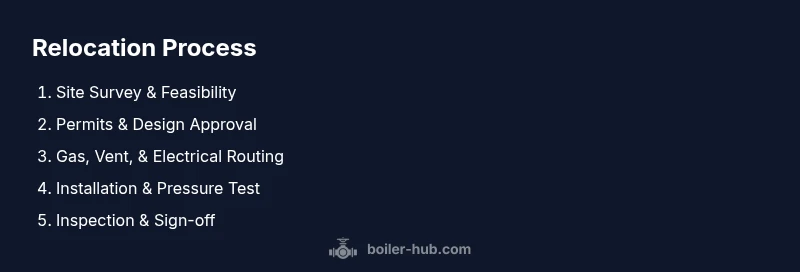
Estimated time: Feasibility assessment: a few hours; permitting and design: several days to a few weeks depending on local authorities; on-site relocation work: typically 1–3 days plus potential extended optimization.
- 1
Arrange a professional feasibility assessment
Engage a licensed gas-safe engineer to perform a site survey and determine if relocation is physically and legally viable. They’ll evaluate venting, gas line routing, clearance, and structural support, and will outline required permits. Plan for potential constraints and establish a preliminary budget.
Tip: Provide site plans, existing vent details, and any restrictive access information to speed the assessment. - 2
Obtain permits and schedule work
Submit permit applications for gas work, vent modifications, and any electrical changes. Coordinate with your gas supplier and building authority to ensure compliance and avoid delays. Schedule the work window to minimize disruption and ensure availability of the licensed team.
Tip: Ask for a fixed timeline and request written confirmation of permit readiness before beginning. - 3
Develop relocation design and spec
The engineer creates a detailed relocation plan, including gas line routing, venting changes, drainage, and structural support. Confirm clearances, service access, and future maintenance needs in the design. Review the plan for potential warranty implications.
Tip: Ensure the design accounts for future service access and potential downline upgrades. - 4
Prepare site and shut off gas safely
Before any physical work, isolate the gas supply and verify zero system pressure. Set up temporary containment and protective barriers. Prepare the new location space to receive the boiler, including a stable base and dry-running electrical connections if required.
Tip: Double-check shutoffs and gas isolation seals; never work on live gas lines. - 5
Disconnect, move, and reconnect boiler
Carefully disconnect the boiler, pipework, and venting, then move to the new location using appropriate lifting gear. Reconnect gas lines, venting, condensate drainage, and electrical connections, ensuring all seals are tight and components are correctly oriented.
Tip: Inspect vent joints and gas seals after installation; a small leak can be dangerous. - 6
Test, inspect, and certify
Perform pressure tests, leak checks, and safety interlock verification. Schedule inspections with the local authority and obtain final sign-off. Confirm warranty coverage and document the completed work for future maintenance.
Tip: Record all test results and keep copies of inspection documents for your records.
Questions & Answers
Is moving a boiler legal in my area?
Legal requirements vary by location, but most regions require permits for gas work and vent changes, plus inspections after completion. Check with your local authority and hire a licensed professional to ensure compliance.
Legal requirements vary, so consult your local authority and a licensed professional before starting.
Can I relocate without changing the vent or flue?
Most moves will require some venting changes to meet safety and code standards. A relocated boiler often needs re-routing or shortening of the flue, with proper clearances and seals.
Usually, vent changes are needed to stay safe and code-compliant.
How long does relocating a boiler take?
Time depends on site complexity, permits, and inspections. Plan for several days on-site plus time for design and approvals.
It typically takes several days, plus planning and permit time.
Will moving affect my boiler warranty?
Relocation can affect warranty if the work isn’t performed by an approved technician or if the boiler is altered beyond the manufacturer’s guidelines. Check with the manufacturer and your installer.
Warranties can be affected, so verify with the maker and installer.
Are there safer or cheaper alternatives to moving a boiler?
Yes. Options include upgrading the existing unit, adding zone controls, or placing a new compact unit in the current location. These can reduce disruption and preserve warranties.
Often, upgrading or rearranging within the same space is safer and cheaper.
What is the minimum clearance and access required?
Clearances depend on local codes and the boiler model. Your plan should specify service access, safe door swing, and unobstructed ventilation paths.
Adequate clearance and access are essential for safe operation and servicing.
Watch Video
Key Points
- Plan with a licensed pro to assess feasibility
- Expect permits and inspections for safety and compliance
- Vent and gas routing are the most critical constraints
- Budget for both relocation and potential replacement paths
- Document everything for warranty and future service