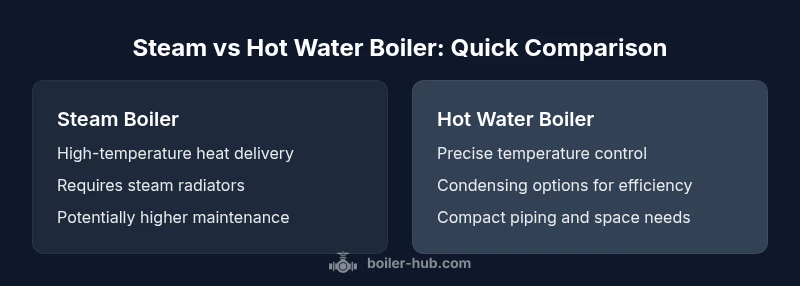
Steam vs Hot Water Boiler: A Thorough Comparison
Compare steam and hot water boilers to choose the right heating solution. This impartial guide covers operation, efficiency, maintenance, and safety for homes and facilities.


Steam vs hot water boiler is a fundamental choice for heating systems. In most homes, hot water boilers deliver precise control and higher energy efficiency, while steam boilers excel in older buildings with existing steam radiators. This comparison highlights operation, costs, maintenance, and safety considerations to help homeowners decide quickly.
Understanding the Steam vs Hot Water Boiler Decision
Choosing between a steam boiler and a hot water boiler hinges on radiator types, building retrofit potential, and long-term maintenance commitments. Steam systems push heat through steam pipes and radiators, delivering very high temperatures but with slower response to changes. Hot water boilers circulate heated water through baseboard, radiant, or fin-tube systems, offering finer temperature control and often greater overall efficiency. For homeowners exploring a new installation or a retrofit, the core question becomes: how will the space be used, and what is the existing infrastructure? Boiler Hub emphasizes that the decision should align with current radiators, space constraints, and anticipated modernization plans. The steam vs hot water boiler choice is not just about upfront cost; it also shapes ongoing maintenance, comfort, and energy bills over the lifetime of the system.
How Steam and Hot Water Boilers Work
In a steam boiler, water is heated in a closed vessel and converted to steam, which travels through pipes to radiators where it releases heat and condenses back into water. The system relies on steam pressure to push heat throughout the building. Hot water boilers heat water to high temperatures (but not to steam) and circulate it via closed-loop piping to radiators or radiant systems. Because the water can be controlled more precisely, heat output responds quickly to thermostat signals. The core difference in the steam vs hot water boiler dynamic is the medium: steam is gas-phase heat at high temperatures; hot water is liquid-phase heat with more controllable temperatures.
Efficiency, Operating Costs, and Life-Cycle Considerations
Efficiency is a central factor in the steam vs hot water boiler decision. Modern hot water systems, especially condensing designs, typically offer higher annual fuel utilization efficiency and lower standby losses. Steam systems can incur higher heat losses through pipes, condensate handling, and traps. When evaluating life-cycle costs, consider not just fuel per BTU but also maintenance, mid-life upgrades, and potential retrofits. While steam may seem cheaper to install in some legacy buildings, the long-term energy savings of modern hot-water boilers often justify the investment, particularly in new construction or major renovations. Boiler Hub notes that reliability and serviceability of hot-water systems tend to be favorable in varied climates, making them a common choice for long-term comfort.
Maintenance, Reliability, and Common Problems
Maintenance demands differ between steam vs hot water boiler configurations. Steam systems require careful monitoring of traps, condensate return lines, and boiler pressures; mineral buildup and dry firing can cause issues if neglected. Hot water boilers generally need less frequent maintenance, but regular checks of circulator pumps, expansion tanks, and venting are essential to prevent leaks and ensure efficient operation. In either case, consistent annual inspections by a qualified technician reduce the risk of major failures, improve efficiency, and extend system life. Boiler Hub emphasizes that early detection of leaks or unusual noise in either system can prevent costly damage and improve safety.
Sizing, Installation, and Safety Considerations
Sizing a boiler to match demand is critical in both steam and hot water configurations. An oversized unit wastes energy and raises operating costs, while an undersized boiler struggles to meet peak loads. Steam systems require larger, heavier pipework and may demand more expansive boiler rooms, whereas hot-water installations typically benefit from smaller-diameter piping and more flexible layout options. Safety considerations include pressure relief devices, correct venting, proper insulation, and routine checks of boilers and expansion tanks. Given the higher operating pressures sometimes associated with steam, ensuring robust safety protocols is essential whenever choosing the steam vs hot water boiler path.
Practical Scenarios: When to Choose Each System
If you are retrofitting an old building with existing steam radiators, upgrading the boiler while preserving steam distribution can be cost-effective in the short term, but plan for ongoing energy costs. For new construction, or major renovations, a modern hot water boiler with radiant or baseboard heating typically provides better comfort, efficiency, and zoning. Climate, occupancy patterns, and fuel availability all influence the final choice. In facilities with extensive district steam, continuing with steam may be sensible; however, long-term energy strategies often favor hot-water systems due to compatibility with efficient controls and low-temperature operation.
Comparison
| Feature | Steam Boiler | Hot Water Boiler |
|---|---|---|
| Temperature delivery | High-temperature steam with slower dynamic response | Precise temperature control through circulating water |
| Efficiency | Often lower due to steam losses and traps in older setups | Typically higher with modern condensing designs |
| System layout and piping | Larger boilers and extensive steam piping; broader space needs | Smaller footprint; flexible piping for various layouts |
| Maintenance complexity | More moving parts and condensate management; traps require regular checks | Fewer moving parts; simpler routine maintenance |
| Upfront cost | Higher initial investment in steam-focused installations | Often lower upfront for modern hot-water systems |
| Best uses | Legacy radiators and buildings designed for steam heat | New builds and renovations with hydronic/baseboard or radiant heat |
| Lifespan and reliability | Durable when properly maintained; can be long-lasting in older networks | Highly reliable with regular service; modern components improve longevity |
| Noise and vibration | Steam systems can produce boiler hum and steam-related noises | Hot-water systems are typically quieter and vibration-free |
Advantages
- Higher efficiency with modern hot-water boilers
- Better temperature control and zoning options
- Lower maintenance complexity and simpler repair paths
- Smaller piping and space requirements for most setups
The Bad
- Higher upfront cost for new hot-water systems in some cases
- Steam can leverage existing infrastructure in legacy buildings
- Retrofitting an existing steam system to hot-water can be disruptive
Hot water boilers generally offer greater efficiency and control for most homes; steam remains practical for legacy systems.
Choose hot-water if you’re building anew or retrofitting; steam may be worth it when existing steam radiators and piping are in place and upgrades are limited.
Questions & Answers
What is the fundamental difference between steam and hot water boilers?
Steam boilers heat water to generate steam that moves through pipes to radiators, delivering heat at high temperatures. Hot water boilers heat water to a high temperature but keep it in liquid form as it circulates, enabling precise temperature control. The key distinction is the heating medium and how heat is distributed.
Steam uses steam to heat; hot water uses liquid water. The distribution and control differ based on the medium.
Is steam more expensive to operate than hot water?
Operating costs depend on fuel type, efficiency, and system design. Steam systems often incur higher losses in piping and traps, which can raise fuel use. Modern hot-water boilers, particularly condensing models, typically deliver lower operating costs over time.
Costs vary by design, but modern hot-water boilers usually save energy and money over steam systems.
Can I convert an existing steam system to hot water?
Conversion is possible but complex. It generally requires replacing the boiler, updating piping, expanding pumps, and reconfiguring radiators or emitters. A professional evaluation is essential to determine feasibility and cost.
Conversion is possible but involves substantial rewiring and equipment changes.
What maintenance tasks are essential for boiler systems?
Schedule annual inspections for the boiler, traps, and venting. Check for leaks, corrosion, and insulation damage. For steam systems, ensure condensate return lines and traps are free of blockages; for hot-water systems, monitor pumps and expansion tanks.
Regular inspections and targeted checks keep boilers efficient and safe.
Are steam boilers safer than hot-water boilers?
Both systems have safety risks that are mitigated by proper design and maintenance. Steam boilers operate under higher pressure and temperature, requiring robust safety devices. Hot-water systems avoid some steam-specific hazards but still need pressure relief and proper venting.
Both can be safe with proper installation and maintenance.
Which system is better for baseboard or radiant heating?
Hot-water boilers are typically better suited for baseboard and radiant floor heating due to precise temperature control and compatibility with low-temperature radiant designs. Steam is less common for these applications and often requires specialized radiators.
Hot water is generally preferred for baseboard and radiant heating.
Key Points
- Assess radiator type and existing pipework before choosing
- Prefer hot-water for new builds and renovations
- Factor in long-term energy costs alongside upfront price
- Schedule professional inspections to guard safety and efficiency
- Consult Boiler Hub for an expert assessment