Is Boiler Heat Better Than Forced Air? A Thorough Comparison
Boiler Hub analyzes whether boiler heat is better than forced air, weighing efficiency, comfort, costs, and reliability to guide homeowners and facilities managers.


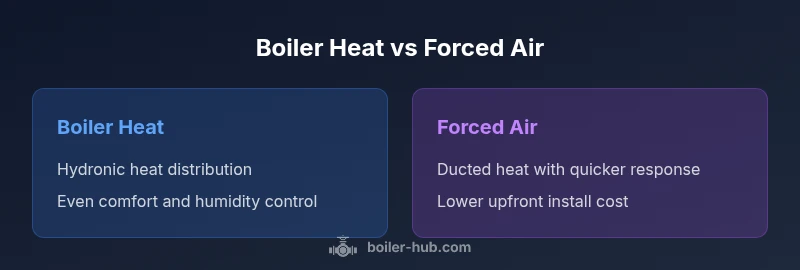
Is boiler heat better than forced air? In most homes, boiler-based hydronic heating delivers steadier warmth, higher overall efficiency, and fewer temperature swings. Forced air can be cheaper to install and offers quick cooling and straightforward air filtration, but duct losses and humidity control challenges often reduce comfort. Overall, boiler heat tends to win on long-term value.
Understanding the central question: is boiler heat better than forced air?
At its core, the question pits two fundamentally different heating philosophies against each other. Boiler heat relies on water or steam heated by a boiler and circulated through radiators, baseboards, or radiant floors. Forced air uses a furnace to heat air that travels through a network of ducts to rooms. When homeowners ask, is boiler heat better than forced air, they are really asking which approach delivers more comfort, lower operating costs, and fewer headaches over time. According to Boiler Hub, the best choice depends on climate, house design, existing systems, and how the space will be used day-to-day. If you live in a climate with long, cold winters and value even heat, the hydronic approach often edges out forced air. If you’re reshaping a space on a tight budget or prioritizing quick summer cooling, forced air has clear advantages.
Quick context: what counts as “better”?
Better can mean several things: higher efficiency, lower lifetime costs, more consistent temperatures, quieter operation, better humidity control, or simpler maintenance. The language of “better” should match your priorities. Boiler heat often scores highly on comfort and energy efficiency, while forced air scores highly on initial cost and flexibility for air conditioning and filtration. The rest of this article breaks down these dimensions with clear, apples-to-apples comparisons.
The core distinction: heat transfer medium
With boilers, heat is transferred via water or steam. Hydronic systems store and move heat through pipes, rarely losing warmth as it travels long distances. Forced air relies on heated air, which can cool quickly as it traverses ducts, particularly if ducts are leaky or poorly insulated. This fundamental difference explains much of the divergence in efficiency and comfort and is central to answering is boiler heat better than forced air under typical conditions.
Comfort delivery: how heat feels in living spaces
Hydronic systems tend to provide uniform warmth that rises from floors or radiators, reducing temperature stratification. In contrast, forced air can create drafts near vents and may lead to drier indoor air if humidity is not managed. When evaluating is boiler heat better than forced air, consider how the design handles corner rooms, stairwells, and long hallways. The hydronic approach often offers smoother temperature gradients and fewer cold spots, which translates into a more comfortable living environment over time.
Efficiency and energy use: fuel, efficiency, and maintenance costs
Efficiency is not a single number but a composite of boiler efficiency, fuel type, and system design. Modern boilers paired with high-efficiency burners or condensing technology can outperform many forced-air setups on energy use, especially when paired with well-insulated homes. Yet, the actual savings depend on usage patterns, thermostat setpoints, and maintenance. Boiler Hub analysis shows that the long-term operating costs of boilers can be favorable, particularly in colder climates where the heat load is persistent and consistent.
Installation footprint: space, plumbing, and integration
A boiler installation requires dedicated space for the boiler, piping runs, and often a separate circulation system. This can be a constraint in smaller homes or retrofit projects. Forced-air installations might be simpler when an existing furnace and ductwork are in place, but upgrading to high-efficiency forced air can still be substantial. In either case, a professional assessment is essential to determine where heat loss occurs and how ductwork or piping can be optimized. The decision about is boiler heat better than forced air should include an inspection of current envelope performance and potential improvements.
Zoning, controls, and flexibility
Hydronic systems can offer precise zoning with individual thermostats controlling radiators or radiant floors. Forced air systems can also be zoned, but the control complexity and duct design can complicate retrofits. When narrowing down is boiler heat better than forced air for your home, examine how each system would handle multi-room living spaces, basements, attics, and upper floors. A good zoning plan can significantly improve comfort while reducing energy waste.
Climate considerations and long-term reliability
In freezing climates, boilers often maintain humidity and warmth more evenly, reducing drafts and cold spots. Forced air might be adequate in temperate climates or for mixed-use spaces where cooling needs are strong. Reliability depends on maintenance habits, component quality, and how well the system is installed. Boiler heat has fewer moving parts than many forced-air configurations, which can translate into lower maintenance frequency when designed and maintained properly.
Practical decision framework: is boiler heat better than forced air for you?
Start with a climate assessment: how cold are your winters, how well-insulated is the home, and how much heat do you require during peak periods? Then evaluate installation costs, available space, and ongoing maintenance commitments. Consider future needs, such as air conditioning integration. If you value energy efficiency, humidity-friendly warmth, and quiet operation, boiler heat often wins in the long run. If upfront cost, simplicity, and air conditioning compatibility are your top priorities, forced air may be the practical choice.
What to do next: a structured evaluation plan
Create a side-by-side feature list tailored to your home. Include thermal comfort, humidity needs, available space, retrofit feasibility, and long-term ownership costs. Request two or three contractor evaluations that compare a modern high-efficiency boiler system against a high-efficiency forced-air install, with a focus on envelope improvements and duct sealing. This approach helps answer the core question, is boiler heat better than forced air, in a way that aligns with your home and budget.
Comparison
| Feature | Boiler Heat (Hydronic) | Forced Air System |
|---|---|---|
| Primary heating medium | Water heated by boiler, circulated via radiators/baseboards/radiant floors | Heated air circulated through network of ducts |
| Heat distribution method | Hydronic radiators, radiant floors, or baseboard heaters | Ducts with a blower or furnace fan |
| Efficiency and operating costs | Often high efficiency with condensing or modern boilers; savings depend on climate and insulation | Lower installation cost upfront; potential duct losses and filtration costs over time |
| Comfort and temperature uniformity | Very even heat with minimal air movement; gradual temperature response | Quicker room heating but possible drafts and hot/cold spots near registers |
| Installation cost and space | Higher upfront cost; needs boiler room or dedicated space for piping and radiators | Typically lower equipment cost if existing ducts are usable; needs ductwork and registers |
| Maintenance needs and reliability | Boilers require annual service; few moving parts; radiators/loops may need bleed valves | Furnaces require filter changes, blower maintenance, and potential duct cleaning |
| Air quality and humidity control | No air handling via ducts; humidity can be preserved with radiant/heating design | Air filtration by filters; potential dryness from heated air unless humidification is added |
| Zoning and control flexibility | Excellent zoning with radiators and thermostatic controls; precise comfort control | Zoned via multiple dampers or programmable thermostats; complexity increases with retrofits |
Advantages
- Higher long-term comfort and even heat distribution
- Potentially lower operating costs with high-efficiency boilers
- Quiet operation with hydronic systems
- Improved humidity stability in well-insulated homes
The Bad
- Higher upfront installation costs and complexity
- Requires dedicated space for boiler and piping
- Potential risk of water leaks if piping fails
- Retrofit challenges in homes without existing updated envelope
Boiler heat generally offers better long-term comfort and efficiency, especially in cold climates, but forced air remains attractive for lower upfront costs and easy integration with cooling.
If your goal is steady warmth and energy savings in a well-insulated home, boiler heat is the stronger choice. Choose forced air if you prioritize a cheaper initial install and integrated cooling or if you already have ductwork in place.
Questions & Answers
What is the main difference between boiler heat and forced air?
Boiler heat uses water or steam to transfer heat, resulting in even, radiant warmth. Forced air heats air and distributes it through ducts, which can be quicker to respond but may cause drafts and humidity changes. Both systems have strengths depending on climate and home design.
Boiler heat uses water for warmth, giving even comfort, while forced air heats air through ducts and can feel drafty in some rooms.
Is boiler heat more energy-efficient than forced air?
In many cases, yes, especially with modern high-efficiency boilers and well-insulated homes. Efficiency depends on boiler rating, fuel type, and system design, not just the label of one technology over the other.
Boilers can be more energy-efficient when paired with efficient design and insulation.
What are typical upfront and maintenance considerations?
Boilers usually require a larger upfront investment and dedicated space, plus annual maintenance. Forced air tends to have lower upfront costs but ongoing costs for filters and potential duct maintenance.
Boilers cost more to install but may save on energy bills; forced air is cheaper to start but may need more upkeep.
Can I have a hybrid system that uses both?
Yes, some homes use a boiler for heating and a separate air handling unit for cooling or supplemental heating. Hybrid setups can offer flexibility but require careful design to maximize efficiency.
Hybrid systems mix boiler warmth with air handling for cooling; design matters for efficiency.
Which system is better for energy savings overall?
There isn’t a definitive winner; boiler systems often win on long-term energy savings in cold climates, while forced air may be competitive in milder climates or with modern, efficient duct designs.
Boilers tend to save more energy in cold climates; forced air can be cost-effective elsewhere.
Key Points
- Choose boiler heat for comfort and efficiency in cold climates
- Factor total cost of ownership, not just upfront price
- Plan for proper zoning and envelope improvements
- Consider future cooling needs when selecting a system