Is a boiler or heat pump better? An in-depth comparison for homeowners
Compare boilers vs heat pumps for home heating and hot water. This Boiler Hub guide analyzes cost, efficiency, climate suitability, installation, and maintenance to help homeowners decide which system is better for their needs in 2026.


Is a boiler or heat pump better? In most homes, a heat pump offers superior year-round efficiency and comfort, while a boiler can be cheaper upfront and more reliable in extreme cold or where gas/oil infrastructure exists. The best choice depends on climate, electricity prices, and existing radiators or underfloor heating. Boiler Hub’s analysis (2026) emphasizes matching the system to local conditions and long‑term energy trends.
Why is a boiler or heat pump better for your home?
Is a boiler or heat pump better? The short answer depends on climate, electricity costs, and how your home is heated today. According to Boiler Hub, there is no one-size-fits-all answer in 2026; the right choice balances upfront cost, ongoing energy use, and comfort. A heat pump can deliver high efficiency in moderate climates with clean electricity, while a boiler remains a solid option where natural gas is cheap or where cold outdoor temperatures make a heat pump less reliable without supplemental heat. This section lays out the framework you can use to compare options against your specific building and energy mix.
Boiler Hub analysis shows that the decision should consider long-term energy prices, system compatibility, and your willingness to upgrade insulation and controls. For homeowners upgrading from an older boiler or radiator system, the evaluation often hinges on whether you have room for a heat-pump outdoor unit, space for a storage tank, and the availability of a reliable electricity supply. The goal is to identify a solution that minimizes total cost of ownership over 10–20 years while maintaining steady comfort.
Key factors that influence the decision
The choice between a boiler and a heat pump is driven by several interrelated factors. First, climate plays a central role: boilers tend to perform consistently in very cold weather, while heat pumps excel in milder winters and benefit greatly from electricity with a low carbon intensity. Second, energy prices and grid mix matter: in regions with cheap, clean electricity, heat pumps can outperform boilers on operating costs. Third, existing infrastructure matters: homes with gas lines and older radiators may incur costs to adapt for a heat pump. Fourth, space and installation constraints influence feasibility: outdoor units, piping, and ventilation requirements add complexity. Finally, maintenance needs and expected lifespan should shape expectations for service intervals and part replacement. A thorough analysis considers all four pillars—climate, price, infrastructure, and space—to choose the right system.
Climate and energy prices: how weather shapes efficiency
Climate dictates the relative efficiency of boilers and heat pumps. In mild winters with access to affordable electricity, heat pumps typically outperform boilers on running costs due to heat extraction from the air or ground and improved part-load efficiency. In regions with very cold snaps, certain heat pump models may require auxiliary or backup heating, which can raise running costs unless temperatures stay moderate. Boilers, fueled by gas or oil, provide dependable heat even when outdoor temperatures plunge, but their operating costs reflect fuel price volatility. From a long-term perspective, energy price trends and grid decarbonization influence future affordability of both options. Boiler Hub analyses suggest modeling yearly energy bills under different electricity and gas price scenarios to identify the lowest total cost of ownership.
System compatibility: radiators, underfloor heating, and ductwork
Compatibility with your current system matters as much as efficiency. If your home relies on old radiators or a gravity-fed system, a heat pump may require retrofits such as lower-temperature supply and possibly new distribution strategies to maximize comfort. Underfloor heating pairs well with heat pumps, since it operates effectively at lower water temperatures, delivering even heat with less waste. Conversely, a retrofit to support a boiler may involve upgrading flues, expansion tanks, and controls. Ducted systems and existing heat distribution layouts influence whether a heat pump can provide centralized comfort without compromising warm-up times. Assessing ductwork, radiator compatibility, and zoning helps determine installation complexity, cost, and performance.
Running costs and upfront investments
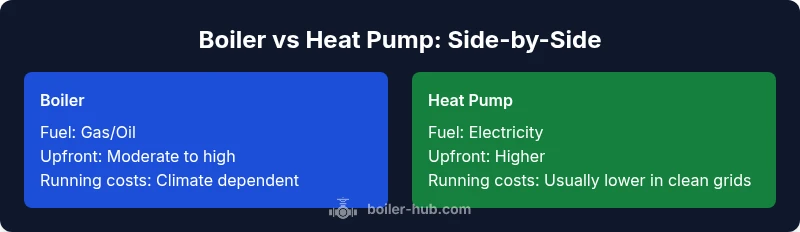
Initial cost and ongoing energy use are the backbone of any decision. Boilers generally require lower upfront investment in homes with existing gas infrastructure, whereas heat pumps can entail higher upfront costs due to outdoor units, compatible heat distribution, and possible electrical upgrades. Yet running costs favor heat pumps in many markets where electricity is cheaper or increasingly decarbonized, especially when paired with solar or other renewables. Life-cycle economics should consider electricity price projections, insulation quality, and maintenance needs. Boiler Hub’s guidance emphasizes building a robust baseline for total cost of ownership, not just purchase price, to avoid surprises over the decade ahead.
Installation, space, and lifecycle considerations
Space and installation complexity heavily influence feasibility. Boilers need a cabinet, flue or venting, and access for servicing; outdoor heat-pump units require clearance, noise considerations, and outdoor space. A heat pump water heater or hybrid system can add complexity but deliver enhanced energy performance if sized correctly. Lifecycle considerations include parts availability, typical replacement cycles, and the impact of refrigerant regulation on service costs. A careful installation plan accounts for local permits, insulation levels, and a schedule that minimizes downtime, so you can enjoy reliable heating and hot water with minimal disruption.
Environmental impact and emissions
Environmental considerations depend on how electricity is produced and the system’s efficiency. Where the grid is powered by low-emission sources, heat pumps can substantially reduce on-site emissions compared to fossil-fuel boilers. In communities with high carbon intensity electricity, the advantage narrows, and the best option may hinge on the overall energy mix and retrofit opportunities such as solar. Boilers running on natural gas still emit CO2, though modern condensing models improve efficiency. Boiler Hub highlights the importance of decarbonization pathways and evaluating annual emissions as part of the decision process.
Smart controls and future-proofing
Smart thermostats, zoning, and demand-response capable equipment can tilt the balance toward heat pumps by optimizing heat distribution and reducing waste. System automation enables better load management, enabling you to align heating with occupancy and utility rates. For boilers, smart controls improve efficiency and comfort but depend on compatible radiators and existing distribution. In both cases, future-proofing means selecting equipment with serviceable components, available spare parts, and compatibility with ongoing energy policy trends.
When to choose a boiler: practical scenarios
A boiler is often a sensible choice when you have reliable natural gas, a high-efficiency modern boiler, and existing radiators designed for higher-temperature water. If you live in regions with very cold winters and limited electricity for long portions of the day, a gas boiler can provide steady warmth and rapid hot water. Replacement costs can be lower if your home already accommodates a gas-fired heating system and venting is straightforward. For homes with pre-1980s infrastructure or where gas is plentiful, boilers remain a robust, familiar option with predictable service pathways.
When to choose a heat pump: practical scenarios
Heat pumps excel in milder climates or when electricity is clean and affordable. They pair well with upgraded insulation, airtight envelopes, and low-temperature distribution like radiant floor heating. If you are moving toward decarbonization or have solar PV, heat pumps can leverage on-site generation to minimize operating costs. For homes without gas infrastructure or those upgrading to a more efficient, low-carbon system, a heat pump—often in a hybrid arrangement—provides long-term value and comfort.
How to evaluate real-world performance and maintenance needs
The real-world performance of boilers and heat pumps depends on load factors, climate, and maintenance. Track your annual energy usage, service intervals, and any unexpected outages to compare predictions with actuals. Ask installers for modeled yearly costs under typical weather patterns and for references from homes with similar size and design. Consider maintenance needs, such as refrigerant checks for heat pumps and condensate management for boilers, and plan service visits accordingly to protect efficiency and reliability.
Comparison
| Feature | boiler | heat pump |
|---|---|---|
| Initial cost (installation) | moderate to high, especially if gas lines and flue upgrades are needed | often higher upfront due to outdoor unit, controls, and possible electrical work |
| Running cost / energy efficiency | depends on fuel price; gas boilers can be economical when gas is cheap | generally high efficiency; best in regions with affordable electricity and clean grids |
| Maintenance needs | annual boiler servicing and venting checks; parts availability | regular refrigerant checks, fan/compressor maintenance; typically fewer moving parts |
| Cold-weather performance | reliable heat when fuel is available; performance varies by boiler type | strong cold-weather performance with proper model and backup heat |
| Noise and footprint | indoor boiler components and venting can be noisier in some layouts | outdoor compressor adds noise; indoor units are usually quiet |
| Space and installation | boiler space for unit, expansion tank, flue; can be compact in modern setups | outdoor unit plus indoor distribution; zoning considerations required |
| Environmental impact | emissions depend on gas/oil usage and efficiency | lower emissions when powered by clean electricity; decarbonization benefits |
Advantages
- Potentially lower running costs in electricity-rich regions with heat pumps
- Enhanced comfort with precise temperature control and zoning
- Lower on-site emissions when powered by clean grid electricity
- Good long-term reliability with modern components and smart controls
- Flexibility to pair with solar or other renewables
The Bad
- Higher upfront cost and installation complexity for heat pumps
- Performance can degrade in very cold climates without auxiliary heat
- Requires electrical upgrades and space for outdoor unit in some properties
- Refrigerant handling and regulatory considerations for some systems
Heat pumps are often the better long-term choice in moderate climates with clean electricity; boilers remain strong in very cold climates or where gas infrastructure already exists.
Choose heat pumps to maximize efficiency and comfort when electricity is affordable and carbon intensity is low. Opt for a boiler if you need rapid, reliable heat in extreme cold or when gas infrastructure is a mature part of your building's energy plan.
Questions & Answers
What is the main difference between a boiler and a heat pump?
A boiler generates heat by burning fuel (gas or oil) to heat water that circulates through radiators or underfloor heating. A heat pump transfers heat from the outside environment into your home using electricity, delivering warm air or water with high efficiency. The choice hinges on climate, energy costs, and existing heating infrastructure.
Boilers burn fuel to create heat, while heat pumps move ambient heat using electricity. The better option depends on climate, energy costs, and your current heating setup.
Which is cheaper to install: boiler or heat pump?
Boilers often have lower upfront costs if your home already has gas lines and venting. Heat pumps typically involve higher initial investment due to outdoor units, wiring, and possible distribution upgrades. Long-term economics depend on energy prices and maintenance needs.
Boilers usually cost less upfront if you already have gas, while heat pumps cost more to install but can save money over time with cheap electricity.
How do climate and electricity prices affect performance?
In milder climates with affordable, clean electricity, heat pumps tend to deliver lower operating costs and better comfort. In very cold areas or where electricity is expensive or unreliable, boilers may be more economical and dependable. Consider your grid mix and seasonal heating needs.
Heat pumps shine when electricity is cheap and clean; boilers may win in extremely cold regions or where gas is cheap.
Can you install a boiler and heat pump together?
Yes. Some homes use a hybrid approach (dual-fuel or bivalent systems) that leverages a heat pump for most of the year and a boiler as a backup during peak cold periods. This can optimize efficiency while maintaining reliability.
A hybrid setup uses both, giving you efficiency most of the year and backup heat when it’s very cold.
What maintenance is required for each system?
Boilers require regular annual servicing, venting checks, and occasional parts replacement. Heat pumps need refrigerant and capacitor checks, filter cleaning, and occasional component servicing. Routine maintenance preserves efficiency and extends system life.
Boilers need annual checks; heat pumps need refrigerant and routine servicing.
Which system is best for a retrofit without major renovations?
If you have limited space and want to minimize disruption, a well-designed heat pump with a compact outdoor unit and compatible distribution can be a retrofit option. However, retrofits must assess electrical capacity and space for outdoor equipment.
Retrofitting with a heat pump is possible, but you’ll need space and the right electrical setup.
Key Points
- Assess climate and electricity prices before deciding
- Check existing infrastructure and space for outdoor units
- Model total cost of ownership, not just upfront price
- Consider future decarbonization and smart-controls readiness
- Consult Boiler Hub guidance and local installers for tailored rates