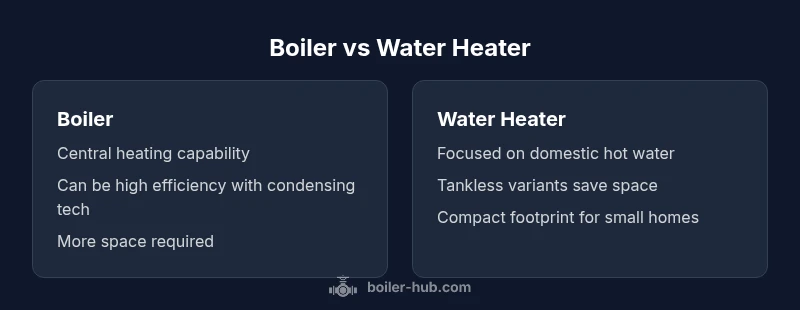
Boiler or Water Heater: Choosing the Right Option for Homes
A comprehensive comparison of boiler vs water heater, covering definitions, efficiency, costs, installation, and maintenance to help homeowners and facility managers decide which system fits their needs.


Choosing between a boiler or water heater depends on your needs for central heating and hot water. If you require consistent central heating plus hot water, a boiler is usually the stronger long‑term option. If you mainly need reliable domestic hot water with minimal footprint, a dedicated water heater may be more cost‑effective. This comparison helps homeowners decide.
Why boiler or water heater decisions matter for home comfort
When considering whether to install a boiler or a water heater, homeowners must weigh how hot water is produced, stored, and delivered across the home. The choice affects energy bills, space usage, and future upgrades. According to Boiler Hub, understanding the interplay between space heating and domestic hot water is essential for a cost‑effective solution. In many homes, the decision isn’t about choosing one device in isolation but about aligning with the overall heating strategy—whether you prioritize radiant warmth, radiant floors, or simple hot water supply. In this guide, we’ll unpack how each system works, the implications for daily use, and practical steps to make the right choice for your household. The term boiler or water heater may refer to very different configurations depending on climate, fuel source, and existing infrastructure.
wordCountPlaceholder
Comparison
| Feature | Boiler | Water Heater |
|---|---|---|
| Heat delivery scope | Central heating (radiators or radiant systems) + hot water (in some configurations) | Domestic hot water only, may be part of a larger system if a coil or combined unit is used |
| Space requirements | Typically requires a dedicated mechanical space; often paired with a home heating system | Can be compact (tankless) or tank-based; many options fit in small utility spaces |
| Upfront price range | Mid to high upfront cost, depending on boiler type and installation | Mid to high upfront cost for many models; tankless variants may offer savings in some cases |
| Operating costs | Costs vary with heating load and fuel; boilers can be efficient but may heat a larger space | Typically efficient for hot water; tankless models minimize standby losses and can lower ongoing costs |
| Maintenance needs | Generally requires annual servicing of the boiler and system checks | Maintenance depends on tank type; tankless units require periodic descaling and service |
| Best for | Homes with existing central heating and space for a boiler room or utility | Homes prioritizing compact footprint or just hot water without full heating needs |
| Lifespan and reliability | Boilers commonly last many years with proper maintenance | Water heaters vary by type; tankless units can have long lifespans with proper care |
Advantages
- Clarifies overall home energy strategy by outlining central heating vs. hot water focus
- Helps homeowners plan space, retrofit needs, and future upgrades
- Improves budgeting by comparing long‑term costs and maintenance expectations
- Supports informed decisions about hybrid or upgrade paths to higher efficiency
The Bad
- Can be confusing for retrofit projects with existing radiators or radiant floors
- Requires professional assessment to confirm compatibility with current fuel and venting
- Costs can vary widely based on home size, climate, and installation complexity
Boiler is typically the better fit for homes needing robust central heating plus hot water; water heaters are ideal for compact spaces or where hot water is the sole priority.
If your home relies on radiators or underfloor heating, a boiler provides integrated comfort and efficiency. For smaller homes or apartments needing reliable hot water without extensive heating demands, a dedicated water heater can be more cost‑effective. The best choice depends on existing infrastructure, space, and long‑term energy goals.
Questions & Answers
What is the main difference between a boiler and a water heater?
A boiler primarily provides central heating for a home and may also supply domestic hot water. A water heater focuses on providing hot water for taps and showers, with or without a central heating system. The right choice depends on whether you need space heating in addition to hot water.
A boiler powers home heating and hot water, while a water heater focuses on hot water supply. Your decision hinges on whether you require central heating alongside domestic hot water.
Can I replace a boiler with a water heater or vice versa?
Yes, but it usually requires substantial system changes, including piping, venting, and potentially a different fuel setup. A professional assessment is essential to determine feasibility, cost, and safety implications.
Replacing a boiler with a water heater, or the other way around, often needs significant system changes. Get a professional assessment.
Which is more energy efficient for a typical home?
Efficiency depends on design, usage, and fuel source. Boilers with modern condensing technology can be highly efficient for whole‑home heating, while modern high‑efficiency water heaters minimize standby losses. The best choice aligns with your heating load and hot water demand.
Efficiency varies; modern boilers and tankless water heaters can be very efficient when sized correctly for your home.
How long do boilers and water heaters last on average?
Boilers often last 15–30 years with proper maintenance. Water heaters vary by type: storage tanks typically last 10–15 years, while high‑efficiency or tankless models can exceed that with good care.
Boilers commonly last decades with maintenance; water heaters last about a decade to a couple of decades depending on type.
What maintenance should I expect for each system?
Boilers require annual servicing, pressure checks, and vent inspection. Water heaters need periodic flushing to remove sediment, and tankless units may require mineral scaling prevention. Regular professional checks help prevent costly failures.
Annual boiler service and regular water heater maintenance keep systems efficient and safe.
What questions should I ask a installer when choosing between them?
Ask about system compatibility with your climate, fuel type, and existing piping. Request a sizing calculation, installation timeline, warranty coverage, and expected running costs. Also ask about maintenance requirements and service availability.
Ask about sizing, costs, warranty, and maintenance when planning the install.
Key Points
- Assess your home’s heating and hot water needs before choosing
- Factor space, retrofit costs, and maintenance into the decision
- Consider total cost of ownership, not just upfront price
- Explore hybrid or future‑proof options (e.g., combi boilers, high‑efficiency tankless models)
- Consult a Boiler Hub professional to tailor the solution