Boiler vs HVAC: Choosing the Right Heating System
A rigorous, expert comparison of boiler and HVAC options for homeowners and facility managers, covering efficiency, installation, maintenance, and total cost of ownership to decide between boiler vs hvac.


Choosing between a boiler and a full HVAC system depends on climate, existing ductwork, and long-term energy costs. In many homes, a boiler-based radiant system can deliver steady comfort with high efficiency, while a traditional HVAC setup offers faster cooling and broader zoning. For a balanced view, compare total cost of ownership, maintenance needs, and compatibility with your home.
The Core Difference: Boiler vs HVAC
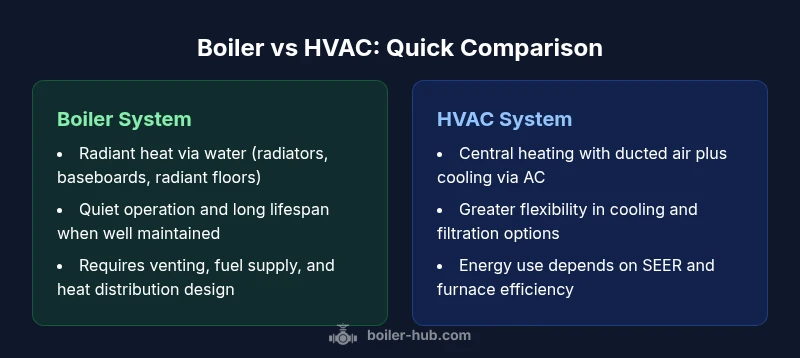
In residential heating, the terms boiler and HVAC describe two distinct approaches to delivering warmth and, in many homes, cooling. A boiler heats water that circulates through radiators, baseboards, or radiant floors to generate comfortable warmth. By contrast, an HVAC system generally refers to heating, ventilation, and air conditioning delivered through ducts to space and air distribution networks. When weighing boiler vs hvac, climate, fuel availability, space, and the distribution network already in place matter most. According to Boiler Hub, the ultimate choice often hinges on climate-related efficiency, installation practicality, and long-term operating costs. This article digs into how each option performs in real-world homes, with practical guidance for homeowners and facility managers. The goal is to help you avoid common missteps and frame a decision around total cost of ownership, not just upfront price.
Climate, Comfort, and System Fit
Climate dictates which approach feels most comfortable and economical over the life of the system. In colder regions, a boiler often delivers steady, low-velocity heat with less temperature fluctuation across rooms, especially when paired with radiant floors or baseboard radiators. In milder climates, an HVAC setup can provide both reliable heating and efficient cooling, offering a single footprint for year-round comfort. When comparing boiler vs hvac, consider your home’s insulation levels, occupancy patterns, and comfort preferences. A boiler-based system may shine where you want quiet operation and uniform warmth, while an HVAC-centric approach may win for homes needing integrated cooling and air filtration. Boiler Hub’s analysis emphasizes evaluating climate-specific performance and user comfort metrics before deciding on boiler vs hvac.
Ductwork, Zoning, and Space Considerations
Distribution networks influence both performance and convenience. Boilers frequently enable radiant or baseboard heat with minimal ductwork, which can reduce air leakage and duct-system maintenance. HVAC systems rely on ductwork to distribute heated or cooled air; poor duct sealing can erode efficiency and comfort, especially when considering boiler vs hvac. Zoning becomes a decisive factor: radiant systems often pair with zone valves or thermostatic controls for precise comfort, while forced-air systems can offer flexible zoning with multiple dampers. Space constraints also matter: boilers may occupy a compact mechanical room, whereas ducted HVAC often requires space for ducts, plenums, and return paths. Understanding the physical footprint is essential when choosing boiler vs hvac for a retrofit or new build.
Energy Efficiency, Operating Costs, and Payback
Efficiency is a central criterion when evaluating boiler vs hvac. Modern boilers can reach high thermal efficiency, especially when paired with well-designed radiant or baseboard layouts. HVAC energy efficiency hinges on both furnace efficiency and cooling efficiency (SEER for cooling). In many homes, the combined energy costs for a boiler-based radiant system can be competitive or superior in heating-dominated climates, while HVAC systems may offer more predictable cooling costs and flexible operation. Boiler Hub Analysis, 2026, suggests the decision often comes down to the local energy mix, fuel costs, and heat distribution losses. A homeowner or facility manager should model seasonal energy use, not just winter usage, to compare boiler vs hvac on a total-cost-of-ownership basis.
Maintenance and Reliability: What to Expect
Maintenance needs differ between boiler and hvac configurations. Boilers typically require annual servicing, safe venting checks, and periodic boiler water tuning (where applicable). Radiant systems with boilers have fewer moving parts in the heat delivery loop, which can translate to reliable long-term operation when well maintained. HVAC systems demand regular furnace or heat-pump service and annual air-conditioning maintenance, including filter replacements and refrigerant checks. In a boiler vs hvac comparison, maintenance frequency and accessibility should factor into your decision, especially if you have limited service resources nearby. Boiler Hub’s guidance stresses proactive maintenance as a differentiator in long-term reliability.
Installations and System Lifespan
Installation complexity drives both cost and disruption. A boiler installation may require specialists for venting, fuel supply, and radiant distribution design, but once commissioned, boilers can last many years with proper maintenance. HVAC installations might involve more trades (electrical, ductwork, refrigerant handling) and can incur higher upfront costs when modifying ducts. Lifespan tends to be long for both options, but the actual longevity depends on usage patterns and service quality. Planning for long-term availability of parts and skilled technicians is a key part of the boiler vs hvac conversation, especially in aging homes where retrofits are common.
Noise, Comfort, and Indoor Air Quality
Noise levels are a practical consideration that can influence comfort in either system. Boilers themselves are often quieter than air-handling equipment, since heat delivery is hydronic rather than air-based. However, radiant heating can take longer to reach desired temperatures, which affects perceived comfort during shoulder seasons. Indoor air quality in boiler-based systems relies on vented combustion air and filtration at the space level, while HVAC systems can actively filter, ventilate, and humidify the air. When weighing boiler vs hvac, think about IAQ goals, filtration needs, and acceptable noise thresholds for bedrooms and living spaces.
Smart Controls and Modern Features
Smart thermostats, zoning interfaces, and remote monitoring are increasingly common in both boiler and hvac configurations. In boiler vs hvac comparisons, you may see stronger cost-effectiveness for smart zoning with radiant systems, where individual rooms can be heated independently. Modern boilers can integrate with heat-pump hybrids or solarthermal assists, while HVAC systems may offer advanced air quality features, variable-speed fans, and efficient cooling strategies. The key is to match control capabilities with your comfort expectations and energy goals, ensuring the system you choose supports efficient operation over its entire lifespan.
Safety and Regulatory Considerations
Both boilers and HVAC systems require attention to safety and compliance. Gas-fired boilers demand proper venting, combustion safety checks, and CO detectors in living spaces. Electric or oil-fired boilers introduce different regulatory considerations and maintenance obligations. Venting, fuel supply, and refrigerant handling all have safety implications in the boiler vs hvac decision. Local codes and manufacturer guidelines should drive installation planning, with a clear focus on continuous air quality, leak prevention, and safety devices. Boiler Hub emphasizes engaging licensed professionals to ensure safety standards are met throughout system life.
Costs in Context: Upfront vs Long-Term
Upfront cost is only part of the picture. Boiler-based radiant systems may require a larger initial investment for equipment, piping, and installation, but operating costs can be favorable in cold climates due to efficient heat distribution and reduced air leakage. HVAC systems typically incur moderate to higher upfront costs depending on ductwork and cooling capacity, with ongoing energy costs shaped by SEER ratings and furnace efficiency. The best boiler vs hvac choice balances installed price, energy costs, and expected maintenance spend over the system’s life, while also considering potential upgrades or hybrids that may reduce total expenditure over time. Boiler Hub Advocacy cautions against focusing solely on upfront price when predicting long-term ownership costs.
Real-World Scenarios: Case Studies (Hypothetical)
To illustrate boiler vs hvac decisions in practice, consider three common scenarios. In a new, well-insulated cold-climate home, a high-efficiency boiler with radiant floors can deliver uniform warmth with low duct losses. In a retrofit in a warm climate with existing ducts, an HVAC system with high-SEER cooling may be the more practical path, especially if cooling is a primary need. For a home seeking year-round comfort with room-by-room temperature control, a hybrid approach combining a boiler for heating with a separate air-source heat pump for cooling can offer balanced performance and flexibility. In each case, calculating total cost of ownership and projected energy usage is essential to choosing boiler vs hvac wisely.
Alternatives and Hybrids: Hybrid Systems and Boilers in Modern Homes
Hybrid systems—often combining a boiler with a heat pump or a high-efficiency furnace—are increasingly popular as a way to optimize boiler vs hvac outcomes. These configurations can leverage the strengths of each technology: radiant warmth from a boiler and efficient cooling from a heat pump, or gas/oil backup with electric cooling. Hybrids can offer better energy performance in transitional seasons and in homes undergoing phased renovations. When evaluating boiler vs hvac with hybrids in mind, assess compatibility, zoning possibilities, and service availability for both technologies.
Boiler Hub's Guidance for Your Home
In summary, the boiler vs hvac decision should hinge on climate, distribution, and long-term energy goals rather than short-term price. Boiler Hub recommends a structured evaluation: map your comfort priorities, model seasonal energy costs, and consult qualified professionals to design a system that aligns with your home’s architecture and maintenance capacity. The goal is a heating and cooling solution that minimizes energy waste while delivering reliable comfort across all seasons. For homeowners and facility managers, this means planning for the long game: efficiency, resilience, and serviceability in the system you choose.
Comparison
| Feature | Boiler system | HVAC system (furnace + central AC) |
|---|---|---|
| Energy delivery method | Hydronic heat (hot water or steam) distributed via radiators, baseboards, or radiant floors | Forced-air distribution through ducts for heat and cooling |
| Ductwork | Often minimal or no ducts when using radiant heat | Extensive ductwork required for centralized heating and cooling |
| Zoning flexibility | Zoning via radiant zones and boiler controls; very effective with baseboard or radiant floors | Zoning via multiple ducts and dampers; depends on air handler capacity and duct layout |
| Cooling capability | No built-in cooling; requires separate AC, heat pump, or evaporative cooling | Integrated cooling via central air conditioning or heat pump system |
| Initial cost trend | Higher upfront costs in radiant boiler-based designs or where extensive piping is needed | Moderate to high upfront costs, influenced by ductwork complexity and cooling capacity |
| Operating costs (heating focus) | Competitive or lower heating costs in well-designed radiant systems; energy losses depend on distribution | Heating costs tied to furnace efficiency and cooling costs tied to SEER rating |
| Maintenance frequency | Annual boiler service, vent/combustion checks, and system-specific maintenance | Annual furnace and AC maintenance; regular filter changes and refrigerant checks |
| Lifespan and durability | Boilers commonly long-lived with proper maintenance; routine checks extend life | Furnaces and central AC units have varying lifespans but typically shorter than boilers |
Advantages
- Potential for high energy efficiency with radiant boiler systems in cold climates
- Reduced duct leakage and potentially quieter operation in boiler-based layouts
- Excellent space utilization in homes with limited crawlspace or attic access
- Strong compatibility with zone-based heating and radiant floor systems
The Bad
- Higher upfront costs for boiler and radiant distribution installation
- Retrofits can be complex if existing ducts and spaces are not ideal
- Need for venting, fuel supply, and CO safety considerations in gas/oil boiler systems
- Cooling requires adding a separate system or hybrid approach
Boiler vs HVAC: choose based on climate and home design
In cold climates with radiant heating potential, a boiler-based system often delivers energy-efficient comfort. For homes needing year‑round comfort with centralized cooling, an HVAC approach—with careful duct design and high-efficiency equipment—can be more versatile. A hybrid approach may offer the best balance in transitional climates.
Questions & Answers
What is the main difference between a boiler and HVAC when comparing boiler vs hvac?
A boiler heats water to distribute warmth via radiators or radiant floors, while HVAC typically combines heating, ventilation, and air conditioning through ducts. The choice between boiler vs hvac often hinges on climate, distribution network, and long-term energy costs.
Boiler heats with water, HVAC uses ducts for air. Climate and distribution determine which is better for you.
Can I install a boiler in a home with existing ductwork, or should I stay with HVAC?
If you already have extensive ducts, you can still evaluate boiler vs hvac by considering radiant heat options and potential duct rework. In some cases, running fewer ducts or converting spaces to radiant heat can reduce energy losses. A professional assessment helps determine feasibility.
Existing ducts can complicate boiler installs, but a designer can suggest radiant options that fit your space.
What factors influence the cost difference between boiler vs hvac?
Cost differences depend on installation complexity, type of fuel, distribution method, and local labor rates. Boilers may require piping and venting, while HVAC depends on ductwork and cooling components. Long-term energy costs also influence the decision.
Installation complexity, fuel, and distribution type drive the cost of boiler vs hvac.
Are boilers safer than HVAC systems?
Both systems require proper venting, CO detectors, and regular maintenance. Boilers have risk considerations related to combustion gases, while HVAC systems emphasize refrigerant safety and electrical protections. Proper installation and ongoing service minimize safety concerns in boiler vs hvac.
Safety hinges on correct venting and regular maintenance for both.
Which system is better for summer cooling?
HVAC systems with central air conditioning or heat pumps provide cooling, while boilers alone do not. For year-round comfort, a combined approach or a dedicated cooling solution is needed in boiler vs hvac planning.
Cooling requires an HVAC or heat pump component; boilers don’t cool by themselves.
What maintenance is required for boiler vs hvac?
Boilers require annual service and vent checks; HVAC systems require regular furnace or heat-pump service and AC maintenance. Filtration and refrigerant checks are part of the HVAC routine. Regular professional maintenance is crucial for both when weighing boiler vs hvac.
Regular professional maintenance is key for both options.
Key Points
- Assess climate and energy costs before deciding boiler vs hvac
- Evaluate ductwork, space, and zoning implications early
- Model total cost of ownership, not just upfront price
- Consider hybrids if you want comfort and efficiency year-round
- Plan for safety, regulatory requirements, and service availability