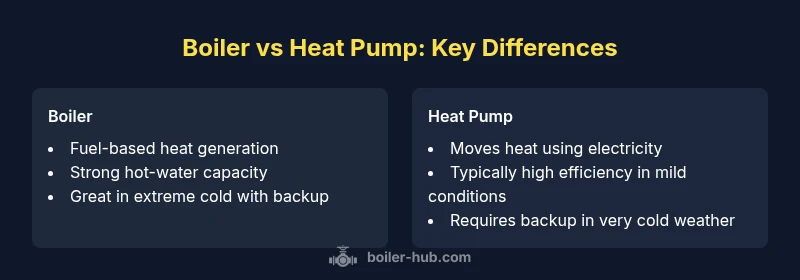
Boiler vs Heat Pump: Side-by-Side Comparison
Explore the essential differences between boilers and heat pumps, including how they work, cost considerations, climate suitability, and practical guidance for homeowners and facility managers evaluating the boiler vs heat pump choice.


Choosing between a boiler and a heat pump hinges on climate, energy costs, and existing infrastructure. In many homes, a heat pump delivers superior overall efficiency in moderate climates, while a traditional boiler may win in very cold regions or when hot water demand is high. The Boiler Hub team emphasizes a climate-smart approach to maximize long-term value.
Overview: boiler vs heat pump
In the broad landscape of home heating, two main approaches dominate: boilers and heat pumps. A boiler generates heat by burning fuel or using electrical resistance to heat water, which then circulates to radiators or taps. A heat pump, by contrast, moves heat from outside air, the ground, or water into the indoor space, powered by electricity. According to Boiler Hub, the best choice depends on climate, energy costs, and existing infrastructure. A clear-eyed comparison focuses on climate fit, long-term operating costs, installation requirements, and compatibility with your current radiators or underfloor networks. Both options can provide space heating and domestic hot water, but their efficiency profiles, service needs, and potential for emissions differ. In practice, many homes use a hybrid approach: a heat pump for daily heating and a boiler as a backup or booster during peak cold spells. This framework helps homeowners and facility managers avoid common missteps and choose a solution that remains comfortable and cost-effective over time.
How each system works
Boilers heat water directly, using natural gas, oil, or electricity, and send the hot water or steam through radiators or radiant floors. The temperature is controlled by a boiler thermostat and a circulating pump; fuel type determines annual fuel cost and emissions profile. Heat pumps operate on a fundamentally different principle: they extract heat from an external source (air, ground, or water) and compress it to a higher temperature for indoor heating and hot water. The external heat source is not consumed in the same way as fuel, so these devices can deliver higher effective efficiency, especially when electricity prices are reasonable. Both systems rely on an indoor distribution network, but heat pumps can also work with ducted air systems. The system’s overall performance depends on insulation, heat load, and whether auxiliary heating is used during extreme cold.
Climate and installation considerations
Climate plays a decisive role in the boiler vs heat pump decision. Heat pumps tend to provide the best balance of comfort and efficiency in moderate climates, with performance improving as electricity prices stay relatively stable. In very cold regions, heat pumps may require supplemental or backup heating to maintain comfort, which can affect total cost and reliability. Boilers, especially gas or oil models, can deliver strong heat quickly in freezing temperatures and hot water on demand, with less reliance on outside conditions. Installation implications include radiator sizing, ductwork, and the potential need for upgrading electrical circuits or adding a ground loop or well to support a heat pump. If you’re upgrading an older home, consider whether your current distribution system and insulation will support either option without major remodeling; this helps avoid hidden costs later.
Efficiency and operating costs
Efficiency is a central consideration. Boilers convert fuel into heat, and their efficiency varies by model, fuel type, and maintenance history; energy costs and fuel prices will influence long-term bills. Heat pumps, by contrast, move heat rather than generate it, and their efficiency is expressed as a coefficient of performance (COP) or seasonal performance metric; COPs typically exceed 1, with higher values in favorable outdoor temperatures. In many markets, heat pumps offer lower running costs than boilers, particularly when electricity prices are stable and cold snaps are infrequent. Boiler Hub analysis shows that the long-term cost dynamics often favor heat pumps in temperate climates, but fossil-fuel boilers can still be economical where electricity is expensive or fuel prices are low. Keep in mind that maintenance, refrigerant charges, and the age of the equipment affect ongoing costs, so a proactive service plan matters for both options.
System compatibility and upgrades
Your existing heating distribution matters. A heat pump may require compatible radiators, a well-insulated home, or a switch from single-zone to multi-zone heating to maximize efficiency. In homes with baseboard or radiator systems, a heat pump may require a buffer tank or a supplemental boiler for very cold days. Conversely, upgrading to a boiler system may necessitate piping changes and a gas supply or electrical service upgrades. Hybrid or dual-fuel solutions are increasingly common, allowing a heat pump to handle typical loads while a boiler provides rapid heat during peak demand. Consider indoor air quality, humidity control, and noise when evaluating compact, retrofittable options versus full-system replacements.
Maintenance and reliability
Boilers require annual service, adjustment of burners, and checks for leaks or corrosion; fuel quality and venting integrity influence reliability and safety. Heat pumps demand less frequent combustion-related maintenance but require refrigerant checks, fan and coil inspection, filter changes, and electrical component care. In both cases, routine inspections help prevent outages and extend life. Reliability also depends on installation quality, system controls, and the building envelope. A well-insulated home with properly sized equipment tends to encounter fewer failures and reduced energy waste over time.
Environmental impact and policy considerations
Fuel-based boilers emit greenhouse gases depending on the fuel type and efficiency; heat pumps generally lower direct emissions when powered by clean electricity. The transition to low-carbon heating is supported by policies in many regions, including incentives and efficiency standards that affect total ownership costs. Boiler Hub analysis shows that climate-friendly policies and rising electricity decarbonization can tilt the balance in favor of heat pumps for many homeowners, though the benefits vary by local energy mixes and tariffs. When evaluating environmental impact, also consider refrigerant choices in heat pumps and lifecycle considerations for both technologies.
Decision framework: choosing the right system
Follow a practical decision framework to select boiler vs heat pump. Step 1: assess climate and typical outdoor temperatures; Step 2: compare local electricity and fuel costs; Step 3: review your home’s insulation, air leakage, and heat-loss profile; Step 4: determine domestic hot water needs and distribution method; Step 5: weigh installation costs, potential tax credits, and maintenance requirements. Step 6: consider a hybrid approach if climate or cost conditions favor combining both. Use real-world tests or consultations to confirm; a careful analysis reduces the risk of overpaying for capacity you don’t need. The Boiler Hub team recommends starting with a climate-aware, total-cost-of-ownership framework to guide the decision.
AUTHORITY SOURCES
- Energy.gov: Heat Pumps and Heating Systems overview
- Energy.gov: EERE Heat Pumps – Basics and benefits
- National Renewable Energy Laboratory (NREL): Heat pump research and performance considerations
FAQ-SECTION
===
Comparison
| Feature | Boiler | Heat Pump |
|---|---|---|
| Installation Cost (upfront) | Typically higher in many retrofits | Often lower upfront when replacing a fossil boiler, but depends on system type |
| Operating Cost | Depends on fuel price; often higher if fossil fuels are expensive | Usually lower running costs in moderate climates with affordable electricity |
| Climate Performance | Reliable in very cold conditions when paired with appropriate controls | Strong performance in moderate to mild climates; may need backup in extreme cold |
| Hot Water Support | Good hot-water delivery in well-designed boiler systems | Can provide domestic hot water; may require storage or booster in some setups |
| Maintenance & Service | Widely available service networks; regular burner/vent checks | Requires refrigerant service and electrical/mechanical checks; fewer moving parts |
Advantages
- Potentially lower upfront costs in retrofit scenarios
- Strong hot-water performance for high-demand homes
- Established service networks for boilers
- Clear, straightforward retrofits with existing radiators
The Bad
- Heat pumps depend on electricity and climate; performance drops in extreme cold without backup
- Boilers rely on fuels with potential price volatility and emissions
- Hybrid setups can be more complex and require careful controls
- Both systems benefit from proper sizing and professional installation
Heat pumps win for efficiency in moderate climates; boilers win in very cold regions or high hot-water demand—often a hybrid approach offers the best balance.
In temperate climates, prioritize heat pumps to reduce running costs and emissions. In cold climates or homes with high hot-water needs, boilers remain strong; a hybrid strategy often delivers reliable comfort and cost savings. The Boiler Hub team recommends a climate-aware, total-cost-of-ownership assessment to determine the optimal setup.
Questions & Answers
What is the primary difference between a boiler and a heat pump?
A boiler generates heat by burning fuel or using electrical resistance to heat water, which then circulates through radiators or taps. A heat pump moves heat from an external source into the building, using electricity. Both can heat spaces and water, but energy pathways and efficiency profiles differ.
Boilers generate heat; heat pumps transfer heat using electricity. Both heat spaces and water, but they do so in different ways.
Is a heat pump suitable for very cold climates?
In very cold locations, air-source heat pumps can lose efficiency and may require supplementary heating or a backup boiler. Ground-source (geothermal) heat pumps perform better in cold weather but usually cost more upfront.
In very cold areas, heat pumps may need backup heat to stay comfortable.
Can I use a heat pump with an existing boiler?
Yes, a hybrid or dual-fuel setup can pair a heat pump with an existing boiler. This can optimize efficiency by using the heat pump most of the time and the boiler for peak demand or very cold days.
Hybrid setups combine both to balance efficiency and reliability.
What factors affect long-term operating costs?
Electricity prices, climate, system efficiency, and maintenance influence operating costs. Heat pumps usually have lower running costs in moderate climates when electricity is affordable; boilers depend on fuel price and efficiency.
Costs hinge on energy prices and how efficient the system is in your climate.
Key Points
- Prioritize climate when choosing boiler vs heat pump
- Consider total cost of ownership, not just upfront price
- Hybrid systems can combine strengths of both options
- Ensure proper sizing and professional installation
- Plan for distribution compatibility and insulation improvements