How Much Does Boiler Repair Cost in 2026? A Practical Guide for Homeowners
Discover typical boiler repair costs in 2026, including labor vs parts, diagnostic fees, regional differences, and budgeting tips to decide between repair or replacement with confidence.


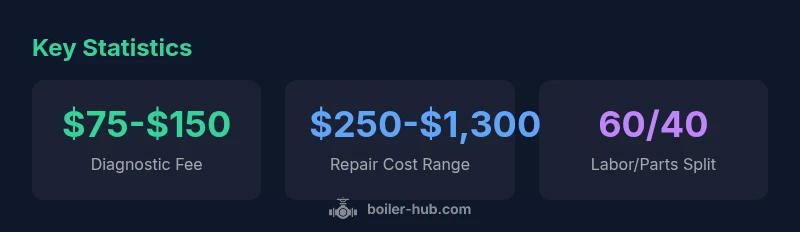
Typical boiler repair costs range from about $250 to $1,300, depending on the issue, boiler type, and your location. The lower end usually covers diagnostic fees and minor parts, while bigger problems can push costs higher. According to Boiler Hub, this range covers most common repairs when labor and parts are considered.
What influences boiler repair costs
Boiler repair costs do not come from a single source; they are a mix of diagnostic fees, labor, and parts, plus you may face travel charges if the technician has to reach an out-of-the-way location. The age and type of boiler play a major role. Older models often require more parts that are less readily available, which can push up prices. Gas-fired boilers may incur different parts costs than oil- or electric-powered models. The severity of the problem matters most: a simple thermostat swap is far cheaper than replacing a failed heat exchanger. Regional labor rates, the contractor’s experience, and whether the work is an emergency after hours also shape the final bill. According to Boiler Hub, most repairs fall within a broad range that reflects these variables, so expect a cost spectrum rather than a single figure. This makes it essential to obtain multiple quotes to benchmark prices in your area.
Diagnostic fees and labor vs parts
In most cases you’ll encounter a diagnostic or travel fee simply to diagnose what’s wrong. After the technician arrives, you’ll see a breakdown between labor and parts in the final invoice. Labor costs are driven by hourly rates and the time required for diagnosis, teardown, and reassembly. Parts costs depend on the component needing replacement, brand, and availability. Some repairs require a specialized module or control board, which can push the bill higher quickly. A common pitfall is assuming a low diagnostic fee means a cheap fix—the invoice often expands once a faulty part is identified. When planning, ask for a fully itemized estimate that clearly separates labor, parts, and any after-hours surcharges.
Regional price variations and contractor pricing
Prices vary widely by region due to factors like local wage levels, demand, and the cost of living. Urban areas with high demand tend to run higher labor rates, while rural regions may charge less but require travel time that increases the overall cost. Contractor pricing also depends on their overhead, the complexity of a given boiler system, and whether a permit is required for the repair. In some markets, a reputable company may charge a premium for quick turnaround and after-hours service, while a no-frills contractor may offer a lower base price but with longer wait times. Boiler Hub’s regional analysis highlights how price snapshots can shift materially from one city to the next, so use local quotes as your main reference point.
Common repair scenarios and cost ranges
Understanding typical scenarios helps shoppers budget sensibly. A small fix, such as a thermostat replacement or sensor recalibration, often falls in the low hundreds. A mid-range repair—like replacing a pressure relief valve or a faulty circulator pump—can creep toward the mid-range. A major intervention, such as replacing a control board, gas valve, or heat exchanger, may push costs well into the high hundreds or beyond. For context, diagnostic fees plus minor parts might be around $100–$250, while more involved repairs commonly land between $300–$800. When problems escalate to major component failures, costs can reach $1,000–$2,500 or more depending on boiler type and regional pricing. These figures illustrate why an upfront, itemized estimate is essential.
How to estimate and budget effectively
A structured approach to budgeting reduces surprises. Start by requesting a written, itemized estimate from at least two qualified technicians. Ensure it separates labor, parts, diagnostic fees, and potential contingencies. Ask for the call-out fee policy and whether the quote includes after-hours service. Use this information to create a conservative budget that allows for a worst-case scenario. If you receive a lower bid but with shorter warranty coverage, weigh the long-term value. For homeowners with older boilers, factor in potential energy efficiency gains from replacement when compared to ongoing repair costs. Finally, maintain a reserve fund specifically for boiler maintenance and unexpected failures—this reduces the need for credit or emergency borrowing.
Repair vs replacement: making the call
When deciding between repair and replacement, consider the boiler’s age, efficiency, and the likelihood of successive failures. If a repair’s cost approaches or exceeds a substantial portion of a new unit’s price, replacement can offer better long-term value due to improved reliability and energy efficiency. Conversely, if the unit is relatively new and the problem is a minor component, repairing can be the most economical choice. Boiler Hub guidance emphasizes evaluating long-term costs, including energy use and potential future repairs, rather than focusing on a single repair bill. Always obtain a professional assessment that compares the two paths in terms of upfront cost, energy savings, and anticipated service life. A balanced decision often combines planned maintenance with a future replacement strategy when warranted.
Maintenance tips to reduce future repair costs
Routine maintenance is the best defense against unexpected boiler bills. Schedule annual professional service to catch wear before it fails, and ensure the technician checks critical safety components, including the gas line, venting, and CO risks. Regularly bleed radiators, check pressure gauges, and verify that expansion tanks are functioning properly. Keep an eye on strange noises, fluctuating temperatures, or frequent cycling, and address warning lights promptly. Simple steps like cleaning jets and filters, clearing condensate drains, and tightening loose connections can extend boiler life. By combining proactive care with a clear budget, homeowners can minimize disruptive repairs and preserve system efficiency.
Typical boiler repair cost scenarios
| Scenario | Estimated cost range | Key drivers |
|---|---|---|
| Diagnostics + minor parts | $120-$350 | Diagnostic time; small components; service call fee |
| Repair of common components | $300-$800 | Parts cost; labor intensity; component availability |
| Major repair (control board/heat exchanger) | $1,000-$2,500 | High-cost parts; specialized labor; possible module replacements |
Questions & Answers
What is the typical cost to diagnose a boiler problem?
Diagnostics usually cost between $75 and $150, depending on location and the service model. Some companies waive the diagnostic fee if you proceed with the repair; always confirm upfront.
Diagnostics typically run seventy-five to one hundred fifty dollars, and many shops credit that toward the repair if you hire them.
Do warranties cover boiler repairs?
Warranties vary by manufacturer and service provider. They may cover parts or labor for a limited period, but many repairs fall outside warranty terms. Always review the exact terms for your unit.
Warranties can cover some parts or labor, but check the specific terms for your boiler and recent repairs.
Is it cheaper to repair or replace a boiler?
As a general guideline, if repair costs approach half or more of a new boiler’s price, replacement may offer better long-term value due to efficiency gains and reduced future failures. Evaluate age, efficiency, and energy costs.
If the repair costs add up toward half or more of a new boiler, replacement can be the smarter long-term choice.
Can I get an estimate over the phone?
A rough estimate can be given over the phone, but a precise quote requires an on-site inspection to assess safety, ductwork, and the exact parts needed.
You can get a rough number, but you’ll need an on-site visit for an exact quote.
What maintenance reduces future boiler repair costs?
Annual professional service, radiator bleeding, pressure checks, and timely part replacements reduce failure risk and costly repairs. Regular maintenance also helps sustain boiler efficiency.
Regular tune-ups and small fixes now save big repair bills later.
“Repairing a boiler is often a cost-effective choice, but it depends on the boiler’s age, expected reliability, and potential future issues. A proactive maintenance plan can extend life and reduce surprise costs.”
Key Points
- Get a diagnostic before committing to repairs
- Ask for itemized quotes to compare
- Budget a wide range to cover unexpected fixes
- Consider replacement if repairs near replacement cost