Home Boiler Cost: Upfront Prices and Long-Term Savings
Learn how to estimate home boiler cost, compare fuel types and efficiency, and plan for installation, maintenance, and incentives with Boiler Hub's 2026 guidance.


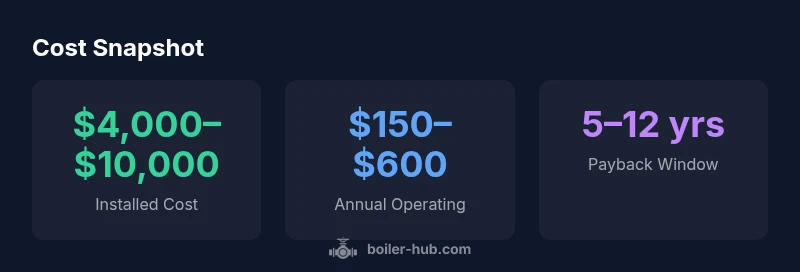
Upfront boiler installation costs typically range from about $4,000 to $10,000, depending on fuel type, boiler efficiency, and installation complexity. According to Boiler Hub, replacing an aging unit with a like-for-like model usually lands toward the lower end, while high-efficiency or system conversions push costs higher. The Boiler Hub Team emphasizes that selecting a correctly sized, efficient boiler can dramatically reduce total lifetime costs through energy savings and fewer service calls.
The cost framework for home boilers
Understanding home boiler cost begins with separating upfront equipment and installation costs from long-term operating expenses. The initial investment covers the boiler unit, venting or chimney work, any required condensate traps or expansion tanks, and labor. Costs vary by fuel choice (gas, oil, electric), boiler type (standard vs. condensing, combi vs. system), and whether the project involves replacing an existing unit or converting to a different fuel or layout. In many markets, labor and permit fees add a meaningful share of the total, especially when ductwork or complex venting is required. According to Boiler Hub, proper sizing and a high-efficiency model are essential levers: a modest upfront premium can translate into substantial energy savings and fewer service visits over the next decade. Homeowners and facility managers should also account for potential rebates and incentives that can reduce the net upfront burden and shorten the payback horizon.
When estimating costs, think in terms of total ownership cost, not just the sticker price. A smaller, well-matched boiler with a modern modulating burner can reduce peak demand and lower annual fuel use. The Boiler Hub team emphasizes that selecting components with durable materials, an efficient heat exchanger, and quiet operation yields better long-term value. Consider also the cost of upgrading controls (thermostats, outdoor reset controls) that optimize boiler performance across seasons, which can improve comfort and efficiency without drastically increasing upfront costs.
What drives the cost up or down
Several cost drivers consistently shape the price tag of a boiler replacement or new installation. First, boiler type and efficiency: high-efficiency condensing boilers cost more upfront but burn fuel more efficiently, potentially reducing annual energy costs. Second, fuel source reliability and price volatility influence both equipment choice and ongoing expenses. Gas tends to be cheaper to operate than oil in many regions, while electric boilers may carry higher electricity costs but lower maintenance and emissions. Third, installation complexity matters: homes with limited access, multiple zones, or existing chimney or venting retrofits may require extended labor, new venting, or specialty permits. Fourth, sizing and zoning: oversizing leads to wasted energy and more expensive equipment, while undersizing fosters inadequate heating and more frequent cycling. Finally, regional permitting, code upgrades, and disposal of old equipment can add to the bill. The Boiler Hub Analysis, 2026, stresses that a precise load calculation by a qualified technician is worth the upfront cost because it reduces both oversizing and long-term fuel waste.
Cost ranges by boiler type and scenario
To give homeowners a practical frame of reference, here are typical installed cost ranges by common boiler types, recognizing that values vary by region and installation specifics: gas-fired condensing boilers often land in the middle to upper end of the range due to high efficiency and condensate handling needs; oil-fired units can be pricier because of fuel logistics and venting considerations; electric boilers usually sit at the lower end but may incur higher electricity costs depending on usage. Switching from an older non-condensing unit or moving to a higher efficiency model can place you toward the higher end of the spectrum, especially if ductwork, chimney liners, or radiant heat integration are involved. Always obtain multiple quotes and verify that each one includes an energy audit, proper venting, and a detailed permit plan. The goal is not the lowest price but the best value over 10–15 years of operation.
Hidden costs and long-term operating expenses
Beyond the purchase price, there are recurring costs many buyers overlook. Regular maintenance, annual tune-ups, and potential part replacements contribute to ongoing expenses. You may also encounter costs for annual boiler servicing, ignition system checks, and venting system inspections. If your home relies on a chimney, inspections or liner upgrades can be necessary for safe operation and improved efficiency. In addition, utility rates and climate can significantly alter annual fuel use, so a boiler with modulation and seasonal efficiency controls can materially impact the total cost of ownership. The Boiler Hub approach favors models with durable heat exchangers, low standby losses, and compatible controls that can optimize energy use across seasons.
How to estimate your home boiler cost today: a practical plan
Start with a professional load calculation that accounts for your home’s size, insulation, window performance, and occupancy patterns. Use this to determine whether a combi, mid- or high-capacity system is most appropriate. Next, gather at least three written quotes that itemize equipment costs, labor, venting, permits, and any required chimney work. Ask each contractor to provide a long-term maintenance plan and an estimated annual fuel bill based on your local energy mix. Conduct a quick sensitivity analysis: what happens if fuel prices rise or if you add another zone in the future? Finally, compare the total cost of ownership over 10–15 years, accounting for energy savings, maintenance costs, and potential rebates. The Boiler Hub guidance highlights that a thorough assessment upfront reduces risk and helps set realistic expectations for total cost.
Financing, incentives, and ROI
Financing options, rebates, and incentives can significantly affect the perceived cost of a boiler upgrade. Look for utility-sponsored energy efficiency programs or state incentives that reward high-efficiency equipment and proper system sizing. Many programs require professional installation and a qualifying household energy audit. When evaluating an offer, ask for a detailed ROI calculation: include upfront incentives, projected annual fuel savings, maintenance costs, and expected system lifespan. Even modest energy savings can justify a higher-efficiency unit if it reduces maintenance and extends service intervals. The Boiler Hub team recommends pairing any upgrade with smart controls and routine maintenance to maximize return on investment over the system’s life.
Practical steps to reduce home boiler cost
- Plan ahead: secure quotes before the heating season peaks, and ask for bundled deals that include controls upgrades.
- Prioritize sizing: ensure contractors perform a proper heat load calculation to avoid overspending on a system that’s too large.
- Seek incentives: investigate utility and government programs that offset part of the upfront cost.
- Consider long-term value: weigh energy savings, maintenance needs, and reliability when comparing options.
- Schedule regular maintenance: annual tune-ups minimize surprises and extend boiler life, lowering total cost over time.
Comparison of boiler types by installed cost, efficiency, and notes
| Boiler Type | Installed Cost Range (USD) | Typical Efficiency | Notes |
|---|---|---|---|
| Gas-fired condensing boiler | 4000-9000 | 80-95% | Popular for efficiency; venting required |
| Oil-fired boiler | 5000-12000 | 75-90% | Fuel logistics and venting add complexity |
| Electric boiler | 3000-8000 | 95-99% | Lower emissions; electricity cost varies |
Questions & Answers
What factors influence the total cost to install a home boiler?
Total cost is driven by boiler type, efficiency, fuel source, installation complexity, and permits. Proper sizing reduces waste and helps you avoid overspending on oversized equipment. Budget for venting and potential chimney work when retrofitting.
Factors include boiler type, efficiency, fuel, and installation complexity. Proper sizing and venting matters, so get a load calculation done.
Is it cheaper to replace an old boiler with a newer model or install a different system?
For many homes, replacing an old boiler with a similar, high-efficiency model is cheapest upfront. Converting to a different fuel or adding zones increases both upfront and ongoing costs but can yield larger energy savings over time.
Replacing with a high-efficiency model is often cheaper upfront, but fuel choices and upgrades can offer bigger long-term savings.
What is the typical payback period for energy-saving boiler upgrades?
Payback depends on energy prices, usage, and efficiency gains, but a typical range is several years. High-efficiency upgrades paired with smart controls usually shorten payback compared with older, less efficient setups.
Payback varies, but higher efficiency and smart controls tend to shorten the time to recoup the investment.
Are rebates or incentives available for boiler upgrades?
Yes, many utility and government programs offer rebates or incentives for high-efficiency boilers and energy upgrades. Eligibility often requires installation by a qualified contractor and an energy audit.
There are rebates in many regions for efficient boilers; check with your utility and state programs.
How long does installation take?
Most residential boiler installs take 1–3 days, depending on existing ductwork, venting, and whether additional components (like expansion tanks) are required.
Typical installs take 1 to 3 days, depending on setup.
Can I install a boiler myself to save on costs?
Boilers are complex and involve gas/oil safety, venting, and electrical work. A licensed professional is required in most jurisdictions to ensure safety and code compliance.
Boiler installation should be done by a licensed professional for safety and code reasons.
“Choosing a boiler is as much about system sizing and efficiency as upfront price; a modest premium for a properly sized high-efficiency unit can pay for itself through energy savings and fewer maintenance visits.”
Key Points
- Compare total cost of ownership, not just upfront price
- Size boilers accurately to avoid wasteful spend
- Leverage high-efficiency options to reduce long-term costs
- Plan for permits, venting, and potential chimney work
- Explore incentives to lower upfront burden