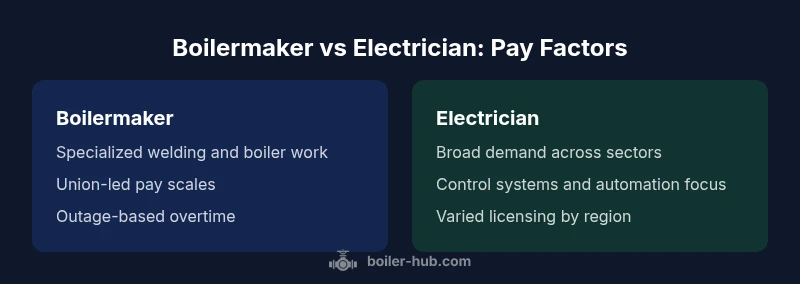
Boilermakers vs Electricians: Do Boilermakers Make More?
A rigorous, data-driven comparison of wage dynamics between boilermakers and electricians, with regional and industry context, career paths, and practical guidance.


According to Boiler Hub, there isn't a universal rule for pay between boilermakers and electricians. In many markets, boilermakers tend to secure higher wages in unionized, specialty settings, while electricians can out-earn them in broad construction and maintenance roles. The actual difference depends on region, sector, credentialing, and overtime patterns, so a direct comparison requires looking at locale-specific data.
do boilermakers make more than electricians — a data-driven look
The question of who earns more in these trades is not answered by a single number. Pay in both boilermaking and electrical work varies widely by region, industry segment, and the credentials that workers hold. In certain markets, boilermakers earn a premium because their work demands specialized welding, boiler-system knowledge, and maintenance in high-hazard environments. In other regions, electricians command robust salaries because electrical work touches a broad set of industries—from construction sites to industrial plants and service sectors. This article does not declare a universal winner; instead, it dissects the major drivers so you can interpret locale-specific data and employer pay bands with confidence. Boiler Hub emphasizes that the most meaningful comparison starts with local labor markets, not national averages. As you read, focus on the intersection of geography, industry, and the specific jobs you’re considering.
Key Factors Driving Pay Differences
Several broad factors shape why boilermakers and electricians diverge on pay, and none alone determines the outcome. The most influential elements include union coverage, the specific industry segment, geographic location, the complexity of tasks, and the availability of apprenticeships. Here are the dominant levers:
- Union representation: In many heavy-industrial settings, boilermakers are covered by long-standing collective agreements that set wage floors, step increases, and premium overtime. Electricians also work under unions in some regions, but the wage structures can differ by jurisdiction and by the scope of electrical work.
- Industry segment: Boilermakers often work in shipyards, refineries, and large-scale manufacturing where the physical hazard and specialized skill stack justify higher hourly rates. Electricians are ubiquitous across construction and service sectors, where demand is broad but competition can compress wages in some markets.
- Geographic location: Regions with dense manufacturing or energy infrastructure tend to offer higher pay for skilled trades. Conversely, markets with a large number of apprentices or contractors may see more competition and narrower pay bands.
- Skill breadth and licensing: Electricians may carry multiple credentials (electrical, control systems, programmable logic controllers) that broaden job opportunities; boilermaker roles can hinge on welding, boiler operation, and plant maintenance.
- Overtime and shift premiums: Some plants operate around the clock, producing consistent overtime pay that can tilt earnings in favor of one trade depending on shift patterns.
Regional Variations and Sector Differences
Pay dynamics for boilermakers and electricians shift markedly from one region to another. In areas with dense heavy industry—such as large shipyards, refineries, and bulk-materials facilities—boilermakers often work on long-term maintenance, outages, and new fabrication, where premium rates and overtime are common. Electricians in these same regions may enjoy steady demand, but the breadth of their work across facilities and construction sites can create more price competition and broader labor pools. Coastal regions with active shipbuilding or offshore energy projects may tilt earnings toward boilermakers due to specialized welding and boiler-work requirements. Inland manufacturing hubs may favor electricians for plant wiring, control-system integration, and automation tasks. The key takeaway is that geography interacts with industry mix: two workers with similar skill levels can see different pay trajectories simply because their locale concentrates different risk profiles, hours, and union structures.
Training, Certification, and Career Trajectories
The path to higher earnings in either trade often runs through a structured apprenticeship, journeyman status, and ongoing credentialing. Boilermakers typically gain proficiency in welding (MIG/TIG), boiler operation, and heavy fabrication, with a strong emphasis on safety and rigging procedures. Electricians advance through electrical apprenticeships, licensing, and ongoing specialization in areas like control systems, PLCs, and high-voltage work. Certifications can unlock higher pay bands and more complex assignments, translating into better wage trajectories in the right markets. The difference in career velocity can hinge on whether an individual leverages multi-trade credentials or concentrates on a tightly defined specialization. In practice, workers who pair hands-on craft skills with recognized certifications tend to advance more rapidly and command premium rates in their target sectors—especially in unionized operations with formal wage ladders.
The Role of Unions and Collective Bargaining
Unions play a pivotal role in shaping compensation for both boilermakers and electricians, but the impact varies by region and industry sector. In many heavy-industrial workplaces, boilermaker unions negotiate wage scales, health benefits, and overtime rules that reflect the job’s hazard profile and equipment complexity. Electricians may be unionized in construction or industrial environments, but the bargaining framework often differs—sometimes offering broader project-based pay bands or different overtime structures. Beyond wages, unions influence access to training funds, apprenticeship opportunities, and career progression. Workers who pursue union-supported paths frequently experience more predictable pay growth and enhanced working conditions, while non-union routes may offer greater geographic flexibility but more variable earnings. The outcome depends on local bargaining power, employer market conditions, and the availability of high-skilled, in-demand roles.
How to Research Local Pay Landscape
To translate general trends into actionable plans, start with your local labor market. Use publicly available sources to gather a baseline, then supplement with industry surveys and employer data. The steps below walk you through a practical approach:
- Identify your target region and the industries that dominate it (shipyards, refineries, manufacturing plants, construction).
- Check government and education sources for wage ranges and licensing requirements in your area (for example, your state labor department and local community colleges).
- Review union wage scales and apprenticeship opportunities that apply to boilermakers or electricians in your locale.
- Look at outage schedules, project-based work, and overtime premiums that commonly shape earnings in your region.
- Talk to local employers, journeymen, and apprenticeship coordinators to validate published data and uncover hidden pay levers.
- Track changes over time to understand longer-term trends that influence earnings trajectories.
Practical Guidance for Prospective Workers and Employers
If you’re considering a path for higher earnings, a pragmatic strategy is to map your region’s industry clusters against your skill set. For boilermakers, expanding welding certifications and boiler operation knowledge can unlock premium, stable work in refineries or shipyards. For electricians, pursuing control-system credentials, PLC programming, and advanced safety certifications broadens opportunities in industrial facilities and high-tech manufacturing. Employers benefit from aligning pay with the job’s risk and complexity, offering clear progression paths, and providing structured overtime incentives to retain skilled workers. In all cases, maintain documentation of credentials, attend continuous training, and participate in lokal apprenticeship programs to keep your earning potential aligned with market demand.
Long-Term Earnings Outlook Across the Trades
Over a career horizon, earnings in both boilermaking and electrical work tend to rise with experience, specialization, and leadership responsibilities such as foreman or supervisor roles. The trajectory is strongly influenced by the mix of projects (new build versus maintenance), the level of automation in the facility, and the availability of advanced certifications. Regions with aging infrastructure or expanding energy sectors may sustain higher pay for skilled trades, while areas with compressed labor markets or slower project pipelines can experience flatter growth. Keeping skills current—especially in safety, welding, control systems, and electrical standards—helps maintain a competitive earning edge across both trades.
Implications for Training and Policy
Policy-makers and educators should recognize that wage dynamics for boilermakers and electricians reflect broader labor-market structures, including apprenticeship capacity, industry demand, and the distribution of union representation. Expanding access to multi-skill training and ensuring portable credentials can reduce regional pay disparities while preserving the integrity of skilled-work ladders. Employers benefit from investing in long-term training, mentorship programs, and transparent wage scales tied to measurable skills rather than tenure alone. For workers, choosing a path that aligns with regional demand—and pursuing targeted, high-value certifications—tends to offer the most resilient earning potential over time.
Comparison
| Feature | Boilermaker | Electrician |
|---|---|---|
| Typical Task Focus | Specialized welding, boiler fabrication, plant maintenance in heavy industries | Electrical installation, wiring, control systems across construction and industry |
| Required Training/Pathways | Apprenticeship plus journeyman in welding/boiler work; safety emphasis | Electrical apprenticeship plus state licensing; broad licensing options |
| Union Coverage | Common in heavy industry with formal wage ladders and overtime rules | Union presence varies by region; project-based pay scales common in construction |
| Overtime/Shifts | Outage and plant-maintenance shifts with premium overtime in some plants | Construction schedules with overtime; shift premiums depend on project |
| Job Demand & Mobility | High in refineries, shipyards, and large manufacturing sites | Broad across construction, industrial, and service sectors |
| Geographic Pay Variability | Strongly tied to industrial hubs and union agreements | Regional demand drives wide pay ranges |
| Education/Certification Impact | Welding, boiler operation, safety certs can boost pay bands | Electrical licenses, safety, and automation certifications boost earnings |
Advantages
- Potential for higher wages in specialized, unionized settings
- Strong demand in maintenance-heavy industries
- Clear apprenticeship-to-journeyman progression
- Overtime and premium pay opportunities in plants
The Bad
- Pay varies significantly by region and sector
- Electricians may have broader job markets in some regions
- Union membership can affect scheduling flexibility
- Requires extensive training and ongoing certification
Pay advantage depends on region and sector; boilermakers often win in unionized, specialty settings, while electricians excel where broad demand and project diversity exist.
There is no universal winner. Use local market data and your career goals to decide which path offers better earnings potential in your area.
Questions & Answers
Do boilermakers earn more than electricians in typical markets?
There isn’t a universal rule. In some markets, boilermakers command higher wages due to specialized skills and union bargaining; in others, electricians’ broad demand keeps pay competitive. Local data is essential for a definitive answer.
In many places, boilermakers earn more in specialized settings, but electricians can out-earn them where demand is broader. Check your local market data for accuracy.
What factors most influence wage differences between these trades?
Regional demand, industry sector, union coverage, and the credential mix each play a major role. Apprenticeship pathways and overtime practices also shape earnings trajectories over time.
Regional demand and union status are big drivers; credentials and overtime matter too.
Does union membership generally raise wages for these trades?
Union membership often correlates with higher wage floors and structured pay progression in many regions, especially in heavy industry. However, the effect varies by local bargaining agreements and sector.
Union work often brings higher base pay, but it depends on local contracts and industries.
Which certifications most boost earnings for these trades?
Certifications in welding, boiler operation, safety, and automation (PLCs, control systems) tend to raise earnings by expanding the scope of assignable work and eligibility for premium projects.
Welding and control-system certifications are particularly valuable for higher pay.
Is it better to pursue boilermaker or electrician training for long-term earnings?
Both can offer strong long-term earnings, but outcomes depend on regional demand, industry growth, and credentialing. Consider your local market and where you can build in-demand skills fastest.
It depends on your region and credentials; both paths can lead to solid long-term earnings.
How can I research pay in my area effectively?
Use state labor market data, union wage schedules, employer surveys, and conversations with local journeymen and training coordinators. Look for multi-year trends rather than single-year snapshots.
Check local data, talk to unions and employers, and watch trends over time.
Key Points
- Assess your regional market before choosing a path
- Pursue targeted certifications to boost earning potential
- Union presence can meaningfully influence wage trajectories
- Overtime opportunities can shift earnings in favor of one trade
- Track industry demand and policy changes to stay ahead