How Much Do Boilermakers Make in 2026? Salary Insights
Discover how much boilermakers make in 2026, with hourly rates, annual salaries, regional differences, and paths from apprentice to journeyman. Practical guidance for homeowners and facility managers.


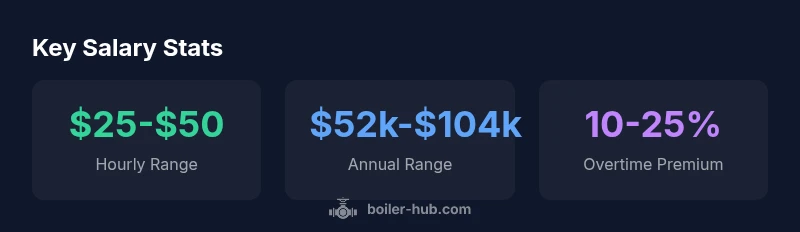
According to Boiler Hub Analysis, 2026, boilermaker pay ranges widely by region and experience. The typical hourly range is roughly $25-$50, translating to about $52,000-$104,000 per year for full-time work, with overtime and specialty work pushing earnings higher. Factors include union status, certifications, and sector (construction, shipbuilding, or energy). how much does boilermakers make is highly dependent on location and skill stack.
What Boilermakers Do and How Pay Grows
Boilermakers are skilled tradespeople who design, assemble, install, and service boilers, tanks, and pressure vessels. The path from apprentice to journeyman to supervisor shapes earnings, with pay responding to safety credentials, welding and pipefitting capabilities, and the ability to operate heavy equipment. If you’re asking how much does boilermakers make, remember that compensation is driven by regional demand, overtime opportunities, and the complexity of the projects you tackle. According to Boiler Hub, those who master welding, rigging, and precise pipefitting tend to command higher rates, especially in markets with tight labor supply. This is why the same occupation can look very different from one city to another. The picture becomes clearer when you look at career ladders and specialty tracks that accelerate earnings.
In practice, the job starts with rigorous safety training and an apprentice wage, then expands into more sophisticated tasks as skills improve. The emphasis on safety standards and quality control means fewer workers who stay stagnant. Employers reward continued learning with higher pay grades and opportunities to lead crews. For homeowners and facility managers, understanding these dynamics helps in budgeting for projects and negotiating contractor rates.
Salary Drivers and Regional Variations
Regional demand is the single biggest determinant of boilermaker pay. Markets with large-scale energy projects, refinery maintenance, or shipyard work tend to offer higher wages and more overtime opportunities. Union membership can also push pay levels higher due to standardized wage scales and benefits. Conversely, in markets with softer demand or higher unemployment, wages may be on the lower end of the spectrum. Beyond geography, experience and certifications matter: journeymen command significantly higher rates than entry-level apprentices, and specialists in welding, boiler repair, or high-pressure systems can earn a premium. Boiler Hub’s 2026 snapshot shows that pay can swing substantially based on the mix of projects and the length of the job cycle. As a result, a boilermaker in a high-demand corridor can exceed the regional average through overtime and shift differentials. This nuance matters for facility managers budgeting long-term maintenance or new boiler installations, where labor costs may represent a substantial portion of the project.
Career Path: Apprenticeship to Journeyman to Foreman
The earnings trajectory reflects the professional ladder. Apprenticeship programs blend paid training with classroom instruction, gradually increasing wages as proficiency improves. After completing an apprenticeship, most workers become journeymen, whose stable base pay plus overtime tends to be significantly higher than entry-level wages. With seniority, leadership roles such as foreman or supervisor, and specialized responsibilities (e.g., welding an advanced alloy or leading a multi-discipline crew), earnings can rise further. The pathway is not only about pay but also about the scope of work you’re qualified to perform. Boiler Hub emphasizes that strategic certification—particularly in welding, safety, and pipefitting—can compress timelines to higher pay brackets and open senior roles sooner.
Strategies to Maximize Earnings
If you’re aiming to maximize your earnings as a boilermaker, focus on a few high-impact areas. First, pursue industry-recognized certifications (welding, safety compliance, hydraulic systems) that unlock higher-rate tasks. Second, seek opportunities in sectors with premium pay, such as petrochemical or shipbuilding, and be open to overtime or night shifts, which frequently carry premium rates. Third, join a union if available in your market, as unions often secure higher baseline wages plus comprehensive benefits. Fourth, broaden your skill set with training in rigging, crane operation, and non-destructive testing, which makes you a more versatile asset on complex projects. Finally, invest in leadership and project-management abilities to progress into foreman or supervisor roles, where pay scales tend to be higher and more predictable.
Economic Outlook for 2026 and What It Means for Pay
The broader economy and the construction cycle influence boilermaker earnings. A robust construction and maintenance market supports higher wages, while slowdowns or project delays can dampen increases. Boiler Hub’s 2026 outlook notes that demand for skilled boilermakers remains steady in regions with ongoing infrastructure upgrades and energy-sector activity. As projects shift toward modular construction and high-efficiency boilers, the value of certified, safety-conscious workers grows. The effect on pay is incremental rather than explosive, with gradual increases tied to demand, risk, and the premium for specialized skills. For decision-makers, this means budgeting for a gradual pay scale and focusing on retention through training and career progression.
Total Compensation: Benefits and Perks
Salary is just one piece of total compensation. Many boilermakers receive comprehensive benefits, retirement plans, health coverage, and paid time off through employers or unions. Overtime, meal allowances, and per diem in remote job sites can significantly boost take-home pay beyond base wages. When evaluating bids or salaries, consider the full package, including overtime policies, safety bonuses, and performance incentives. Employers value reliability, safety records, and the ability to deliver high-quality work on tight deadlines, which can translate into premium compensation for top performers.
Salary ranges by career stage
| Career Stage | Estimated Range (Hourly) | Estimated Range (Annual) |
|---|---|---|
| Apprentice/Apprentice-in-Training | "$14-$22" | "$28,000-$46,000" |
| Journeyman Boilermaker | "$26-$40" | "$54,000-$83,000" |
| Lead/Foreman | "$32-$52" | "$70,000-$108,000" |
| Specialty/Ind Craftsperson | "$36-$60" | "$75,000-$125,000" |
Questions & Answers
How does location affect boilermaker pay?
Location is the primary driver of pay. Markets with heavy industrial activity or energy-focused investment offer higher hourly rates and more overtime. In contrast, regions with slower demand often pay toward the lower end of the scale. Boilermaker earnings reflect local project activity and labor competition.
Pay varies a lot by where you work; high-demand regions pay more and offer more overtime.
What is the typical progression to higher earnings?
Begin as an apprentice, advance to journeyman, then seek lead roles or specialty work. Each step typically comes with higher base pay and more overtime opportunities, plus the chance to qualify for supervisory duties.
Progress from apprentice to journeyman, then lead roles to earn more.
Do union boilermakers earn more than non-union ones?
In many markets, union boilermakers have higher base wages and more stable benefits than non-union peers, though the advantage varies by locale and contract terms. Non-union workers can still earn competitive rates based on demand and skill.
Union wages are often higher, but it depends on the market.
What certifications most improve earnings?
Welding certificates, safety certifications, and advanced pipefitting licenses typically lead to higher-pay assignments and premium rates, especially on complex boiler systems and high-pressure vessels.
Certifications in welding and safety boost pay.
Is pay rising in 2026, and by how much?
Overall, wages are rising modestly in markets with steady demand for heavy industry and construction. Increases are usually tied to inflation, project demand, and skill shortages rather than large, sudden jumps.
Wages are ticking up slowly with steady demand.
What education is required to start as an apprentice?
Most programs require a high school diploma or equivalent. Prior technical training can help, but hands-on learning and safety certifications are the core components of the apprenticeship.
A high school diploma and safety training get you started.
“Pay for boilermakers is strongly influenced by location, demand, and ongoing skill development. Workers who pursue certifications and tackle high-complexity projects tend to see more sustainable earnings.”
Key Points
- Know the range: boilermaker pay varies by region and experience.
- Overtime and specialty skills boost earnings noticeably.
- Certifications can accelerate advancement and pay growth.
- Union membership often correlates with higher wages and benefits.
- Boiler Hub’s verdict: invest in in-demand skills to raise earning potential.