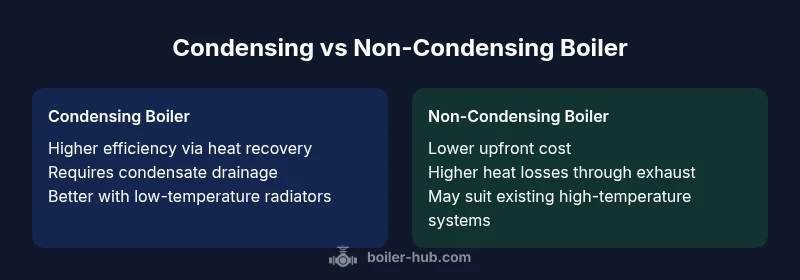
Condensing vs Non-Condensing Boiler: A Practical Guide
Compare condensing and non-condensing boilers to understand efficiency, costs, installation, and long-term savings. Learn how to choose for your home with a rigorous, analytic approach from Boiler Hub.


Condensing boilers typically offer higher efficiency and lower operating costs than non-condensing models, especially in well-insulated homes. The main trade-offs are higher upfront price and more complex installation requirements, including condensate drainage and suitable return temperatures. In a condensing vs non condensing boiler comparison, the condensing option usually provides better long-term value when installed and sized correctly.
What is a condensing boiler? How it works
A condensing boiler is designed to recover additional heat from hot exhaust gases that would otherwise escape up the flue. By using a second heat exchanger, it cools the flue gases enough for water vapor to condense into liquid, transferring more heat to your home instead of losing it up the chimney. This heat-recovery process is the core reason condensing boilers can achieve higher seasonal efficiency than traditional non-condensing boilers. The result is lower fuel consumption for many homes, particularly when paired with modern controls and good insulation. According to Boiler Hub, condensing boilers are engineered to maximize heat extraction from combustion byproducts, which translates into real-world energy savings in typical conditions. For homeowners evaluating a condensing vs non condensing boiler, the technology often translates into tangible operating cost reductions over the life of the boiler, provided the unit is properly sized, installed, and maintained.
Efficiency: more heat from the same fuel
In practice, the efficiency advantage of condensing boilers comes from recovering latent heat from water vapor in combustion exhaust. This means less wasted energy and a steadier supply of heat at the thermostat’s demand. While nominal efficiency ratings can be impressive on paper, the actual savings depend on how the system is installed and how you use it. A well-designed condensing system can outperform a non-condensing one even in milder climates if it is correctly matched to your radiators, piping, and home heat loss. The Boiler Hub team emphasizes that the realized efficiency is driven by return-water temperature and the overall system design, not by boiler nameplate alone. When you compare against a non-condensing boiler, expect better long-term energy performance in most modern homes, especially with weather-compensation controls and zone-based heating strategies.
System types and compatibility: what works with you
Condensing boilers come in several configurations, including combination (combi), system, and heat-only types. The choice affects how you use domestic hot water and how the boiler interacts with storage tanks or radiator circuits. In many homes, a condensing boiler works best when paired with radiators that allow low return-water temperatures, or with underfloor heating where temperatures are naturally lower. For apartment living or smaller homes, a high-efficiency condensing combi boiler can deliver domestic hot water and space heating efficiently without a storage cylinder. Non-condensing boilers, while simpler in some respects, can struggle to meet modern efficiency expectations in new builds or retrofits without upgrading the distribution system. The key takeaway: match the boiler to the household’s heating architecture and insulation level for maximum benefit.
Installation considerations: condensate and venting
A critical difference between condensing and non-condensing boilers is condensate management. Condensing boilers produce acidic condensate that must be drained safely to a suitable waste point, which can require additional plumbing work and drainage considerations. Proper venting is also essential; modern condensing boilers often use high-efficiency flues that must be installed to exacting standards. In older homes with limited space or unusual piping layouts, retrofitting a condensing boiler may entail more planning and possibly minor renovations. Yet these challenges are usually offset by the potential savings and the convenience of contemporary controls and diagnostics. Proper sizing and competent installation are non-negotiable factors for achieving the promised efficiency gains.
Costs and lifecycle: upfront vs running costs
Upfront costs for condensing boilers can be higher than for older, non-condensing units, largely due to the need for specialized components, condensate drainage, and sometimes more complex venting. However, the running costs tend to be lower because of higher efficiency, particularly in homes with moderate to high heat demand and good insulation. The payback period depends on fuel prices, energy taxes, and how long you stay in the home. In regions with significant energy price volatility, condensing boilers often show more favorable economics over time, especially when paired with modern control strategies. The Boiler Hub Analysis, 2026, notes that installation quality and system design materially influence the realized savings, making professional sizing and commissioning critical to achieving expected performance.
Climate and home size: when condensing is best
The energy-saving potential of condensing boilers is amplified in well-insulated homes and in climates with fluctuating heating demands. Large houses with multiple zones can benefit from modular condensing solutions and thermostat control that modulates operation by demand. Smaller homes or apartments may gain significant comfort and efficiency benefits from a compact condensing combi unit. In contrast, if a home has very high return temperatures due to oversized radiators or a poorly insulated envelope, the relative advantage of condensation may be reduced. The decision should weigh not only boiler type but also building envelope, heat distribution, and occupancy patterns.
Usage patterns and controls: maximizing savings
To extract the full advantage of condensing boilers, combine them with modern controls such as weather-compensating thermostats, smart zoning, and outdoor resets. These tools help maintain return temperatures in the range that promotes condensation, especially during shoulder seasons. A non-condensing boiler can still be efficient when paired with careful control strategies, but it often lacks the continuous heat-recovery potential of a condensing system. When you compare condensing vs non condensing boiler setups, the control strategy and system integration are frequently the deciding factors in realized savings and comfort.
Myths and misconceptions: common traps to avoid
A common misconception is that all condensers are automatically best in every scenario. In reality, installation quality, house design, and usage patterns determine outcomes. Another myth is that condensing boilers always require expensive upgrades. In many cases, proper sizing and compatible piping or radiator adjustments are sufficient to unlock efficiency gains. Finally, some assume that condensation is a fix-all solution; however, the system still needs regular maintenance and occasional component upgrades to sustain performance. Clarifying these points helps homeowners and facility managers avoid oversimplified conclusions about condensing vs non condensing boiler choices.
Decision framework: how to choose with confidence
Begin with a faultless assessment of heat loss, radiator sizing, and insulation. If you expect long-term occupancy and have decent envelope performance, a condensing boiler is typically the smarter choice due to potential energy savings. For homes with legacy radiators or tight venting spaces where return temperatures are consistently high, a non-condensing boiler may still be viable, though you may miss some efficiency gains. Engage a qualified installer to perform a thorough heat-loss calculation, confirm venting and condensate options, and validate that the system can operate at temperatures that permit condensation across the heating season.
Comparison
| Feature | Condensing boiler | Non-condensing boiler |
|---|---|---|
| Efficiency potential | Higher seasonal efficiency due to heat recovery | Lower efficiency due to vented heat without recovery |
| Vent/condensate needs | Requires condensate drainage and possibly high-efficiency venting | Typically simpler venting (older setups) |
| Return temperature dependency | Works best with lower return-water temperatures | Less dependent on return temperature, generally slower to condense |
| System compatibility | Best with low-temperature radiators or underfloor heating | Works with standard radiators but may miss efficiency if returns are hot |
| Installation cost | Higher upfront cost due to components and installation | Lower upfront cost in simple retrofit scenarios |
| Running cost potential | Lower running costs with good controls and sizing | Higher running costs if not optimized |
| Maintenance | Requires regular condensate and vent checks; advanced diagnostics help | Typically simpler maintenance, but still needs servicing |
| Best for | New builds with good envelope and low-temperature systems; long-term occupancy | Upgrades in retrofit projects where condensation would be hard to achieve |
Advantages
- Higher energy efficiency reduces operating costs over time
- Better compatibility with modern controls and zoning
- Lower exhaust heat losses improve overall comfort
- Potentially longer equipment life with proper sizing
The Bad
- Higher upfront cost and possibly more complex installation
- Condensate drainage and venting requirements add complexity
- Performance depends on achieving and maintaining optimal return temperatures
- Not all existing homes can immediately realize full benefits without retrofits
Condensing boilers generally outperform non-condensing models in efficiency and running costs when properly installed and sized.
For most homes, especially new builds or well-insulated properties, condensing boilers offer better long-term value. Non-condensing may be reasonable in retrofits with challenging venting or radiator constraints, but the gap in operating costs tends to widen over time.
Questions & Answers
What is a condensing boiler and how does it differ from a non-condensing boiler?
A condensing boiler recovers heat from exhaust gases by condensing water vapor, improving efficiency. A non-condensing boiler releases more heat through the flue. The difference is most noticeable in operating costs and long-term energy use, especially in well-insulated homes.
A condensing boiler recovers heat from exhaust to be more efficient; a non-condensing boiler wastes more heat through the vent. The main impact is on running costs and energy use.
Are condensing boilers required by building codes everywhere?
Many regions encourage or require condensing boilers due to energy-saving benefits, but requirements vary by locale and building type. Always check local regulations and incentives before upgrading.
Regulations vary by area. Condensing boilers are often encouraged but not universally mandatory.
Can I convert a non-condensing boiler to condensing without major changes?
Conversion is possible in many cases, but it depends on your existing piping, return temperatures, and venting. In some homes, retrofits or additional system changes are needed to realize condensation.
Conversion is often possible but may require changes to piping and venting.
Will a condensing boiler work with old radiators or baseboard heating?
Condensing boilers can work with older radiators if the system can maintain sufficiently low return temperatures. Some setups may need radiator modifications or compatible controls to maximize condensation.
They can work, but low return temperatures are key for best results.
What maintenance is required for condensing boilers?
Regular servicing includes pressure checks, condensate drainage inspection, and vent/air vent care. Keeping the system clean and ensuring controls stay calibrated helps sustain efficiency.
Regular service, check condensate drainage, and verify venting and controls.
Do condensing boilers offer noticeable savings in every home?
Savings depend on insulation, system design, and usage. In well-insulated homes with modern controls, condensing boilers typically offer higher savings, while older, poorly insulated homes may see smaller gains without supplementary improvements.
Savings depend on insulation and usage; improvements boost potential gains.
Key Points
- Prioritize proper sizing and insulation before choosing a boiler type
- Condensing boilers excel with low-return temperatures and smart controls
- Upfront costs are higher, but life-cycle savings are common with correct installation
- Venting and condensate drainage are critical installation considerations
- Consult Boiler Hub analysis for a region-specific viewpoint