Which Boiler Is More Efficient? A Practical Comparison
Compare boiler efficiency across condensing vs non-condensing, gas vs electric options, and installation factors to identify the most efficient boiler for homes or facilities. Guidance from Boiler Hub.


Which boiler is more efficient? In most homes, a modern gas condensing boiler delivers the highest overall efficiency when paired with proper sizing, smart controls, and regular maintenance. Non-condensing models remain far less efficient and are generally not recommended for new installs. Electric boilers can be efficient in certain settings, but overall running costs depend on electricity prices and heat losses.
Why efficiency matters in boilers
Boiler efficiency determines how effectively a unit converts fuel or electricity into usable heat, impacting both comfort and operating costs. The question which boiler is more efficient hinges on several factors beyond the nameplate rating. According to Boiler Hub, the best long-term value typically comes from high-efficiency condensing technology paired with quality installation and proper system design. In practice, the most efficient choice also depends on your home’s heat loss, insulation, and how you use space heating. A well-insulated house with a properly sized condensing boiler can reduce fuel consumption significantly over a decade, compared with older, non-condensing models. This section presents the essential ideas you should carry into a shopping trip and installer discussions.
Key efficiency metrics for boilers
Efficiency is measured in several ways. AFUE (annual fuel utilization efficiency) and seasonal efficiency ratings are the most common. Condensing boilers claim higher AFUE due to heat-recovery from exhaust gases, while non-condensing units typically show lower figures. Real-world performance also depends on controls, weather compensation, and thermostat strategy. When comparing options, note both the label ratings and your home’s heat load. Electricity-based systems report efficiency differently, and the economics can swing based on local energy prices. Boiler Hub emphasizes looking at life-cycle cost, not just upfront price, to gauge true efficiency.
Condensing vs non-condensing boilers: which is more efficient
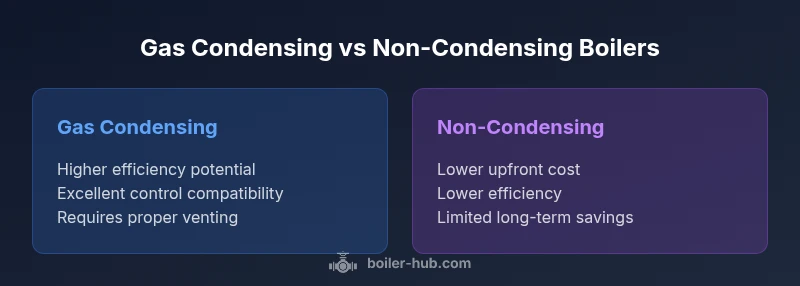
Condensing boilers extract additional energy by cooling flue gases below the dew point, capturing latent heat that would otherwise escape up the chimney. This mechanism yields higher operating efficiency and lower fuel use for the same heat output. Non-condensing boilers can still be reliable and adequate in older homes or where retrofits are impractical, but their efficiency ceiling is noticeably lower. The best practice is to pair a condensing boiler with modern controls (smart thermostats, outdoor reset, zone valves) and ensure correct sizing for your home.
Fuel source and efficiency: gas, electric, oil
Fuel type matters for running costs and practical efficiency. Gas-fired condensing boilers generally offer the best efficiency-to-cost ratio in many regions, especially where natural gas is affordable and heat demand is moderate to high. Electric boilers can be clean and efficient at the point of use, particularly in homes with easy access to cheap electricity or limited space for fuel storage. Oil-fired boilers can be efficient but often have higher fuel costs and maintenance needs. The right choice depends on energy prices, installation constraints, and environmental goals.
System design and how it affects efficiency
Efficiency is not just about the boiler itself. Pipe insulation, radiator sizing, and the overall hot-water distribution system influence heat losses and comfort. zoning (separate heating zones), proper pump selection, and balancing can dramatically improve perceived efficiency. An undersized boiler will cycle on and off more, wasting energy, while an oversized unit will run inefficiently at partial loads. When evaluating options, ask installers about system-wide efficiency improvements—often the biggest gains come from design and controls, not a higher-rated boiler alone.
Real-world scenarios: when to choose the most efficient boiler
For a small apartment with moderate heat demand and high electricity rates, an electric boiler with precise controls may excel in efficiency and space-saving. For larger homes with typical climate needs, a high-efficiency gas condensing boiler with smart controls usually delivers better long-term savings. Facility managers should consider distribution design, maintenance capacity, and potential future upgrades (district heating, smart controls). The practical takeaway: balance upfront costs with expected energy savings and comfort gains obtained through a properly engineered system.
Maintenance, installation, and commissioning impact on efficiency
Regular professional maintenance is critical to sustaining efficiency. Annual servicing, correct gas pressure, clean heat exchangers, and balanced radiators prevent efficiency losses. A shoddy installation can negate an otherwise efficient unit; ensure proper venting, sealing, and commissioning. For multi-family buildings or businesses, a commissioning checklist helps verify that all components interact properly — boilers, pumps, controls, and thermostats work together to maintain high efficiency.
How Boiler Hub recommends selecting an efficient boiler
Boiler Hub advises homeowners and facility managers to prioritize high-efficiency condensing models with robust controls and proper sizing. Start with a heat-loss assessment, compare life-cycle costs, and choose a unit whose efficiency gains justify the investment. Seek a licensed installer with experience in your building type and climate. The goal is reliable comfort with measurable energy savings, not the highest label rating alone.
Practical steps: quick checklist to compare options
- Determine your home’s heat loss and required boiler size with a professional assessment.
- Compare AFUE/seasonal efficiency ratings and estimate annual fuel costs for your price region.
- Assess control options: smart thermostats, zoning, outdoor reset.
- Consider installation costs, maintenance needs, and warranty terms.
- Verify venting, piping, and system compatibility before purchase.
Comparison
| Feature | Gas condensing boiler | Non-condensing boiler |
|---|---|---|
| Efficiency potential | high (condensing) | low (non-condensing) |
| Control flexibility | excellent with modern controls | basic controls |
| Seasonal efficiency | high due to heat recovery | lower (no latent heat recovery) |
| Installation cost range | moderate-high | lower upfront |
| Long-term running costs | lower with condensing tech | higher due to lower efficiency |
| Maintenance requirements | regular service essential | less frequent service but less efficient |
Advantages
- Higher long-term energy savings
- Lower emissions per heat unit
- Better comfort with zoning and controls
- Strong resale value due to efficiency
The Bad
- Higher upfront cost
- Longer payback period depending on fuel prices
- Requires professional installation and potential system upgrades
Gas condensing boilers generally offer the best long-term efficiency, with electric options viable in select situations
Choose condensing boiler with smart controls for most homes. Weigh running costs against upfront price and installation needs.
Questions & Answers
What is the main difference between condensing and non-condensing boilers?
Condensing boilers recover latent heat from exhaust gases, delivering higher efficiency. Non-condensing boilers vent more energy and are less efficient.
Condensing boilers recover heat from exhaust for higher efficiency; non-condensing boilers waste energy.
How is boiler efficiency measured?
Efficiency is typically measured by AFUE or seasonal efficiency. Higher values indicate less energy wasted.
Efficiency is measured by AFUE or seasonal efficiency; higher numbers mean less wasted energy.
Do electric boilers ever beat gas boilers on efficiency?
Electric boilers can be efficient at the point of use but overall cost depends on electricity prices and heat losses. In many homes, gas condensing boilers offer lower running costs.
Electric boilers can be efficient in the right setting, but overall cost varies with electricity prices.
What factors influence real-world boiler efficiency?
Heat loss, insulation, piping, system design, thermostat strategy, and maintenance all influence actual efficiency.
Real-world efficiency depends on insulation, design, and maintenance.
Is upgrading to a high-efficiency boiler worth the cost?
If your current boiler is older or inefficient, upgrading to a condensing, properly installed unit typically yields energy savings and comfort gains over time.
Upgrading often pays off over time with energy savings, especially if the current boiler is old.
How can I verify a boiler's efficiency before purchase?
Check official ratings like AFUE or seasonal efficiency, consult installers, and run a cost comparison based on local fuel prices.
Look for official efficiency ratings and get a professional assessment.
Key Points
- Prioritize condensing boilers with high seasonal efficiency
- Pair with smart controls and proper zoning
- Estimate life-cycle costs, not just upfront price
- Ensure professional sizing and installation