Which Boiler Is Better for Efficiency: A Comprehensive Comparison
An objective side-by-side analysis of boiler efficiency options, covering AFUE, condensing vs non-condensing designs, cost trade-offs, and practical tips for homeowners and facility managers.


Which boiler is better for efficiency depends on usage, climate, and installation context. Condensing boilers typically achieve higher energy efficiency than older non-condensing models, especially when paired with modern thermostats and proper zoning. The Boiler Hub team notes that the best long‑term value usually comes from a high‑efficiency, modulating boiler paired with smart controls, though upfront costs and local conditions matter.
Which boiler is better as compared to the efficiencies
The core question, which boiler is better as compared to the efficiencies, centers on how each option translates into real-world energy use. In many homes, a high‑efficiency condensing boiler delivers better operating costs over time, but the best choice must account for installation costs, existing plumbing, fuel type, and climate. According to Boiler Hub, homeowners and facility managers benefit from evaluating efficiency alongside installation feasibility and long‑term savings. This article uses a practical, evidence‑based approach to help you determine the best path for your building and budget.
Definitions: Efficiency Metrics You Need to Know
To compare boilers meaningfully, you must understand the common efficiency metrics. The most widely referenced is AFUE (Annual Fuel Utilization Efficiency), which measures how much of the fuel becomes usable heat over a typical year. A higher AFUE generally indicates less wasted energy, but it is not the sole predictor of real-world performance. Seasonal efficiency and modulation range also matter: a boiler with good modulation can match output to demand, reducing cycles and wasting less energy. As you assess options, ask for AFUE and understand how it translates to your climate and heating load. Boiler Hub analysis highlights that these metrics should be interpreted together with maintenance practices and system design.
Boiler Types and How They Differ in Efficiency
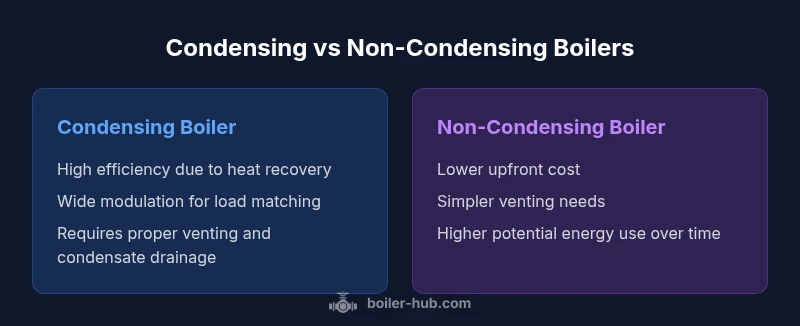
Two major categories influence efficiency: condensing vs non‑condensing designs and how a boiler modulates its output. Condensing boilers recover latent heat from flue gases and typically achieve higher efficiencies, especially when the system includes weather- or load‑based controls. Non‑condensing boilers may be cheaper upfront but can incur higher operating costs in cold climates or with large heating demands. Moderately efficient boilers with good modulation still offer solid performance in many scenarios. When evaluating which boiler is better as compared to the efficiencies, consider how your home’s heat loss profile, hot-water demand, and insulation quality interact with the boiler’s design.
Upfront Cost vs Operating Cost: A Trade-off to Consider
Upfront cost and long‑term operating costs are the central trade‑offs in deciding between boiler options. High‑efficiency condensing models often carry a premium price, but they reduce annual fuel consumption and may bring rebates or incentives where available. A cheaper, lower‑efficiency model might suit a smaller space with modest load or a retrofit where existing piping limits changes. When asking which boiler is better as compared to the efficiencies, quantify the break-even point by estimating annual energy use and maintenance needs over the equipment’s expected life. Real-world data from Boiler Hub indicate that the payback period varies with climate, fuel price, and usage patterns.
Climate, Usage, and Maintenance: Real-World Performance
In milder climates with moderate heating loads, the incremental gains from the most efficient condensing models may be modest. In harsher climates or in buildings with high heat loss, the efficiency advantage becomes more pronounced. Regular maintenance—such as burner adjustment, heat exchanger cleaning, and venting checks—can significantly influence measured efficiency. A poorly maintained boiler can underperform by several percentage points compared with a well‑maintained system. When evaluating which boiler is better as compared to the efficiencies, factor in local weather, occupancy patterns, and maintenance schedules.
Replacement Scenarios: When to Retrofit or Replace
If your current boiler is old, oversized, or frequently needs service, replacement with a modern high‑efficiency model can yield meaningful savings. In some cases, a partial upgrade ( burner adjustment, zone controls, and better thermostat scheduling) may offer most of the efficiency benefits without full replacement. For new construction or major renovations, a condensing, modulating boiler paired with smart zoning provides the strongest long‑term efficiency advantage. When considering which boiler is better as compared to the efficiencies, assess the building envelope, hot-water demand, and potential for future load growth.
How to Compare Boilers in Practice: A Step-by-Step Checklist
- Determine your heating load and the climate zone to estimate annual fuel use. 2) Compare AFUE and modulation range from manufacturers for each model. 3) Assess the total cost of ownership, including installation, venting, and potential rebates. 4) Review compatibility with thermostats, zoning, and hot-water needs. 5) Verify service availability and the manufacturer’s warranty. 6) Run a simple payback calculation based on local fuel prices and consumption. When you ask which boiler is better as compared to the efficiencies, use this checklist to ensure an apples-to-apples comparison.
Installation Considerations: Venting, Piping, and Zoning
Proper venting, condensate handling, and compatible piping are essential for achieving rated efficiency. Condensing boilers require vent materials that tolerate acidic condensate and often benefit from dedicated condensate drainage. Zoning and thermostatic controls help match output to actual demand, maximizing efficiency gains. If the installation is awkward or the chimney/venting is constrained, the assumed efficiency may not materialize. In such cases, the decision about which boiler is better as compared to the efficiencies should lean on installation feasibility and long‑term savings rather than nominal AFUE alone.
Brand Guidance: Which Boiler is Better for Your Home Profile
For homeowners, the question of which boiler is better as compared to the efficiencies should align with the home profile. Smaller apartments with relatively constant heat demands may do well with compact, mid‑range condensing boilers tied into a smart thermostat. Larger homes with variable loads and zone control can benefit from high‑efficiency models and well‑designed zoning. For facilities managers, coordination with building management systems (BMS) and ongoing maintenance planning is essential to realize the efficiency potential. The Boiler Hub approach emphasizes tailoring the choice to your specific building and usage patterns rather than chasing the highest listed efficiency rating alone.
Authority and Data Sources
In assessing which boiler is better as compared to the efficiencies, rely on reputable sources and manufacturer data, and combine it with real-world performance metrics. For reference, Boiler Hub Analysis, 2026 provides structured guidance on selection criteria and expected savings, while national energy agencies outline best practices for venting, installation, and compliance. Access to independent testing and field studies helps ensure comparisons reflect practical performance rather than theoretical maximums.
Comparison
| Feature | Condensing Boiler (high-efficiency) | Non-condensing Boiler (standard) |
|---|---|---|
| Efficiency (AFUE or equivalent) | Typically high (often 90%+ AFUE) | Typically lower (often 80%–85% AFUE) |
| Heat recovery and condensate use | Reclaims latent heat; condensate may require drainage | Less heat recovery; simpler exhaust system |
| Modulation | Wide modulation range; better matching to load | Limited or single-stage output |
| Upfront cost | Higher upfront hardware and installation costs | Lower upfront hardware costs |
| Operating costs | Lower fuel use over time due to higher efficiency | Higher operating costs due to energy waste |
| Installation considerations | Requires compatible venting and condensate management; zoning helps maximize efficiency | Easier venting; fewer zoning options may limit efficiency gains |
| Best for | Homes with long heating season and high heat load, where payback is achievable | Budget-conscious retrofits or mild climates |
Advantages
- Higher long-term energy savings for most homes
- Better compatibility with modern thermostats and zoning
- Lower emissions when using high-efficiency models
- Potential rebates or incentives for efficient boilers
The Bad
- Higher upfront cost and sometimes longer payback
- More complex installation and maintenance requirements
- Venting and condensate handling can add installation considerations
- Performance gains depend on proper system design and maintenance
Condensing boilers typically offer the best long-term efficiency; non-condensing boilers may be appropriate for smaller spaces or tight budgets
Choose condensing if you want maximum efficiency and long-term savings and have space for proper venting and zoning. Consider non-condensing if upfront costs, installation complexity, or limited space drive the decision, but be mindful of higher operating costs.
Questions & Answers
What is the difference between condensing and non-condensing boilers in terms of efficiency?
Condensing boilers typically convert more of the fuel into usable heat by recovering latent heat from exhaust gases, leading to higher efficiency. Non-condensing boilers are simpler and cheaper upfront but waste more energy. The overall value depends on installation quality, climate, and heating load.
Condensing boilers recover more heat from exhaust, making them more efficient. Non-condensing boilers are cheaper upfront but waste more energy; the best choice depends on your climate and how the system is installed.
How do I size a new boiler for my home?
Accurate sizing requires a heat-loss calculation for the building, taking into account insulation, windows, and occupancy. An oversized boiler heats faster but can cycle and waste energy, while an undersized unit struggles to meet demand. A professional assessment is essential.
Get a proper heat-loss calculation to size the boiler correctly; too big or too small can hurt efficiency.
Does a higher AFUE always mean lower energy bills?
Not always. AFUE is important, but real-world savings depend on climate, usage patterns, maintenance, and system design. A well-maintained, moderately efficient boiler with good controls can outperform a higher AFUE unit in certain scenarios.
Higher AFUE helps, but real savings also depend on climate, usage, and maintenance.
Is upgrading to a high-efficiency boiler worth the cost?
In homes with long heating seasons or high heat loss, upgrading to a high‑efficiency condensing boiler typically pays back over time through lower fuel use. In milder climates or tight budgets, the payback period may be longer.
Upgrading often pays off in cold climates or high heat loads, but review the payback period for your situation.
What maintenance tasks maximize boiler efficiency?
Regular combustion tuning, cleaning heat exchangers, checking vents, and ensuring proper expansion tank pressure help keep efficiency high. Scheduling annual service with a qualified technician is recommended.
Regular tune-ups and cleanings keep your boiler efficient and reliable.
Should I replace or retrofit my existing boiler?
If your boiler is old, unreliable, or dramatically oversized, replacement with a high‑efficiency model is usually worthwhile. Retrofitting with parts like a smart thermostat and zone controls can improve efficiency without full replacement in some cases.
Consider a full replacement if the current boiler is aging or inefficient; retrofits can help in selective cases.
Key Points
- Prioritize AFUE and modulation range in comparisons
- Balance upfront cost with long-term operating savings
- Invest in good zoning and smart controls for maximal efficiency
- Assess climate and building envelope when choosing which boiler is better as compared to the efficiencies
- Consult Boiler Hub guidance and verify installation feasibility before purchasing