Condensing Boiler Cost in 2026: Prices, Installations, and Savings
Explore condensing boiler cost, installation ranges, and potential savings. Boiler Hub analyzes 2026 data to help homeowners estimate total price and long-term efficiency.


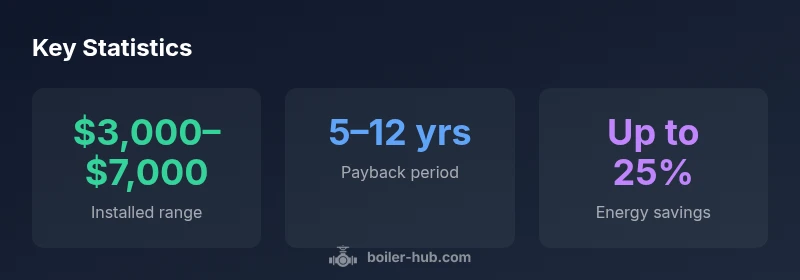
According to Boiler Hub, condensing boiler cost typically ranges from installation-only costs of about $3,000 to $7,000, with total installed prices higher for retrofit projects depending on boiler size, existing piping, and local permits. For new installations, equipment plus labor often falls near the upper end. Boiler Hub Analysis, 2026 notes that long-term energy savings frequently justify the upfront premium.
What drives condensing boiler costs
Condensing boiler cost is influenced by multiple factors, including boiler efficiency (AFUE), equipment quality, installation complexity, venting compatibility, and regional permitting. The upfront price covers the boiler unit, control system, and venting. The most significant variable is installation complexity: if your home has old piping, restricted access, or unusual venting needs, labor and materials rise quickly. According to Boiler Hub, the cost landscape also shifts based on whether you're replacing an existing system or installing a new one, and whether a retrofit involves upgrading to a higher efficiency model. In colder climates, more robust models with larger heat outputs can push prices higher, but the long-term energy savings from higher efficiency can offset this premium over time.
Equipment vs installation: breaking down the price
Understanding the difference between equipment cost and installation helps homeowners budget more accurately. The boiler itself represents only part of the total; high-efficiency condensing boilers can range widely in price depending on brand, size, and modulating capabilities. Installation costs include mounting, piping, venting, controls, and commissioning. In many markets, a plumber or HVAC technician will also perform a combustion analysis and warranty check, which adds to labor hours. If your system requires additional components—such as an expansion tank, heat exchanger, or upgraded condensate trap—expect extra line items. While the boiler unit price might be the most visible number, the install essentials blend equipment+labor into a single installed price. Retrofit projects often incur extra costs from removing old equipment and upgrading gas lines or venting.
Retrofit vs new installation: cost implications
Retrofit projects typically cost more per unit of heat output than new installations because of existing infrastructure constraints. You may need to add or enlarge venting, rework boiler room clearances, or upgrade the chimney. New installations can optimize pipe routing and enable zoning or radiant heating integration, driving upfront efficiency but potentially increasing upfront costs. When sizing for retrofit, oversizing can waste energy, while undersizing reduces comfort and may void warranty. Boiler Hub Analysis, 2026 suggests that careful load calculation and proper-sequence installation can minimize costs while maximizing performance.
Operating costs and payback: budgeting long-term savings
Switching to a condensing boiler can reduce annual fuel consumption due to better efficiency; however, the exact payback depends on fuel prices, energy use, and how well the system is installed. A well-sealed, correctly sized system with modern controls can reduce heat loss and boiler cycling, extending equipment life. In some cases, homeowners see payback within 5–12 years, with shorter payback in high-efficiency homes. It's important to consider maintenance costs, potential refrigerant or gas line upgrades, and service plans. Boiler Hub's 2026 analysis underscores that energy savings accumulate over time, impacting total life-cycle cost and return on investment.
Choosing the right size and efficiency: impact on cost
Selecting the correct boiler size and AFUE rating is critical for cost and comfort. An oversized unit heats space quickly but cycles frequently, wasting fuel and driving wear. An undersized boiler struggles in cold weather and fails to meet demand, leading to higher operating hours and wear. For condensing boilers, a higher AFUE yields more savings, but the equipment price increases with efficiency. A proper heat load calculation, performed by a certified installer, ensures you buy the right size and efficiency level, balancing upfront cost with long-term energy savings.
Labor, permits, and regional variation
Labor costs and permit requirements vary widely by region. Some areas require insulating materials, stack permits, or gas line inspections that add to the project timeline. In addition, the choice of contractor and access to space can cause price variability. If you upgrade ventilation or install a modern control system, expect extra line items. When comparing bids, ask for a line-item breakdown and verify that the scope includes permits, testing, and warranty coverage. Boiler Hub notes that transparency in pricing reduces change orders and surprises at the end of the project.
Financing options and incentives
Financing condensing boiler cost can help spread the upfront price. Look for programs that cover high-efficiency equipment or home energy upgrades. Some regions offer rebates or tax incentives aligned with energy-efficiency improvements. When evaluating options, compare APR, loan terms, and any included maintenance plans. Energy savings on utility bills should be modeled alongside loan costs to determine net benefit over the lifespan of the equipment. Boiler Hub highlights that incentives can materially affect total-cost-of-ownership calculations.
Common myths about condensing boiler cost
Common myths can distort budgeting: that condensing boilers always require expensive venting, that installation is always quick, or that higher efficiency means proportionally higher operating costs. In reality, requirements vary by home and venting system. Some installations can be completed quickly with standard venting, while others need extensive rerouting. Assessing the actual fuel savings versus upfront costs is essential to avoid over- or under-estimation. Boiler Hub's evidence-based approach in 2026 shows that the best-value choice depends on your home’s load, fuel type, and insulation quality.
Cost checklist when hiring an installer
- Get at least 3 written bids with itemized line items for boiler, labor, permits, venting, and taxes.
- Confirm system size via a professional load calculation (Manual J/ASHRAE-inspired methods).
- Ask about warranty terms, service plans, and fuel type compatibility.
- Request a commissioning report showing efficiency and safe operation after installation.
- Check installation timing, permits, and potential need for upgrading gas lines.
Typical installed cost ranges for condensing boilers (2026)
| Category | Typical installed cost (range) | Notes |
|---|---|---|
| Boiler unit price (condensing) | $2,000–$4,500 | Equipment price varies by size and brand |
| Labor and installation | $1,000–$3,000 | Includes mounting, piping, venting, commissioning |
| Piping & venting | $500–$1,500 | Materials and modifications to fit system |
| Total installed (retrofit) | $4,000–$9,000 | Retrofit scenarios can be higher |
| Total installed (new construction) | $5,000–$12,000 | Optimized layouts may raise upfront cost |
Questions & Answers
What is the typical installed cost of a condensing boiler?
Installed costs usually range from a few thousand dollars to well into the upper end, influenced by boiler size, labor, permits, and retrofit needs. Always request a line-item bid to compare apples-to-apples, and verify that loads are calculated by a qualified professional.
Installed costs can vary. Get a line-item bid and a qualified load calculation to compare options clearly.
Are condensing boilers worth it for older homes?
Condensing boilers often pay back over time due to higher efficiency, but the benefits depend on insulation, ducting, and existing gas lines. In older homes, upfront retrofit costs can be higher, but energy savings accumulate with continued use.
In older homes, savings depend on insulation and ducting. The long-term energy savings can justify the upfront retrofit cost.
How long is the payback period for condensing boilers?
Payback typically ranges from several years to over a decade, varying with climate, fuel prices, usage, and installation quality. A good-load calculation helps estimate the precise timeline for your home.
Payback varies; a precise load calc helps estimate your exact timeline.
Do I need a permit for installation?
In most regions, permits are required for gas fittings, venting, and electrical work. Your installer should handle permit applications and inspections as part of the project.
Yes, permits are usually required; your installer handles the processes.
Can a retrofit cost more than a new installation?
Retrofits can be more expensive due to modifying existing venting, piping, and space constraints. A new installation can be optimized for efficiency but might involve different upfront costs.
Retrofits often cost more due to existing infrastructure, but new installs can also be costly if optimized for efficiency.
What incentives or rebates are available?
Incentives vary by region and time. Look for rebates on high-efficiency equipment and energy upgrades, and compare loan terms and maintenance plans to maximize value.
Check regional rebates and financing options to boost value.
“A well-chosen condensing boiler should balance upfront cost with reliable, consistent heat and measurable energy savings over its life. Proper sizing and professional installation are the keys to achieving that balance.”
Key Points
- Estimate installed costs using a three-part model: equipment, labor, and extras
- Retrofits typically cost more than new installs due to existing conditions
- Higher efficiency yields long-term savings that can justify upfront costs
- Get itemized bids and load calculations to prevent budget overruns
- Consider incentives and financing options to improve payback