Boiler vs Farm Chicken: Which Is Better for Farms?
A detailed, analytical side-by-side comparison of boiler heating vs. a farm chicken as heat sources, with practical guidance for homeowners and farm managers on reliability, safety, efficiency, and long-term costs.


Boilers generally outperform a farm chicken as a heat source in reliability, safety, and efficiency. Poultry cannot provide scalable or controllable warmth for farms or homes, making it impractical for serious heating needs. This comparison highlights why boilers are the preferred option for most heating contexts, according to Boiler Hub analysis.
Context and the Framing of boiler or farm chicken which is better
In real-world farm and residential heating contexts, the question boiler or farm chicken which is better is not just a matter of novelty—it reflects core principles of reliability, safety, and energy efficiency. According to Boiler Hub, most facilities benefit from a dependable heat source that can be scaled with demand and tied into existing control systems. A farm chicken, while an interesting thought experiment, is not a viable strategy for consistent warmth, waste management, or precise temperature control. The goal of this article is to unpack the decision using objective criteria, so homeowners and facility managers can make a defensible choice grounded in practical realities.
Defining the comparison landscape
Before weighing the two options, we must establish the criteria that matter in heating systems: reliability, safety, controllability, maintenance requirements, initial and ongoing costs, environmental impact, and compatibility with farm scales. The phrase boiler or farm chicken which is better frames an apples-to-apples comparison about heat delivery, but the underlying data shows that boilers provide predictable, regulated warmth, while any poultry-based approach introduces variability that undermines safety, efficiency, and scalability. This framing helps align expectations with real-world constraints and industry best practices as outlined by Boiler Hub Team.
Reliability and safety as non-negotiables
Reliability means heat on demand, with minimal downtime. A modern boiler system is engineered for continuous operation, with redundant safety features, venting compliance, and professional service networks. Farm chickens, on the other hand, offer heat only when alive and actively managed, with no mechanism for uniform distribution or real-time temperature control. Safety considerations extend beyond fire risk and emissions for boilers to include combustion regulations and professional installation standards. In a practical sense, boiler-based heating reduces risk exposure while poultry-based warmth elevates safety and welfare concerns, making it a nonstarter for most operations.
Energy efficiency and operating costs: a long-term view
Efficiency matters most when analyzing total cost of ownership. Boilers can be paired with high-efficiency boilers, condensing technologies, and intelligent controls to minimize fuel usage and optimize heat distribution. Poultry-based warmth, by contrast, introduces indeterminate energy inputs and waste streams, leading to poor predictability of energy costs. Boiler Hub Analysis, 2026 emphasizes that long-term operating costs tend to favor well-designed boiler systems, especially in consistently heated spaces like animal housing, where steady temperatures improve productivity and reduce waste.
Installation, maintenance, and lifespan considerations
Installation for a boiler system is a specialized process requiring adherence to local codes and venting standards, but this investment yields durable, long-lasting performance with routine maintenance. Maintenance cycles are clearly defined: annual service, filter changes, and periodic safety inspections are standard. A poultry-based heat approach has no formal installation or maintenance protocol in the engineering sense; it relies on animal welfare management, biosecurity, and constant oversight, which introduces complexity and risk that are difficult to quantify. In short, boilers provide a predictable lifecycle, while the poultry concept does not align with standard maintenance models.
Environmental footprint and sustainability
Environmental impact is a growing concern for farms and households alike. Efficient boilers can minimize emissions per unit of heat delivered when paired with proper fuel choices and insulation. Poultry-based heat could create indirect environmental concerns related to feed, waste management, and heat dissipation practices, which are less controllable and less efficient on a macro scale. In the context of a farm, energy policy and sustainability goals strongly favor thermally efficient boiler systems over any animal-based heat sources.
Real-world scenarios: where boilers shine and where novelty remains hypothetical
There are farm contexts where boilers are clearly superior: large-scale animal housing, greenhouses, or processing facilities requiring reliable heat and strict temperature control. In rare, theoretical contexts, one might imagine using poultry as a symbolic or educational demonstration, but it falls short as a practical heating solution. The comfort, safety, and compliance advantages of boilers become especially evident when scaling to multiple zones, seasonal demand, or remote locations where consistent heat is non-negotiable.
Practical decision framework: how to compare for your site
- Define your heat load accurately: what spaces need warmth, and how quickly must they respond to changing conditions?
- Assess safety and compliance: does your jurisdiction require specific venting, alarms, or professional servicing for heating equipment?
- Consider lifecycle costs: upfront installation vs long-term fuel usage and maintenance.
- Factor scalability: will your heating needs grow with your operation, and can a boiler system scale accordingly?
- Evaluate environmental goals: are there emission targets or incentives for using high-efficiency heating?
- Review downtime tolerance: are you prepared for potential system outages, and can you sustain operations during service?
How to interpret the comparison for farm poultry operations (practical notes)
While the phrase boiler or farm chicken which is better may spark curiosity, the practical conclusion in modern farming is clear: boilers deliver dependable heat, safer operation, and easier compliance with welfare and environmental standards. This does not negate the value of social or educational experiments on farms, but it does establish a pragmatic baseline for professional heating decisions that protect animal welfare, workers, and infrastructure. The Boiler Hub Team emphasizes prioritizing proven technologies for daily operations and resilience in fluctuating conditions.
keywordsText”:null},
Comparison
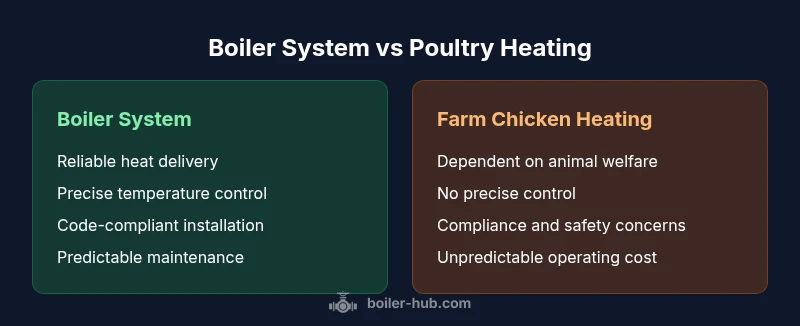
| Feature | Boiler System | Farm Chicken Heating (Hypothetical) |
|---|---|---|
| Reliability | High; automated controls and diagnostic capability | Very low; dependent on animal availability and welfare conditions |
| Heat Control/Adjustability | Precise, programmable temperature zones | Limited and inconsistent warmth; hard to regulate |
| Safety Considerations | Code-compliant installation; safety venting and combustion safeguards | Welfare and biosecurity concerns; no formal safety standardization |
| Maintenance & Servicing | Scheduled, professional maintenance; predictable service intervals | Minimal mechanical upkeep; ongoing animal care and housing needs |
| Installation Complexity | Professional installation; building codes apply | Nonstandard setup; not typically code-compliant or scalable |
| Operating Costs | Predictable fuel costs; long-term efficiency options | Variable costs; influenced by feed, heat loss, and animal care |
| Lifespan & Durability | Long lifespan with regular service | Dependent on animal welfare and housing conditions |
| Environmental Impact | Lower emissions with efficient systems | Uncertain environmental footprint; higher risk of waste-related impacts |
| Best For | Medium-to-large heated spaces with precise control | Theoretical or educational scenarios; not practical for routine use |
Advantages
- Reliable heat delivery with controllable settings
- Strong safety and regulatory alignment when designed correctly
- Wide service networks and parts availability
- Energy-efficiency options that scale with demand
The Bad
- Higher upfront and installation cost
- Requires professional design, permits, and ongoing maintenance
- Less flexible for very small or temporary spaces
- Dependence on fuel supply and boiler integrity
Boiler systems are the recommended choice for most heating needs on farms and homes.
Boilers provide reliable, safe, and controllable heat with clear maintenance and supplier support. The farm chicken option is not practical for regular heating due to safety, welfare, and scalability concerns. For most scenarios, boilers offer clearer long-term value and resilience.
Questions & Answers
What is the main difference between boiler heating and poultry-based heat sources?
The boiler delivers controlled, scalable heat with safety compliance and predictable maintenance. Poultry-based warmth is unreliable, difficult to regulate, and raises welfare and biosecurity concerns, making it unsuitable for regular heating.
Boilers offer reliable, adjustable heat with clear maintenance paths; farm-based warmth from poultry is not dependable for ongoing operations.
Is it safe to use poultry as a heat source on a farm?
Poultry as a heat source introduces welfare and biosecurity risks and lacks standardized safety protocols. It is not compatible with modern heating regulations and should be avoided for routine operations.
Using birds for heat is unsafe and not compliant with typical farm safety standards.
What are typical cost considerations when choosing a boiler?
Costs include upfront equipment and installation, ongoing fuel or energy costs, and periodic maintenance. The long-term efficiency and service availability strongly influence total cost of ownership.
Initial installation costs exist, but ongoing energy and maintenance costs can be minimized with high-efficiency options.
Can a boiler be retrofitted into an existing farm setup?
Yes, many boilers can be retrofitted, but it requires an assessment of existing ventilation, insulation, and space, plus compliance with local codes. A professional evaluation is essential to ensure safe integration.
A professional assessment will tell you if retrofit is feasible and compliant.
What environmental factors should I consider with boilers?
Consider emissions, fuel source, and overall energy efficiency. Using modern, condensing boilers with good insulation typically reduces environmental impact compared to older systems.
Opt for high-efficiency boilers and ensure proper insulation to reduce environmental impact.
Key Points
- Choose boilers for reliable, controllable heat
- Invest in professional installation and regular maintenance
- Prioritize energy-efficient boiler options to lower long-term costs
- Avoid animal-based heat sources for operational heat needs
- Plan for scalable heat distribution when farm growth is likely