Average Boiler Cost in 2026: A Practical Homeowner Guide
Learn the typical installed boiler costs in 2026, including equipment, labor, and venting. Boiler Hub guides homeowners on cost drivers, budgeting, and strategies to maximize long-term energy savings.


On average, homeowners pay between $3,500 and $9,000 for a boiler installed, depending on unit type, efficiency, and local labor costs. This estimate includes the boiler, standard installation, and basic venting; extras like extended warranties, permits, and removal of an old boiler can push total upward. Boiler Hub Analysis, 2026.
What determines the average boiler cost
Several factors shape the price you’ll see on an installed boiler, and they interact to set the final bill. The most visible drivers are the boiler type (gas, oil, or electric), the unit’s efficiency rating, and the size needed to heat your home. Efficiency matters because higher AFUE (Annual Fuel Utilization Efficiency) models typically cost more upfront but can deliver savings over time through lower energy use. Fuel type also matters: gas boiler installations may require venting and gas line work, while electric boilers avoid combustion-related costs but may carry higher operating costs in some regions.
Regional labor markets influence installation fees—the same job can cost hundreds of dollars more in high-wage areas. Permit requirements, disposal of an old boiler, and any needed modifications to your heating system (radiant floors, zone controls) add to the bottom line. According to Boiler Hub, understanding these multi-year cost drivers helps homeowners plan a budget that reflects both upfront payments and future operating costs. When you know the main levers, you can compare apples to apples across quotes and avoid sticker shock.
Boiler types and cost implications
Understanding boiler types helps explain why prices vary. Gas condensing boilers are the most common choice for modern homes and often strike a balance between performance and cost. Installed costs typically fall in the mid-to-upper range, reflecting higher efficiency and modern venting requirements. Standard gas boilers are usually cheaper upfront but may deliver higher annual fuel use if they are older or less efficient. Oil-fired boilers, while reliable in some regions, generally command higher installation costs and ongoing fuel expenses. Electric boilers tend to have the lowest upfront price, but running costs can be higher depending on electricity prices and heating demand. Combination boilers (combi) are compact and convenient for smaller homes, but their price can be higher due to advanced controls and compact heat exchangers. In general, plan for an installed range of roughly $3,000 to $9,000 depending on type, size, and installation specifics.
Hidden costs and maintenance that impact total price
Beyond the sticker price, several factors can quietly push costs upward. Removing and disposing of an old boiler, upgrading venting or flue systems, and ensuring proper zoning or hydronic distribution can add to the bill. Permit fees and inspection costs vary by locality and may range from modest to substantial. If your home requires additional components like an expansion tank, new piping, or a larger gas line, estimate those as extra line items. Warranties and service contracts can influence total expenditure, either by offering long-term savings or adding annual costs. Finally, labor rates differ by region, so even similar installations can look different from city to city. The key is to itemize every potential cost in advance and confirm it in writing on the quote. This approach minimizes surprises and clarifies what’s included in the installed price, according to Boiler Hub.
A practical cost-estimation workflow
Use a step-by-step approach to estimate total installed cost. Step 1: determine heating load and target boiler type based on house size, insulation, and climate. Step 2: shortlist 2–3 boiler models that meet efficiency and feature needs. Step 3: obtain written quotes from at least 3 licensed installers, asking each to itemize equipment, labor, venting, permits, and removal. Step 4: compare apples to apples by aligning the scope of work across quotes, such as whether old equipment removal is included. Step 5: add a contingency of 5–15% to cover unforeseen work. This workflow tends to yield a realistic total and helps homeowners avoid overpaying for extras.
Budgeting for replacement vs repair decisions
If your current boiler is nearing the end of its service life, replacing it with a higher-efficiency model can reduce energy costs over time, even if the upfront price is higher. Consider the payback period—the time required for energy savings to cover the extra upfront cost. In some cases, repairing a boiler may be economical, but repeated repairs can erode reliability and increase long-term expenses. For budget planning, estimate both scenarios: repair costs over the next year plus expected energy use versus replacement costs plus energy savings. The Boiler Hub team emphasizes prioritizing systems with modern controls, good zoning, and clear warranty terms, which tend to improve comfort and reduce fuel use.
Typical installed cost ranges by boiler type
| Boiler Type | Approx Installed Cost | Notes |
|---|---|---|
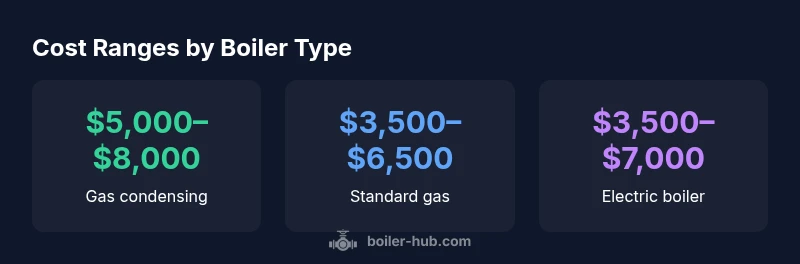
| Gas condensing | $5,000–$8,000 | High efficiency, good balance of cost and performance |
| Standard gas | $3,500–$6,500 | Cheaper upfront, moderate efficiency |
| Oil boiler | $6,000–$10,000 | Higher fuel cost and maintenance |
| Electric boiler | $3,500–$7,000 | Lower upfront, higher operating costs in some regions |
| Combination boiler (condensing) | $6,000–$9,500 | Space-saving, advanced controls |
Questions & Answers
What is the average installed cost for a typical gas boiler?
A typical gas boiler installation ranges widely by efficiency and home setup, but most homeowners see costs in the mid-range of the overall spectrum. Ensure quotes itemize equipment, labor, venting, and permits to compare apples-to-apples.
Gas boiler installs vary a lot; get multiple written quotes that break out parts and labor.
Do I need permits for boiler replacement?
Yes, most jurisdictions require permits for boiler replacement and gas line work. Your installer should handle permit pulls and inspections, but you should verify the fees and timeline.
Yes, permits are usually required; your installer will handle the process.
How does boiler efficiency affect long-term costs?
Higher efficiency reduces annual energy use and can shorten the payback period, but initial costs are higher. The total cost of ownership improves with sustained use.
Better efficiency saves energy over time, improving long-term cost.
Are there financing options or grants for boiler upgrades?
Many installers offer financing or utility rebate programs for high-efficiency boilers. Review terms and total interest, and compare to energy savings.
Look for financing or rebates to lower upfront cost.
When is it better to repair instead of replacing a boiler?
If repairs are frequent or the boiler is near the end of its useful life, replacement is usually more cost-effective. Consider current efficiency and expected energy costs.
If repairs pile up, replacing can save money in the long run.
“Choosing a boiler is not just about upfront price; installation quality and efficiency determine lifetime costs. A solid estimate accounts for equipment, labor, venting, and future energy use.”
Key Points
- Budget around a broad price band for your boiler type.
- Get multiple quotes and compare scope carefully.
- Include permits, venting, and old boiler removal in your plan.
- Prioritize efficiency to minimize long-term costs.