Why Would a Boiler Not Fire Up? Troubleshooting Guide
Urgent boiler troubleshooting guide: learn quick wins, diagnostic flow, and when to call a pro if your boiler won't fire up. Brought to you by Boiler Hub.


According to Boiler Hub, the most likely reason a boiler won’t fire up is a power or fuel-supply fault, with ignition or control issues close behind. Start with quick wins: confirm the boiler is on, the breaker isn’t tripped, and the gas valve or fuel line is open. If these basics pass, check the thermostat, pressure, and ignition components; and call a professional if problems persist.
Why would a boiler not fire up
The question "why would a boiler not fire up" often stems from a simple sequence failure rather than a complex breakdown. In most homes and facilities, the root cause is either a power issue, a gas/fuel problem, or an ignition/control fault. A boiler is a safety-conscious appliance: if it senses anything amiss, it will lock out or refuse to ignite to prevent dangerous conditions. According to Boiler Hub, the two most common culprits are power/fuel supply problems and ignition or control faults. Understanding this framework helps you prioritize checks without risking your safety. If you identify a single fault—like a tripped breaker or a closed gas valve—you may restore ignition quickly. If multiple areas seem suspect, you should plan a systematic inspection rather than random tinkering. This approach minimizes risk and speeds up resolution for homeowners and facility managers alike.
Why would a boiler not fire up: practical context
Power and fuel are the lifeblood of ignition. Without a stable power source and a clear fuel path, even the best burner cannot light. A typical ignition sequence requires: power, fuel, air, and a safe combustion chamber. If any link breaks, the sequence halts. Many outages are due to circuit breakers, blown fuses, or a shut-off valve. Lighting systems (electronic ignitions vs standing pilots) add another layer: a faulty igniter or a wet sensor can prevent ignition entirely. In commercial settings, a control board failure or a failed safety switch can trigger a lockout, forcing the system to remain cold until repairs are completed. The Boiler Hub Team notes that most issues are fixable with methodical checks rather than complete replacement.
Quick wins and safe checks
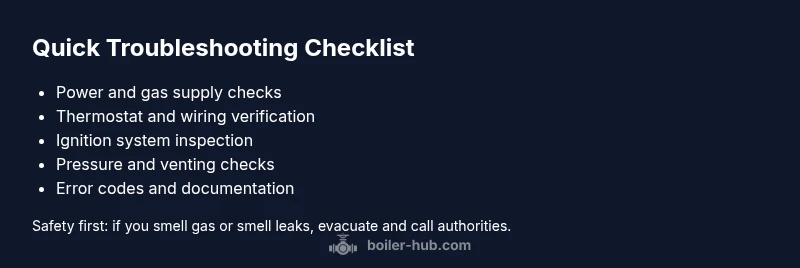
- Confirm the boiler’s power switch is on and the circuit breaker is not tripped.
- Inspect the gas valve or fuel line to ensure fuel is available.
- Verify the thermostat is calling for heat and set to a temperature appropriate for your space.
- Check for obvious error codes on the control panel.
- If you smell gas or notice a hissing sound, leave the area and contact the utility or a qualified technician immediately.
If these steps don’t restore ignition, move to more thorough diagnostics or professional service. Safety is the priority, and attempting gas line work without training is hazardous.
The role of ignition and sensors
Ignition systems vary by boiler type. Some use electronic spark igniters, others rely on a standing pilot. A failed igniter or pilot can prevent firing even when power and fuel are present. Modern boilers also employ flame sensors and gas safety valves that shut off if a flame isn’t detected or if venting is blocked. In these situations, the control board will log an error and prevent ignition to protect occupants. Regular maintenance reduces the likelihood of sensor or ignition faults by catching wear or buildup early.
Steps
Estimated time: 30-60 minutes
- 1
Power and fuel sanity check
Verify the boiler has power, the breaker is on, and the unit is properly plugged in if applicable. Confirm fuel supply is open (gas valve for gas boilers or fuel line for oil boilers). This step eliminates the most common, easy-to-fix issues.
Tip: Document the exact breaker status and valve position for service notes. - 2
Read error codes and reset safely
Check the control panel for error codes or fault lights. Note them and perform a controlled reset if the manual allows it. Do not force resets if a gas leak or burner abnormality is suspected.
Tip: Always wait 5-10 minutes after resetting before testing ignition again. - 3
Thermostat and wiring check
Ensure the thermostat is calling for heat and wired correctly. Confirm there are no loose wires, and the sensor is placed appropriately away from drafts or heat sources.
Tip: Calibrate or temporarily swap with a known-good thermostat if available. - 4
Inspect ignition system
For electronic ignition, inspect the spark or glow component for signs of wear. For standing pilots, verify the pilot flame is stable and properly adjusted.
Tip: Do not touch hot components; allow the system to cool before inspection. - 5
Check pressure and safety sensors
Verify system pressure is within the manufacturer's acceptable range and that high-limit or flame sensors are clean and functional. Bleed air if necessary and ensure there are no leaks.
Tip: Use manufacturer guidance for specific pressure ranges. - 6
Vent and condensate checks
Inspect the vent terminal for blockages and ensure condensate drains are clear. Blocked vents can trigger shutoffs; a clean drain prevents future lockouts.
Tip: Never operate with a visibly blocked vent; switch off and call a pro. - 7
Call a professional when in doubt
If ignition still won’t occur after these steps, schedule a service with a licensed technician. Complex failures often involve gas safety systems or control boards.
Tip: Provide the technician with notes, error codes, and a timeline of what you checked.
Diagnosis: Boiler won't ignite or stays cold after thermostat calls for heat
Possible Causes
- highPower issue (tripped breaker, blown fuse, unplugged unit)
- highGas supply problem or closed valve
- mediumThermostat or control wiring fault
- mediumIgnition system failure (igniter or flame sensor)
- lowLow water pressure or air in the system
- lowPressure switch or limit switch engaged (overheat)
- lowVent/ flue obstruction causing safety shutoff
Fixes
- easyReset power, reset boiler, and ensure breakers/fuses are intact
- easyVerify gas supply: valve open, line unobstructed, and meter not delivering zero pressure
- easyTest thermostat and wiring for continuity and correct settings
- mediumInspect ignition components for buildup or wear and clean/replace as needed
- mediumCheck system pressure and refill if below the recommended range; bleed air if present
- mediumConfirm safety switches and venting are clear; clear any blockages or reset switches
- hardIf none resolve it, contact a qualified technician for a full diagnostic and service
Questions & Answers
What is the first thing I should check if my boiler won't fire up?
Start with power and fuel checks: confirm the boiler is on, breakers are intact, and gas or fuel supply is open. Then verify the thermostat is calling for heat and watch for any fault codes on the control panel.
First check the power and fuel supply, then verify the thermostat is signaling for heat and note any error codes.
Why might the boiler ignite briefly and then stop?
A faulty igniter, flame sensor, or safety switch can cause a brief ignition attempt followed by a shutoff. It could also be related to gas pressure fluctuations or venting restrictions.
A bad igniter or flame sensor often causes a quick ignition followed by shutoff, sometimes due to gas pressure or venting issues.
Can a thermostat cause no ignition even when power is fine?
Yes. A miscalibrated or faulty thermostat may not signal the boiler to fire. Wiring faults or dead batteries (in wireless stats) can also prevent heat requests from reaching the boiler.
A faulty thermostat can prevent ignition by not signaling heat, even if power is fine.
Is it safe to relight a standing pilot or perform gas work myself?
Do not attempt gas work or relight procedures if you’re not trained. Standing pilots and gas valves require proper safety protocols to avoid leaks or explosions.
No, only trained professionals should relight standing pilots or handle gas valves.
What should I do if I detect a gas smell?
Leave the area immediately and contact the gas company or emergency services. Do not operate switches or electrical devices in the area.
If you smell gas, leave and call the gas company or emergencies right away.
When should I replace a boiler rather than repair it?
If the boiler is old, has frequent failures, or repair costs approach or exceed replacement costs, replacement may be more economical and safer in the long run.
Consider replacement if failures are frequent or the system is old and costly to repair.
Watch Video
Key Points
- Start with power and fuel checks before deeper diagnostics
- Ignition and control faults are common but fixable with methodical steps
- Always prioritize safety; call a pro for gas/vent issues or uncertain situations
- Document error codes and events to streamline professional service
- Regular maintenance reduces ignition failures and lockouts