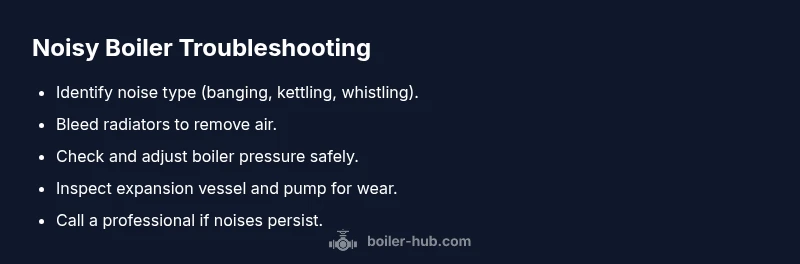
Why Is My Boiler So Noisy? A Practical Troubleshooting Guide
Learn how to diagnose and fix common causes of a noisy boiler—from trapped air to pump and expansion tank issues. Safe, practical tips from Boiler Hub to restore quiet, efficient heating.


Most boiler noises stem from normal operation or simple issues like air in the system, low pressure, or kettling. A quick fix is to bleed radiators to remove trapped air, check the boiler pressure, and top it up if needed. If banging continues, switch off power, pause use, and consult Boiler Hub’s troubleshooting guide for safe next steps.
Why is my boiler so noisy? Understanding the basics
Noise in a boiler isn't always a sign of imminent failure, but ignoring it can lead to bigger problems. According to Boiler Hub, most noises fall into a few categories: banging from mineral buildup, kettling due to limescale, whistling from air or flow restrictions, tapping from expanding pipes, and pump hum when flow is restricted. The Boiler Hub team found that many noises are preventable with regular maintenance and correct pressure. Quick checks at home can distinguish between harmless sounds and issues that require a pro. This guide focuses on safe, practical troubleshooting for homeowners and facility managers dealing with a noisy boiler. Always start with electricity off and the gas supply secure if you’re qualified to work on the system; if you smell gas, exit and call emergency services.
Common noise categories and what they signal
Boilers produce several distinctive sounds, and identifying the type helps target the fix.
- Kettling or rumbling: often signals mineral buildup in the heat exchanger. Left unchecked, scale reduces efficiency and increases wear.
- Banging or hammering: can indicate restricted flow, a dying pump, or air pockets that push water against the pipes.
- Whistling or screeching: usually means air in the system or a faulty valve limiting water flow.
- Tapping or creaking: expanding pipes or joints reacting to temperature shifts.
Understanding these categories helps you decide whether you can safely try fixes (like bleeding air) or if you should call a pro.
Quick safety-first checks you can perform
Before touching any equipment, ensure your safety.
- Turn off the boiler and power supply and, if you’re comfortable, switch off the gas at the meter.
- Look for obvious leaks around pipes, radiators, and the boiler casing.
- Check for recent service dates; if the boiler is overdue for maintenance, plan a service.
- If you smell gas, evacuate immediately and call the gas emergency number.
If any of these checks reveal danger or if you’re unsure, stop and contact Boiler Hub for guidance.
Bleeding radiators to remove trapped air (the easy fix)
Air trapped in radiators is a common cause of noise and cold spots.
- Start with the highest radiator first, locate the bleed valve, and prepare a cloth and small container.
- Insert the radiator key slowly and open the valve a quarter turn until air and a steady stream of water emerge.
- Close the valve promptly, wipe spilled water, and check the radiator. Repeat for all radiators that feel cold at the top.
- Re-check all valves and ensure the boiler pressure remains in the recommended range.
Tip: Bleeding may release a small amount of water; place towels and wear gloves.
Checking boiler pressure and topping up safely
Low pressure often creates banging and poor heating performance.
- Read the boiler pressure gauge; most systems run around 1-1.5 bar when cold.
- If pressure is below the recommended range, use the filling loop to top up slowly, watching the gauge.
- Stop at the recommended level and re-check for leaks.
- If pressure consistently drops, there may be a leak or a faulty component needing professional attention.
Note: Do not exceed the maximum allowed pressure; over-pressurizing can cause safety issues.
Expansion vessel and water hammer considerations
A faulty expansion vessel or water hammer can produce loud banging during heating cycles.
- Check the expansion vessel by testing its air charge if you have the proper gauge; a professional may be needed to confirm.
- Look for signs of a leaky or corroded vessel and listen for repeated banging when the system heats.
- If the vessel pressure is off, it may require recharging or replacement.
- A well-functioning expansion vessel stabilizes pressure and minimizes water hammer.
Pro tip: A corroded or water-filled vessel often requires a professional replacement.
Pump, filter, and flow-related noises
The circulator pump can cause whines, grinding, or hums when it’s worn or air-bound.
- Check for visible leaks around the pump and ensure it’s securely mounted.
- If the pump is old or noisy, professional inspection is recommended; sometimes replacing seals or the motor is necessary.
- Ensure the pump speed is appropriate for your radiator load; excessive speed can cause vibrating pipes.
- Clean any accessible filters to improve flow and reduce noise.
If you hear a grinding sound when starting the boiler, stop and consult a pro.
Burner, heat exchanger and mineral buildup
Kettling and roaring sounds can come from buildup on burners or heat exchangers.
- Mineral scale reduces heat transfer and causes knocking sounds during heating cycles.
- A chemical flush or mechanical descaling may be required; this should be performed by a licensed technician.
- Dirty burners can misfire or produce unusual noises; routine servicing resolves this.
- After descaling, monitor the boiler performance and noise levels to confirm.
Safety: Only trained technicians should perform descaling due to gas connections and electrical components.
When to call a professional and prevention tips
If the noise persists after trying the safe steps above, it’s time to bring in a professional.
- Persistent banging, strong gas smells, or leaks require immediate attention.
- Schedule an annual boiler service to prevent buildup and instability that causes noise.
- Implement preventative measures like magnetic filters, regular radiator bleeding, and correct pressure management.
- Maintain a log of noises, times, and frequencies to help a technician diagnose quickly.
The Boiler Hub team recommends proactive maintenance and prompt professional evaluation for noisy boilers to ensure safety and efficiency.
Steps
Estimated time: 60-120 minutes
- 1
Power down & safety check
Shut off the boiler and electrical supply; if you’re unsure about gas, switch it off at the meter. Confirm there are no gas smells or leaks before proceeding. This step minimizes risk before any activation or inspection.
Tip: Always start with safety and never bypass a gas smell. - 2
Identify noise type & inspect
Listen carefully to categorize the noise (banging, kettling, whistling). Visually inspect for obvious leaks, loose pipes, or vibration sources near the boiler.
Tip: A simple observation can rule out many issues. - 3
Bleed the radiators
Proceed to highest radiator first; use a bleed key to release air until water runs steadily. Wipe the valve area after each bleed.
Tip: Keep a container ready to catch water and avoid spills. - 4
Check & top up pressure
Read the pressure gauge; typical cold range is about 1-1.5 bar. If low, open the filling loop slowly and watch the gauge until within range.
Tip: Do not overfill; gradual adjustments prevent over-pressurization. - 5
Inspect expansion vessel
Check that the vessel has the correct air charge and isn’t leaking. A faulty vessel can cause pressure fluctuations and banging.
Tip: You may need a professional test if you’re unsure how to test the charge. - 6
Check the pump
Listen for grinding or excessive vibration from the circulator. If noise persists, the seals or bearings may be worn and require replacement.
Tip: Ensure the pump is securely mounted and free of obstructing debris. - 7
Inspect burner & heat exchanger
A dirty burner or scale on the heat exchanger can cause kettling. If buildup is present, a professional descaling is often needed.
Tip: Never attempt gas-related servicing beyond basic checks. - 8
Evaluate pipework & insulation
Check for loose clamps, vibrating pipes, or missing insulation that can amplify noise. Secure and insulate where appropriate.
Tip: Tighten loose fixtures gradually to avoid damage. - 9
Decision point & prevention
If noises persist after steps, contact a qualified technician. Schedule annual maintenance and implement a routine bleeding/pressure check schedule to prevent future noises.
Tip: Document noise patterns for faster diagnosis next time.
Diagnosis: Boiler makes banging, kettling, or whistling noises during operation.
Possible Causes
- highKettling from mineral buildup in the heat exchanger
- highAir trapped in the system causing air lock
- highLow system water pressure
- mediumExpansion vessel failure or water hammer
- mediumWorn circulator pump or valve stuck
- lowDirty burner or heat exchanger causing roar
Fixes
- easyBleed radiators to remove air
- easyCheck and top up boiler pressure to the recommended range
- mediumFlush the system to remove mineral buildup
- mediumInspect expansion vessel and pressure relief valves
- mediumInspect and possibly replace circulator pump
- hardClean burner and heat exchanger or call a pro
Questions & Answers
What are the most common causes of a noisy boiler?
The most common causes include trapped air, low pressure, mineral buildup, and faulty pumps or expansion vessels. These issues are typically fixable with basic checks; persistent sounds may indicate more serious problems.
Common causes are air, pressure, buildup, or a faulty pump; most fixes start with bleeding and pressure checks.
How can I tell if kettling is happening?
Kettling is a rumbling or banging sound from the heat exchanger. It often indicates mineral scale buildup and restricted flow; addressing scale or water quality can solve it.
Kettling sounds like a rumble in the heat exchanger; it's usually from limescale buildup.
Is it dangerous if my boiler is noisy?
Noises can signal issues but aren't always dangerous. However, loud banging, gas smells, or hissing require immediate attention and professional inspection.
Noises can be a warning sign; if you smell gas, evacuate and call emergencies.
Do I need to bleed the radiators?
Bleeding is a common fix for air in the system. If the radiator remains cool at the top or you hear air hiss, bleeding helps restore proper flow.
Bleeding helps remove trapped air and often quiets noisy radiators.
When should I replace my boiler because of noise?
If noise persists after safe fixes and professional servicing, and the boiler is old or inefficient, replacement may be the best option.
If fixes don't help and the boiler is aging, replacement may be sensible.
Can air in the system cause banging?
Yes, air locks can cause banging and kettling. Bleeding the system and balancing flow usually resolves it.
Air in the system can cause banging; bleeding often fixes it.
Watch Video
Key Points
- Identify noise type to target fixes.
- Bleed air and check pressure first.
- Expansion vessel or pump issues often require a pro.
- Regular maintenance prevents noisy boilers.
- If in doubt, pause use and seek expert guidance.