Why Is My Boiler Short Cycling? A Troubleshooting Guide
Learn why boilers short cycle and how to fix it fast. A practical Boiler Hub guide covering common causes, diagnostics, and safe fixes for homeowners.


Short cycling happens when your boiler heats up too quickly and shuts off, then restarts shortly after. The typical causes are improper boiler sizing, a restricted heat exchanger, air in the system, or a faulty thermostat. The quickest fix is to check water pressure, bleed air, and confirm thermostat settings. If the problem persists after basic checks, switch off and call a certified technician. According to Boiler Hub, diagnosing controls early saves fuel and wear.
What is boiler short cycling and why it matters
Short cycling is when your boiler repeatedly turns on and off in rapid succession instead of running a steady burn. It may heat the space unevenly, waste fuel, and shorten the boiler’s life due to startup wear. For homeowners and facility managers, diagnosing and stopping short cycles quickly saves money and reduces the risk of breakdowns. According to Boiler Hub, a common cause is mismatched sizing or a control fault that causes premature shutoffs. In practice, you’ll notice the burner lighting, heating for a few minutes, then shutting down before the room reaches set temperature. Understanding the signs helps you prioritize safety and plan the right fixes.
The short-term impact includes higher fuel bills and more frequent cycling; the long-term risk is stressed components, overheated heat exchangers, and potential condensate-related issues in modern boilers. A practical approach is to treat short cycling as a symptom of an underlying problem rather than a nuisance. Before diving into parts or replacements, confirm basic operating conditions: thermostat settings, water pressure, and radiator bleeding. By addressing the simple culprits first, you often restore normal cycling behavior without major repairs.
Common causes to check first
The most frequent culprits are simple to verify and usually quick fixes. Start with boiler pressure: too low or too high pressure can trigger short cycles as the system tries to reach set points. Next, look for air trapped in the system, which disrupts flow and causes rapid cycling. A dirty heat exchanger or clogged filter also reduces heat transfer, making the boiler fire up more often than it should. Finally, inspect the thermostat or aquastat for incorrect readings or wiring faults that cause premature shutoffs. If you find a clear issue, address it before moving on to more complex diagnostics.
The role of sizing and system design
Sizing mismatches are a leading cause of short cycling, especially in older homes or with retrofitted components. An oversized boiler will heat the space quickly and then shut off, only to restart soon after, wasting energy and causing wear. Conversely, a boiler that is too small will run longer and struggle to maintain temperature, potentially short cycling during high demand. The importance of proper system design cannot be overstated. Boiler Hub analysis shows that even well-maintained boilers can exhibit short cycling if the load calculation did not account for insulation, radiator distribution, and zoning patterns. If you suspect a sizing issue, a professional assessment can determine whether a replacement or a different control strategy is needed.
The diagnostic flow you should follow
Follow a logical sequence to confirm the root cause without guesswork. Start with the simplest checks that you can perform safely at home:
- Symptom verification: note exactly when the boiler starts and stops.
- Check pressure and water level.
- Inspect thermostat settings and response.
- Listen for unusual noises or frequent relights. If basic checks don’t resolve the issue, progress to testing the heat transfer path, then controls, then sizing. If at any point you encounter gas smells, water leaks, or carbon monoxide risk, shut down and call a professional immediately. This flow prioritizes safety and budget, helping you know when to DIY and when to escalate.
Step-by-step fixes for the most likely cause
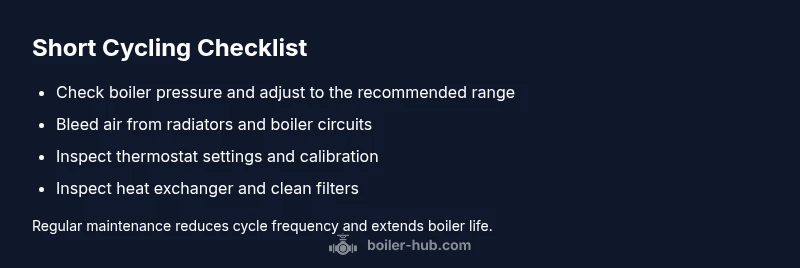
- Check boiler pressure and adjust to the recommended range. If the gauge shows too low or too high, adjust according to manufacturer instructions. 2) Bleed air from radiators and boiler system to remove air pockets that hinder heat transfer. 3) Test thermostat settings and recalibrate or replace a faulty thermostat. 4) Inspect the heat exchanger and clean or replace filters if obstructed. 5) Verify wiring connections and control wiring for loose contacts or corrosion. 6) If no improvement occurs, assess boiler sizing and consider a professional sizing check; replacement may be required in some cases.
Tip: Work methodically and document each change to avoid chasing multiple issues at once.
Safety tips and prevention to avoid future short cycles
- Always switch off power before servicing and follow gas safety guidelines. - Schedule annual service. - Keep an efficient thermostat and clean the system; maintain pressure. - Bleed radiators at the start of the heating season. - Install proper insulation to reduce load, reducing cycling frequency.
Steps
Estimated time: 60-90 minutes
- 1
Check boiler pressure and adjust
Locate the pressure gauge when the boiler is cold. If pressure is outside the 1–1.5 bar range, adjust per the manual, then recheck cycling after it stabilizes.
Tip: Use the bleed valve slowly and avoid sudden pressure changes. - 2
Bleed air from system
Start with the highest radiator and work downward. Use a radiator key or screwdriver to release air until water appears, then close valve firmly.
Tip: Have a cloth ready to catch drips and prevent scalding. - 3
Test thermostat/aquastat
Set to the desired temperature and observe response. If the boiler short cycles despite correct pressure, there may be a control fault.
Tip: Recalibrate before replacing components to confirm the fault isn't user settings. - 4
Inspect heat exchanger/filters
Look for debris or scale that blocks heat transfer. Clean or replace accessible filters; consider professional descaling if needed.
Tip: Never force parts;停止 if you encounter resistance to avoid damage. - 5
Check wiring and controls
Inspect for loose terminals, corrosion, or damaged wires. Reseat connections and replace damaged components as needed.
Tip: Turn off power before handling electrical connections. - 6
Confirm sizing and plan next steps
If the cycle issue persists, arrange a professional sizing check and discuss possibilities like replacement or advanced controls.
Tip: Document all tests and outcomes to aid the technician.
Diagnosis: Boiler turns on, heats, and shuts off shortly after reaching the setpoint, then restarts.
Possible Causes
- highIncorrect boiler sizing for the space
- mediumAir in the system or trapped air
- highLow water pressure or improper pressure setting
- mediumFaulty thermostat or control wiring
- lowClogged heat exchanger or dirty filter
Fixes
- easyInspect and adjust boiler pressure to the recommended range, then recheck cycle behavior
- easyBleed air from the system and radiators to remove air pockets
- easyTest thermostat/aquastat and recalibrate or replace if readings are off
- mediumClean or replace filters and inspect the heat exchanger if accessible
- hardIf unresolved, arrange professional sizing assessment and control diagnostics
Questions & Answers
What exactly is boiler short cycling?
Short cycling is when the boiler turns on and off rapidly rather than running a steady cycle. It often signals a sizing, pressure, or control issue and can waste fuel if not addressed.
Short cycling means the boiler keeps turning on and off quickly, usually due to sizing, pressure, or control problems.
Is short cycling dangerous?
Short cycling is not typically dangerous, but it can indicate risky conditions such as gas or carbon monoxide risks. If you detect gas, leave immediately and call emergency services.
It's not usually dangerous, but it can point to hazards like gas leaks. If you smell gas, leave and call for help.
Can low pressure cause short cycling?
Yes, low pressure reduces heat transfer and triggers the boiler to restart frequently. Restoring proper pressure is a common fix.
Low pressure can cause cycling; fixing the pressure often stops the cycle.
Should I bleed radiators to fix short cycling?
Bleeding radiators can remove trapped air that impedes heat distribution and triggers cycling. Do this safely and slowly.
Bleeding radiators can help if air is the cause, but do it carefully.
When should I call a professional for short cycling?
If basic checks don’t resolve the issue, or you suspect sizing or a control fault, schedule a professional evaluation to prevent future damage.
Call a pro if basic checks fail or sizing/control faults are suspected.
Will replacing the boiler fix short cycling?
Replacement is rarely the first fix. Most short cycling cases are solved with adjustments to pressure, controls, or sizing; replacement is considered if the system is outdated or undersized for the demand.
Replacing isn't always needed; many times fixes save money and time.
Watch Video
Key Points
- Identify root cause beyond quick fixes
- Start with simple checks: pressure, air, thermostat
- Baseline pressure and correct sizing matter
- Escalate to a professional if needed