Why Does My Boiler Have No Power? A Practical Troubleshooting Guide
Experiencing a boiler that won’t power on? This Boiler Hub guide takes homeowners through fast, safe checks, diagnostic flow, and step-by-step fixes to restore heat and hot water efficiently.


Most no-power boiler issues are caused by a simple power problem. Check the circuit breaker, fuses, and the boiler’s own on/off switch first. If power is reaching the unit but it still won’t light, inspect the wall thermostat or room sensor, and look for a tripped safety switch. If none of these fix it, professional service may be needed.
Why power loss happens to boilers and the role of safe troubleshooting
When a boiler suddenly has no power, the first thing to ask is: is the power supply actually cut, or is the boiler failing to respond to a normal signal? According to Boiler Hub, many instances of no power are traced to the electrical supply or to simple control faults rather than a failed boiler component. This means that careful, low-risk checks can often restore heat quickly without expensive service. In this guide we’ll distinguish between power supply issues, safety interlocks, and control faults, so you can approach the problem calmly and safely.
Quick, safe checks you can perform today
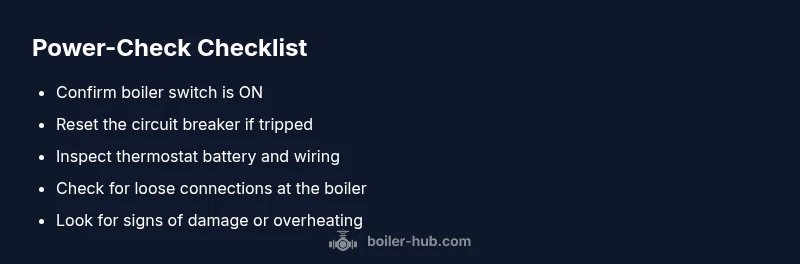
Before you touch wires or open the boiler cabinet, ensure your safety: switch off power at the source and wear dry gloves if you must handle electrical parts. Start with the basics: confirm the wall switch is on, verify the circuit breaker or fuse for the boiler feeder hasn’t tripped, and inspect the boiler’s own power switch. If the boiler still shows no activity, test the room thermostat battery or wiring and confirm it is calling for heat. If you detect any burning smells, melted insulation, buzzing noises, or scorch marks, stop and call a professional immediately. These quick checks cover the most common causes and often resolve the issue without professional intervention.
Electrical basics: how a boiler gets power and what can fail
A modern boiler relies on a stable electrical supply and a few control signals to operate. The main power feed should deliver clean voltage, while the boiler’s internal control board responds to thermostat signals and safety sensors. Problems can arise from a tripped circuit breaker, a blown fuse, a faulty switch, or degraded wiring connections. Some controls include a reset button; use it only after ensuring the system is safe to reset. If the supply is interrupted by a faulty breaker or GFCI/RCD, the boiler won’t power on even if other appliances work in the same circuit. This section explains how to verify each component step by step.
Diagnostic flow: symptom → diagnosis → solutions
Symptom: boiler shows no power or refuses to light. Diagnosis can range from a simple power disruption to a failed control board. The most likely causes, in order, are: 1) Power issue (high likelihood) such as a tripped breaker or off switch; 2) Thermostat or wiring issue (medium likelihood); 3) Faulty boiler control or safety interlock (low likelihood). Fixes: reset breakers, replace fuses, set the boiler switch to the ON position, replace thermostat batteries, and if needed, escalate to a qualified technician for electrical testing or control board replacement.
Step-by-step fixes for the most common power issue
This section provides actionable steps to restore power safely. Start with the simplest fixes and progress to more involved checks only if necessary. Use the sequence to minimize risk and avoid creating new problems. If you’re uncomfortable with any step, stop and call a pro.
Tips, warnings, and common mistakes to avoid
Electrical work carries risk. Always de-energize before touching conductive parts, never work alone if you’re uncertain, and never bypass safety devices. Do not attempt to repair a damaged cord or outlet; replacing or upgrading wiring should be done by a licensed electrician. Common mistakes include assuming the boiler is at fault when the issue is a tripped breaker elsewhere in the home, and neglecting to test the thermostat in addition to the boiler.
Key takeaways and prevention tips
By understanding the power path and keeping a regular safety check routine, you can reduce the frequency of intentional no-power events. Scheduling annual visual inspections, testing the thermostat, and ensuring your circuit protections are appropriate helps prevent future breakdowns.
Steps
Estimated time: 30-60 minutes
- 1
Verify main power to boiler
Locate the boiler’s dedicated switch and the house circuit breaker. Ensure the switch is ON and the breaker hasn’t tripped. If the breaker is tripped, switch it OFF, wait a moment, and switch it back ON to test for a reset.
Tip: Use a non-contact voltage tester to confirm power presence without touching live conductors. - 2
Check boiler wiring and connections
With the power OFF, inspect exposed terminals for loose or corroded connections. Carefully reseat wires and ensure there are no signs of scorching or damaged insulation.
Tip: Only touch metal parts when power is OFF; wear insulated gloves. - 3
Inspect thermostat and sensors
Verify the thermostat is calling for heat. If it’s battery-powered, replace the battery. For wall sensors, ensure placement isn’t blocked or damaged and that the wiring harness is secure.
Tip: Test by turning the thermostat up and watching the boiler for response. - 4
Reset and test boiler controls
If the boiler has a reset button, press and hold as directed in the manual. Observe for indicator lights or fault codes. Note any codes and refer to the manual for interpretation.
Tip: Only perform a reset once per event to avoid masking a real fault. - 5
Inspect safety interlocks and venting
Check that all safety switches (drain, pressure, flame safeguard) are properly engaged and that vents are free of obstructions. A tripped interlock can stop power to the boiler.
Tip: Blockages can create false fault conditions; ensure clear air paths. - 6
Call a professional if power remains off
If after these steps the boiler remains unpowered or you notice burning smells, electrical arcing, or water leakage, stop and contact a licensed professional.
Tip: Safety first: untrained electrical work can cause serious harm.
Diagnosis: Boiler shows no power or refuses to light
Possible Causes
- highPower issue (breakers, fuses, switches)
- mediumThermostat or wiring fault
- lowFaulty boiler control or safety interlock
Fixes
- easyCheck and reset the main boiler circuit breaker / fuse; ensure the boiler’s power switch is ON
- easyTest the wall thermostat or room sensor; replace batteries or recalibrate wiring as needed
- mediumInspect and tighten electrical connections at the boiler terminal board; tighten any loose wires
- hardIf the boiler still won’t power, call a licensed electrician to test the supply and control board
Questions & Answers
What should I check first if my boiler has no power?
Start with the boiler’s power switch, then confirm the circuit breaker hasn’t tripped. If power is present but the boiler remains dark, inspect the thermostat and safety switches for faults.
First check the boiler switch and the breaker. If it’s still off, power may be interrupted or a safety switch tripped; then inspect the thermostat.
Can I reset my boiler to fix no power?
A reset can clear minor faults, but it should be done only once. If the boiler doesn’t respond after a reset, or if fault codes appear, stop and call a professional.
Yes, you can try a single reset, but don’t repeat it or ignore fault codes. If nothing changes, get professional help.
Is a tripped breaker always the cause?
Not always, but it’s the most common avoidable cause. If the breaker trips repeatedly, there may be an overloaded circuit or a fault in the boiler wiring.
Often it’s the breaker. Repeated trips mean the circuit or boiler wiring needs a professional check.
When should I call a professional for boiler power issues?
Call a professional if basic checks don’t restore power or if you notice burning smells, sparking, or moisture around wiring. Electrical work should be left to licensed technicians.
If basic checks fail or you smell burning or see moisture, call a professional now.
Can thermostat problems cause no power to the boiler?
Yes, a faulty thermostat or miswired sensor can prevent a boiler from firing even when power is fine. Check batteries and wiring before assuming the boiler is at fault.
Thermostats can block firing even if power is fine—check batteries and wiring first.
How can I prevent boiler no-power problems?
Schedule annual boiler maintenance, test the electrical supply, ensure safety interlocks are clean and undisturbed, and keep a simple troubleshooting checklist for quick reference.
Keep up with annual maintenance and a simple power-check routine to prevent surprises.
Watch Video
Key Points
- Check the main power and boiler switch first
- Thermostat and sensors can mimic power issues
- If the power path is intact but it won’t fire, a control fault may exist
- Call a licensed pro for hard electrical testing
- Regular maintenance reduces future no-power events