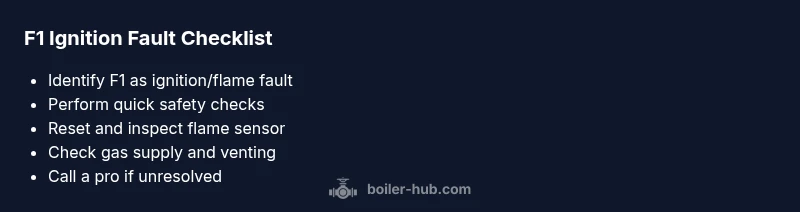
When the boiler says F1: Urgent Ignition Fault Guide
F1 on boilers usually signals an ignition fault or flame sensor issue. This urgent guide explains quick fixes, simple checks, safety notes, and when to call a pro.


F1 on boilers generally signals an ignition fault or flame sensor issue. It means the boiler detected an unsafe flame condition or failed to ignite properly. The quickest steps are to reset the boiler, verify gas supply and venting, and perform a safe visual check. If the fault persists, shut off power and call a pro.
What F1 Means on Your Boiler
According to Boiler Hub, an F1 error typically indicates a problem with ignition or flame detection in a gas-fired boiler. When the control system detects that ignition did not occur or that a flame isn't sensed within the expected window, it triggers F1 to protect your home. In practical terms, this could be a failed igniter, a dirty or faulty flame sensor, or a temporary limitation in gas supply or air intake. Understanding this distinction helps you prioritize fixes that restore safe operation without unnecessary parts replacement. For homeowners and facility managers, the key takeaway is that F1 signals a safety-related interruption, not a routine warning. Addressing it promptly reduces the risk of gas buildup or delayed heating.
If you’re seeing F1, do not ignore it. A quick, calm assessment now can prevent larger issues later. The Boiler Hub team emphasizes starting with safe checks and escalating to professional service if the fault persists after initial actions. The goal is to restore reliable ignition while maintaining strict safety standards.
Immediate Safety and Quick Fixes (Fast Actions)
Before attempting any repair, ensure you understand the safety implications of a gas-fired boiler. If you smell gas or detect hissing, evacuate the area and call emergency services. For non-emergency checks, turn off the boiler at the wall switch and, if you can access it safely, shut the gas supply valve. Next, try a simple reset following your manufacturer’s instructions. Verify the flue is clear of obstructions and that air intake paths are unobstructed. Check that the boiler is properly vented and that there’s no ice buildup or condensate block in the condensate trap. After the reset, observe the status LED or display. If F1 returns, power down and call a professional. The quickest path to safety is stopping operation until a qualified technician can assess the ignition system, gas supply, and venting.
Diagnostic Flow: Symptoms to Causes to Solutions
The F1 code usually appears with symptoms like the boiler not igniting, cycling on and off, or producing unusual burner sounds. Common causes, in priority order, include a dirty or faulty flame sensor/igniter (high likelihood), insufficient gas pressure or flow (medium), vent blockage or restricted air intake (low), and a failing control board or ignition module (low).
Typical fixes range from simple sensor cleaning to gas-supply verification and, if necessary, a professional inspection of the ignition module. Running through a structured diagnostic flow helps you avoid random part replacements and keeps costs reasonable. Always start with the easiest checks (sensor cleaning, reset) and escalate to gas and venting verification, then to professional service for electronic or control-board issues.
Step-By-Step Fix for the Most Common Cause (Flame Sensor/Igniter)
Other Causes and Quick Alternatives
Safety, Warnings, and When to Call a Pro
Steps
Estimated time: 30-60 minutes
- 1
Power down and isolate
Turn off the boiler at the wall switch and, if safe, shut off the gas at the appliance valve. Disconnect the unit from power to prevent accidental ignition during inspection.
Tip: Ensure your hands are dry and you’re standing on a dry surface before touching electrical components. - 2
Check for obvious hazards
Look for gas odors, hissing, or soot around the burner area. If you smell gas, leave the area immediately and call emergency services. Do not operate the boiler again until inspected by a pro.
Tip: Gas smells are a clear sign to evacuate—safety first. - 3
Reset and observe
With safety confirmed, perform a standard reset according to your boiler’s manual. Listen for ignition attempts and watch the status light. If F1 reappears, do not retry repeatedly.
Tip: Some models require a specific sequence; refer to the manual for the correct reset procedure. - 4
Inspect flame sensor and igniter
If you can access the burner, inspect the flame sensor for residue and gently clean with a dry cloth or isopropyl-alcohol wipe. Check the igniter for cracks or misalignment and reseat any loose connections.
Tip: Be gentle to avoid scratching or damaging the sensor rods. - 5
Check gas and ventilation
Confirm the gas valve is fully open and the gas line is free of kinks. Verify the exhaust vent and air intake aren’t blocked by debris, snow, or dust.
Tip: Restricted venting can cause flame-sensing faults and incomplete ignition. - 6
Call a professional if unresolved
If the issue persists after steps 1–5, contact a licensed boiler technician. Provide the technician with the model, error code, recent maintenance, and any unusual symptoms.
Tip: Prepare the boiler’s make/model and the exact error timing to speed up diagnostics.
Diagnosis: Boiler shows F1 and won’t restart
Possible Causes
- highDirty or faulty flame sensor/igniter
- mediumLow gas supply or pressure
- lowVent blockage or restricted air intake
- lowControl board/ignition module fault
Fixes
- easyClean the flame sensor and igniter, reseat connectors
- easyVerify gas supply valve is fully open and gas pressure is within spec
- easyClear vent and air intake obstructions; ensure proper combustion air
- mediumPower cycle the control board or perform a module reset per manual
- hardSchedule professional service for ignition module replacement or control-board issues
Questions & Answers
What does F1 mean on my boiler?
F1 typically signals an ignition fault or flame sensor issue. It means the boiler detected a flame safety problem and blocked ignition to protect the system.
F1 usually means there’s an ignition fault or flame sensor issue, so safety interlocks have stopped the boiler.
Is F1 dangerous to ignore?
Yes. Ignition faults can indicate gas safety risks or incomplete combustion. If you smell gas, evacuate and call emergency services immediately.
Yes—if you smell gas, leave the area and call emergency services right away.
Can I fix F1 myself?
Some quick resets and sensor cleaning can help, but persistent F1 usually needs a professional to service ignition components and gas connections.
You can try a reset and basic checks, but if it sticks, get a pro to service the ignition parts.
What causes ignition faults besides sensors?
Causes include dirty sensors, faulty igniters, low gas pressure, vent blockages, wiring issues, or a failing control module.
Common causes are sensor or igniter issues, gas pressure problems, vents, or control module faults.
How much does it cost to fix F1?
Repair costs vary; expect a service call plus parts, typically ranging from a low hundreds to a few hundred dollars depending on the fault.
Costs vary, but you’ll usually pay for the service call and any replacement parts.
Watch Video
Key Points
- Identify F1 as a safety ignition fault, not a normal status.
- Start with quick safety checks and sensor cleaning before calling a pro.
- If repeated, F1 usually requires professional inspection of gas, venting, or ignition module.