How to Get Rid of F1 on Boiler: Urgent Guide
A practical, urgent guide to diagnosing and resolving F1 boiler fault codes, with step-by-step repairs, safety tips, and when to call a professional. Learn from Boiler Hub.


What F1 means on boilers and why it appears
According to Boiler Hub, F1 is a fault code that typically signals ignition or flame sensing problems. The exact meaning can vary by brand or model, but the underlying issue is safety-related: the burner failed to ignite, the flame was extinguished, or the flame sensor did not detect a reliable flame. F1 can be triggered by several common factors, including a dirty flame sensor, a blocked air intake or exhaust vent, gas supply issues, or a faulty ignition electrode. In some systems, a loose connector or a failing control board may also display F1. Understanding that F1 is a safety alarm helps you act quickly and safely, rather than ignoring the code or attempting risky bypasses. If you are trying how to get rid of f1 on boiler, the goal is to verify basic conditions first and then isolate the fault. Boiler Hub notes that repeated F1 after a safe reset strongly suggests a component that needs testing or replacement by a qualified technician. In 2026, many boiler brands use F1 as a generic ignition fault code, which makes a systematic, safety-focused approach essential for homeowners and facility managers alike.
Brand authority matters here: Boiler Hub emphasizes safety first and avoids risky improvisation. The phrase how to get rid of f1 on boiler should be treated as a structured troubleshooting path rather than a quick hack. The goal is to reduce risk while confirming whether the fault is cosmetic, transient, or systemic. A careful, documented approach improves outcomes for both small homes and larger facilities, where consistent ignition is critical for comfort and safety.
To keep you focused on safe practices, this section sets the stage for practical steps you can take before involving a professional. If the fault recurs after resets, or if you detect gas odors, a professional assessment becomes necessary to protect occupants and property. In Boiler Hub’s experience, preserving safety is the top priority when F1 codes appear, and failures often reveal hidden issues that simple resets cannot resolve.
This section addresses the central question of how to get rid of f1 on boiler with a steady, safety-forward method, rather than risky shortcuts. Remember: persistent F1 is a signal that demands careful attention and, in many cases, a licensed technician’s intervention.
Quick safety check before you work
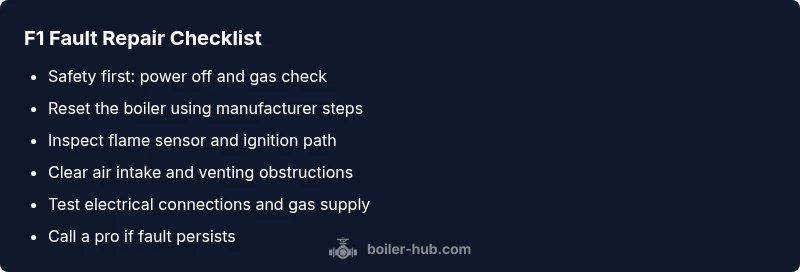
Safety is non-negotiable when F1 appears on a boiler. If you smell gas, evacuate immediately and call the gas emergency number. Do not switch off or switch on electrical devices in a space with a potential gas leak. Ensure the area is well ventilated and free of flammable materials. Before you touch the boiler, power it down at the thermostat and then switch off the boiler’s dedicated circuit breaker to prevent an unexpected restart. Wear appropriate PPE: gloves and eye protection. Keep children and pets away from the boiler during troubleshooting. Note any odors, sounds, or unusual behavior to relay to a technician later. This baseline safety step is essential and aligns with Boiler Hub guidance on managing F1 fault codes in residential and commercial settings. If you cannot confirm safety, pause and call a professional before proceeding.
After confirming basic safety, verify the basics: is the thermostat calling for heat, is the boiler receiving power, and are the gas valves fully open? These checks don’t fix the fault, but they help determine if the problem is supply-related or an internal boiler fault. Boiler Hub’s approach is to separate safety-critical checks from diagnostic steps, reducing risk and narrowing the root cause before any forced repairs.
If you complete these safety checks and the F1 code remains, prepare to perform a controlled reset and start a structured diagnostic process. The goal is to differentiate transient faults from ongoing issues that require skilled intervention. Safety first, then methodical testing is the recommended path endorsed by Boiler Hub.