What to Do When Your Boiler Says F1
When your boiler shows F1, you’re facing a flow or sensor fault. This urgent guide from Boiler Hub walks homeowners through quick fixes, diagnostic flow, safety tips, and when to call a pro. Learn how to restore heat fast and safely.


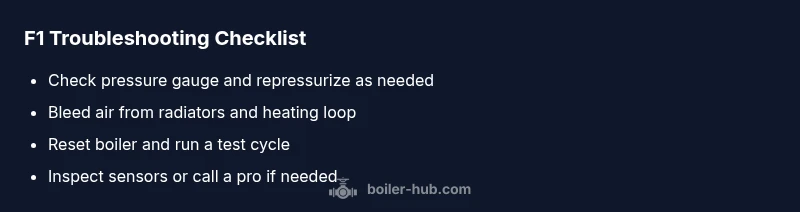
F1 means a fault in water flow or a sensor in many boilers. The quickest fixes are to check the pressure gauge, bleed trapped air, and repressurize to the recommended level, then reset. If the code persists after these steps, power down safely and call a qualified technician ASAP. If you smell gas or notice leaks, leave the area immediately and seek help.
What F1 Means for Your Boiler
F1 is a safety-oriented fault code used by many residential boilers to signal a problem in the water flow path or with a flow-related sensor. When this error appears, the boiler typically locks out to prevent damage or unsafe operating conditions. The precise meaning can vary by brand, but the common thread is a disruption in the hydronic loop—either the boiler isn’t getting enough water flow, or a sensor is misreading flow. In some models, F1 can also indicate a sensor circuit fault or wiring issue that prevents the unit from validating safe ignition and heating cycles. Because F1 triggers a safety lockout, do not ignore it or bypass it. Addressing it promptly protects your heating system and your home’s comfort.
According to Boiler Hub, F1 is among the more frequent boiler faults homeowners encounter, and it often stems from straightforward causes such as pressure issues or air in the system. While some F1 fault conditions are quick fixes, others may require professional diagnostics, especially if the fault reappears after initial checks. With the right approach, you can restore heat without unnecessary service calls, but you should always prioritize safety first and monitor for any signs of gas odor or water leaks as you troubleshoot.
Immediate Safety and Quick Fixes
Safety is the first priority when a boiler shows F1. If you smell gas, hear hissing sounds, or notice a hissing or burning smell near the boiler, evacuate the area and call emergency services. If everything seems safe, begin with low-risk checks that you can perform without specialized tools.
- Power and gas safety: Ensure the boiler is turned off and switched to the “off” position. If you have a gas supply, verify that the gas valve is fully open only if you know it is safe to do so. Do not operate the boiler if you’re unsure about the gas line or ventilation.
- Visual clues: Look for obvious signs of leakage or corrosion, scorched wiring, or melted insulation around wiring plugs. If you see anything suspicious, stop and call a professional.
- Pressure gauge check: Most boilers want a pressure reading in the range of roughly 1–1.5 bar when cold. If the pressure is well outside this range, you’ll need to repressurize and recheck.
- Bleed air from radiators and loop: Air trapped in the heating circuit can disrupt flow. Use a radiator key to release air carefully at each radiator, listening for a steady stream of water rather than a hiss of air.
- Reset and monitor: After air is bled and pressure is adjusted, reset the boiler according to the manual and observe whether F1 returns. If it does, move to the diagnostic flow below.
Diagnostic Flow: From Symptom to Solution
When F1 appears, a structured diagnostic approach helps identify the root cause without unnecessary disassembly. Start with the simplest fixes and escalate only if needed:
- Symptom: Boiler displays F1 and won’t heat water or radiators.
- Possible causes (in order of likelihood):
- Low water pressure or air in the system (high likelihood)
- Dirty or failing flow/temperature sensor (medium)
- Blocked flow path or dirty filter (low)
- Core fixes to try first:
- Bleed air and repressurize to the recommended level (easy)
- Power cycle the boiler and perform a soft reset (easy)
- Inspect sensor connections or schedule replacement if the fault persists (hard)
Keep track of pressure changes and any visual clues as you test. If F1 returns after these steps, it’s a strong signal that a sensor or control circuit requires professional diagnosis.
Step-By-Step Fix for the Most Common Cause
This section provides a practical, repair-focused sequence for the most common F1 trigger: low pressure and air in the loop.
- Prepare and safety-check: Confirm power is off, ventilate the area, and have a towel ready for any minor water discharge.
- Bleed air from the system: Starting with the radiator closest to the boiler, use a radiator key to bleed slowly until you hear a steady stream of water. Move to other radiators if necessary.
- Check and adjust pressure: After bleeding, check the pressure gauge. If it’s below 1 bar when cold, use the filling loop to repressurize gradually to about 1–1.5 bar. Do not overpressurize.
- Reset and test: Reset the boiler per the manual and run a short heat cycle to confirm whether F1 reappears. If the display remains clear, observe the system for a full cycle. If not, proceed to professional assessment. Tip: Keep a small, labeled notebook of your pressure readings for a week to help your technician diagnose recurring issues.
Other Possible Causes and How to Handle Them
If the common low-pressure scenario is not the cause, other possibilities to evaluate include sensor faults, wiring issues, and the heat exchanger or flow path itself.
- Sensor or wiring fault: A faulty flow sensor or damaged wiring can trigger F1 even if there’s sufficient water flow. Visual inspection of connector pins and insulation is reasonable if you have experience. If you spot a damaged connector, do not touch exposed metal; isolate and call a technician.
- Blocked flow path or dirty filter: Sediment or scale buildup can impede flow, triggering F1. A professional may need to clean the heat exchanger or replace a clogged filter to restore proper flow.
- Control board fault: In some cases, a faulty PCB or sensor circuit triggers F1 intermittently. This typically requires diagnostic tools and replacement parts from a pro.
Safety Tips and When to Call a Professional
F1 can be a safety-critical fault; never ignore it. If you encounter gas odors, hissing noises, or visible water leaks, leave the area and contact emergency services. Do not attempt major repairs beyond your comfort zone. If you are uncertain about pressure readings or electrical connections, contact a licensed gas boiler technician. For many F1-related fixes, a pro can perform a safe pressure check, sensor testing, and control-board diagnostics with calibrated tools. Budget for professional service if front-line fixes fail or if the fault recurs after follow-up checks.
Prevention Tips to Avoid F1 in the Future
A proactive maintenance mindset reduces the likelihood of F1 interrupts. Schedule annual boiler servicing and keep your system clean by changing filters (where applicable) and flushing the system if advised by your technician. Regularly check and maintain the correct pressure range, and bleed radiators at the start of each heating season to minimize air buildup. Document pressure readings and any F1 occurrences to help your service visit go faster and more precisely.
What Next: Maintenance Plan and Monitoring
After addressing F1, create a simple maintenance plan to minimize future faults. Keep a log of dates for service visits, pressure readings, and any anomalies such as unusual noises or temperature fluctuations. If your boiler is under warranty, consult the service provider before attempting any major repairs. The goal is to preserve safe operation, efficient heating, and reliable hot water without sudden outages.
Steps
Estimated time: 30-60 minutes
- 1
Ensure safety and initial checks
Verify power is off, switch to the off position, and ensure proper ventilation. Check for gas odors and visible leaks. If danger signs exist, do not proceed.
Tip: If you smell gas, evacuate immediately and call the gas emergency line. - 2
Check pressure and bleed air
Read the boiler pressure gauge; aim for around 1–1.5 bar when cold. Bleed air from radiators using a radiator key until water runs steadily.
Tip: Do not reopen valves too quickly; slowly release pressure if you overfill. - 3
Repressurize and reset
Open the filling loop gradually to raise pressure to the target range, then close the loop. Reset the boiler per the manual and monitor for F1.
Tip: Document the pressure after repressurizing to help future diagnostics. - 4
Test and monitor
Turn on heating for a short cycle and check if F1 returns. If it does, schedule a professional check to test sensors and circuit boards.
Tip: If the error persists, avoid repeated resets and seek expert service.
Diagnosis: Boiler displays F1 error code and may stop heating water
Possible Causes
- highLow water pressure or air in the system
- mediumFailed or dirty flow/temperature sensor
- lowBlocked flow path or dirty filter
Fixes
- easyBleed air and repressurize to the manufacturer-recommended pressure
- easyPower cycle the boiler and perform a soft reset
- hardInspect/replace flow sensor or consult pro
Questions & Answers
What does F1 mean on my boiler?
F1 is a safety fault indicating a flow-related issue or sensor problem. It often means the boiler has locked out to prevent damage. Start with pressure checks, bleed air, and reset, but if the fault recurs, call a professional.
F1 is a safety fault usually tied to water flow or a sensor problem. Check pressure and bleed air, then reset; if it comes back, call a technician.
Is F1 dangerous?
Not inherently dangerous, but it signals a fault that can affect heating and hot water. If you smell gas or detect leaks, exit and call emergency services.
F1 isn’t usually dangerous by itself, but it means a fault is present. If you smell gas, leave the area and call for help.
Can I reset the boiler to clear F1?
Resetting may clear the code temporarily, but it does not fix the underlying problem. If F1 returns after a reset, stop and seek professional help.
Resetting might clear it briefly, but the root cause isn’t fixed; if F1 returns, get professional help.
How much does it cost to fix F1?
Repair costs vary by cause. Typical ranges might be from a few hundred dollars for sensor fixes to several hundred for PCB or replacement parts. A homeowner should expect a diagnostic fee plus parts and labor.
Costs vary; expect a diagnostic fee plus possible sensor or control-board repairs depending on the cause.
When should I call a professional?
Call a professional if you’re unsure, if pressure readings are unstable, or if you smell gas. Also seek pro help if the fault recurs after basic checks.
Call a pro if you’re unsure, if pressure is unstable, or if you still get F1 after basic checks.
What maintenance helps prevent F1?
Annual service, regular bleeding of radiators, monitoring pressure, and addressing minor leaks quickly can reduce F1 occurrences.
Regular servicing and quick attention to leaks and pressure changes can help prevent F1.
Watch Video
Key Points
- Address F1 promptly to restore heat
- Start with pressure, air, and reset
- Persistent F1 requires professional diagnostics
- Regular service helps prevent F1 recurring