What Causes Boiler Short Cycling: Troubleshooting Guide
Learn the common causes of boiler short cycling and a practical, step-by-step approach to diagnose and fix the issue safely. From pressure checks to venting and expansion tanks, Boiler Hub guides homeowners and facility managers to quick resolutions.


Most boiler short cycling is usually caused by a control/flow issue rather than a furnace problem. Start with the basics: check boiler pressure, bleed air from radiators, and verify the thermostat and aquastat are set correctly. If the issue persists, inspect the expansion tank and venting for blockages. This quick check often resolves the issue and halves wasted energy.
What causes boiler short cycling and why it matters
Short cycling occurs when the boiler starts heating, reaches its setpoint, and shuts off too quickly, only to start again shortly after. This pattern wastes energy, wears components, and can indicate a deeper problem in your hydronic system. In many homes, the phrase 'what causes boiler to short cycle' leads homeowners to look for quick fixes, but effective resolution requires diagnosing underlying causes. According to Boiler Hub, the most frequent triggers are issues with pressure, controls, air in the system, or faulty venting. Addressing these can restore smooth operation without skipping essential safety steps. If you notice frequent cycling, you may also experience uneven heating, louder operation, and higher energy bills. A calm, systematic approach helps you identify the root cause without risking safety.
The most common causes at a glance
From a homeowner’s perspective, certain failures show up as short cycling far more often than others. The top culprits include low boiler pressure, a faulty thermostat or aquastat, and air trapped in the system. Additional issues like a waterlogged expansion tank, a dirty burner or heat exchanger, and restricted venting can also trigger rapid on/off behavior. Each cause changes the diagnostic path: pressure problems are easy to verify, while a faulty aquastat may require professional testing. Because many of these issues affect safety and efficiency, it’s wise to address them promptly rather than continuing to run the boiler in a compromised state. Boiler Hub analysis shows that resolving the primary control or flow problem often stops cycling and restores consistent heat.
Quick checks you can perform safely
Before dismantling components, perform safe, high-impact checks. Always switch off power to the boiler and, if you smell gas, exit the area and call emergency services. Start with the basics: verify the pressure gauge reads within normal operating range as per your boiler manual, bleed air from radiators or radiant panels, and inspect the thermostat settings. Check that thermostat placement isn’t near a heat source or draft that could cause the system to short cycle. Inspect the aquastat or high-limit control for obvious signs of wear or incorrect settings. If the boiler has an automatic fill valve, ensure it isn’t stuck open. These simple steps often reveal simple fixes.
Diagnostic flow in practice
A practical diagnostic approach follows a clear flow: identify the symptom (rapid cycling), form a hypothesis about the likely causes, test the simplest fixes first, and escalate to more involved checks if needed. For example, if the symptom is short cycling and the pressure gauge is low, the diagnosis leans toward a pressure issue and a quick refill and bleed may solve it. If pressure is normal but cycling persists, the next focus is thermostat accuracy or a faulty aquastat. Boiler Hub emphasizes documenting each attempt and any error codes shown on the control board to streamline further service if required.
Step-by-step fixes for the top causes
Top causes tend to fall into two broad categories: control/flow issues and trapped air or water imbalance. Step by step fixes below address the most common culprits. Always start with low-effort, safe actions and progress to more involved ones if necessary. Remember: if you smell gas, hear hissing, or notice any sudden flame irregularities, shut down the boiler and call a professional immediately. Regular maintenance is the best defense against short cycling, and Boilers Hub recommends scheduling annual checks to keep the system in good shape.
Safety, maintenance, and when to contact Boiler Hub
Safety first: never bypass safety devices, and always power down the system before attempting any intervention. Use only manufacturer-approved procedures and gauges when adjusting pressure or filling the system. If you’re unsure about any step or if the issue recurs after basic checks, contact a licensed technician. Timely professional assessment can prevent heat loss, energy waste, and potential equipment damage. Boiler Hub’s guidance emphasizes proactive maintenance and documented checks to catch issues before they escalate.
Steps
Estimated time: 90-120 minutes
- 1
Power down and ensure safety
Shut off the boiler and switch off the circuit or energy source if applicable. If you smell gas or suspect unsafe conditions, evacuate and call emergency services. Confirm the area around the boiler is clear and safe before proceeding.
Tip: Always prioritize safety and use proper PPE when inspecting components. - 2
Check and adjust boiler pressure
Locate the pressure gauge and compare it with the manufacturer’s recommended range. If it’s low, use the filling loop to top up gradually until you’re within the normal band, then recheck for fluctuations.
Tip: Do not overfill; tiny pressure changes can affect cycling. - 3
Bleed air from radiators or baseboards
With the system off and cool, bleed air from each radiator or baseboard until a steady stream of water flows. Have a rag ready for drips and recheck the system pressure after bleeding.
Tip: Bleeding can cause slight pressure drops—rebalance if needed. - 4
Test thermostat placement and function
Ensure the thermostat is located away from direct heat sources, drafts, or dead zones. Confirm it’s calling for heat and that wiring isn’t loose or misconnected.
Tip: If uncertain, temporarily bypass the thermostat with a known-good unit to test cycling. - 5
Inspect expansion tank
Check if the expansion tank is properly charged to match your system’s pressure and ensure it’s not waterlogged. Replace or recharge as needed per your boiler manual.
Tip: A faulty tank is a common cause of short cycling. - 6
Check venting and combustion air
Inspect flue pipes for blockages and ensure the boiler has adequate combustion air. Clean any debris and verify that venting is installed correctly.
Tip: Restricted venting can trigger cycling and safety shutoffs. - 7
When in doubt, call a pro
If the problem persists after these steps, contact a licensed technician for a thorough diagnostic and safe repair. Provide them with any error codes and a summary of what you’ve tested.
Tip: Professional assessment is essential for safety and long-term reliability.
Diagnosis: Boiler cycles on and off quickly (short cycling)
Possible Causes
- highLow boiler pressure
- highFaulty thermostat or aquastat
- mediumAir trapped in the system or waterlog expansion tank
- mediumBlocked venting or restricted flame path
- mediumDirty burner or heat exchanger
Fixes
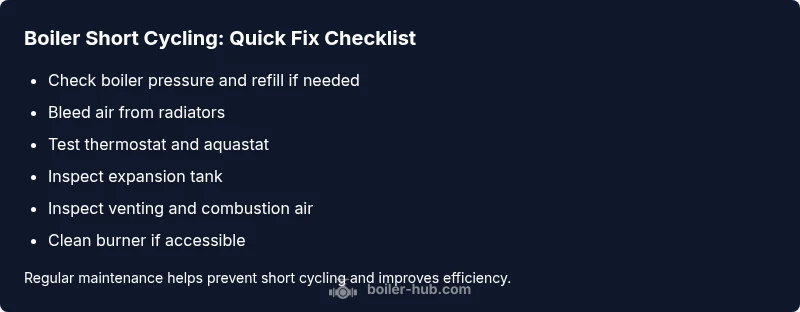
- easyCheck boiler pressure and refill if necessary, then bleed radiators to remove trapped air
- easyTest thermostat and aquastat settings; replace faulty sensors or adjust controls
- easyInspect expansion tank; if waterlogged or damaged, replace or recharge
- mediumInspect and clear venting paths, ensure proper combustion air supply
- hardClean burner/heat exchanger or consult a pro for professional cleaning
Questions & Answers
Why does my boiler cycle on and off so quickly?
Quick cycling usually points to a control or flow issue, such as low pressure, a faulty thermostat, or air in the system. Addressing these basics often stops the cycle and brings back efficient heating.
Quick cycling is often due to a control issue or air in the system; start with pressure and thermostat checks.
Can low boiler pressure cause short cycling?
Yes. When pressure is too low, the boiler may short cycle as it struggles to maintain heat. Refill to the recommended range and check for leaks.
Low pressure can trigger cycling; refill and look for leaks.
Is thermostat placement important for cycling?
Absolutely. A thermostat placed near a heat source or in a draft can cause the system to turn on and off prematurely. Reposition if needed and verify settings.
Placement matters; move away from heat sources or drafts.
Should I bleed radiators to fix short cycling?
Bleeding removes trapped air which can cause uneven heating and cycling. Do this safely, then recheck pressure.
Bleeding often helps; recheck boiler pressure afterward.
When is it urgent to call a professional?
If you smell gas, notice sizzling noises, or the boiler keeps cycling after basic checks, call a licensed technician promptly.
If you smell gas or dangerous signs, call a pro now.
Watch Video
Key Points
- Check and correct boiler pressure before anything else
- Bleed trapped air to stop cycling and improve heat transfer
- Test thermostat/aquastat and replace faulty components
- Persistent cycling warrants professional assessment by Boiler Hub